
Getting around Montréal seems simple until you are standing outside Montréal-Trudeau airport with four suitcases, or trying to move eighty wedding guests from three hotels to a single venue before 6 PM. That is where shuttles and transfers stop being a commodity and become a genuine logistics discipline. This pillar page introduces the full landscape: what these services are, how shared and private options differ, how event coordination works, and why small details like a precise pickup point can save you twenty minutes or more.
A transfer is a pre-arranged ride between two points, typically airport to hotel or hotel to venue. A shuttle is a scheduled or pooled service carrying multiple passengers whose routes overlap. Think of a transfer as a private taxi ride you reserved in advance, and a shuttle as a bus that exists because several people are travelling the same way at the same time. Both fall under ground transportation, but they solve different problems: transfers optimize your time, shuttles optimize shared cost.
In Montréal, the most common corridors are YUL airport to downtown, downtown to the Palais des congrès, and hotel-to-venue movements during conferences, weddings, and sporting events at places like the Bell Centre.
Shared shuttles work on a fill algorithm: the operator groups passengers heading in the same direction, then the vehicle collects them before continuing downtown. This is why your ride may stop several times before reaching your hotel. A practical rule of thumb for estimating your trip: direct travel time plus roughly eight minutes per additional stop.
Shared service makes sense in specific situations:
The break-even point matters: for one traveller, shared is almost always cheaper. For two, it depends on the route. For three or more, a private transfer frequently becomes the better deal, both in price per person and in total time. Booking early also matters, since reserving about forty-eight hours ahead typically secures your space and a better rate than last-minute requests.
A private transfer moves only your party, on your schedule, directly to your destination. Beyond airport runs, one of the most underrated uses is the event drop-off. Driving to the Bell Centre for a Canadiens game and paying fifteen dollars for parking sounds reasonable, until you add the walking time, the exit queue, and the reality that fifteen dollars of parking often becomes thirty-eight dollars of time and friction. A drop-off service eliminates the parking search entirely, which can save close to forty minutes on the busiest event nights.
Venues differ, too. The parking and circulation situation around Place des Arts is not the same as around the Bell Centre, and knowing which venue justifies a paid drop-off is part of planning like a local.
Moving six or more vehicles for a wedding, conference, or corporate event is a coordination problem, not just a transportation problem. Experienced planners rely on a few core concepts:
The classic failure mode is well documented in event planning: a single unclear instruction left forty wedding guests stranded for thirty-five minutes. Coordination mistakes are rarely dramatic; they are small ambiguities that compound.
Here is a detail that delays roughly forty percent of rides: the passenger gives a building name but not a door. “Fairmont Queen Elizabeth” is not enough, because major Montréal hotels have multiple entrances. Place Ville Marie is a tower with several street-level exits. “123 Rue Sainte-Catherine” can send a driver to the wrong end of a fifteen-block street.
Good pickup instructions follow a simple pattern:
Have you ever wondered why your shuttle did not visit stops in geographic order? Modern operators use route optimization software, which calculates sequences based on traffic, pickup windows, and passenger counts rather than simple geography. The results are measurable: optimized routing cuts shared-ride time by roughly thirty-one percent compared to manual planning, and dynamic re-routing can save over twenty minutes when an unplanned closure blocks a planned route.
Operators choose between two models:
There is also a timing discipline: routes are typically locked about two hours before deployment, after which changes shift from replanning to real-time adaptation.
When deciding between a shared shuttle, a private transfer, or a coordinated multi-vehicle service, ask three questions in order:
Shuttles and transfers in Montréal reward preparation. Know your entrance, book ahead for peak periods, size the service to your group, and understand whether your operator plans routes manually or with real optimization. The articles in this category unpack each of these topics in depth, from shared-shuttle algorithms to event dispatch strategy, so you can approach any Montréal trip or event with the confidence of someone who has done the logistics math before.
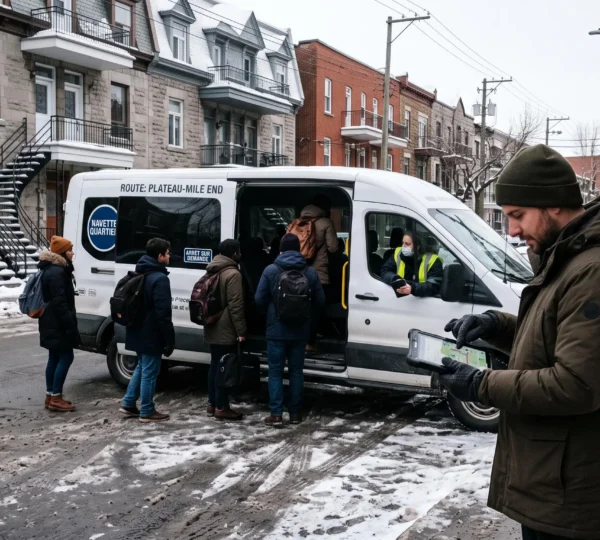
A shuttle can visit every scheduled stop, collect every passenger, and still waste considerable time….
Read more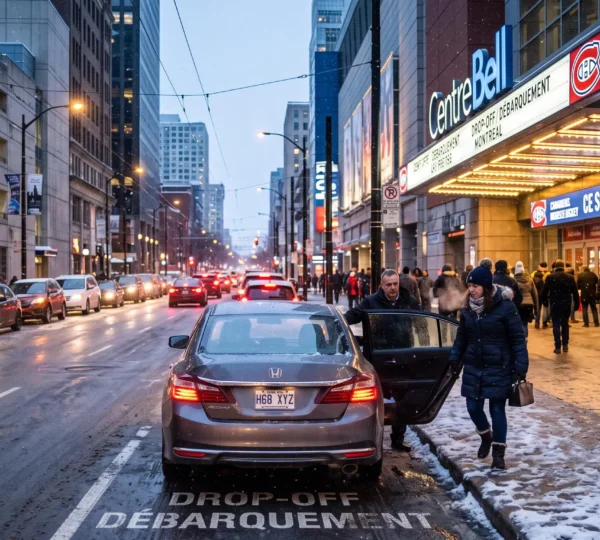
The concert starts in 30 minutes. You’re already downtown Montréal, but the parking garage entrance…
Read more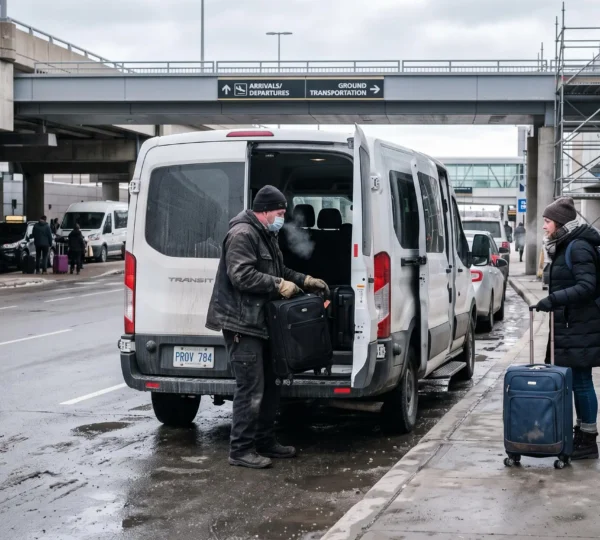
A shared airport shuttle can be the cheapest practical door-to-door option for a solo traveller…
Read more
Coordinating six or more vehicles for a wedding, conference or corporate event is fundamentally different…
Read more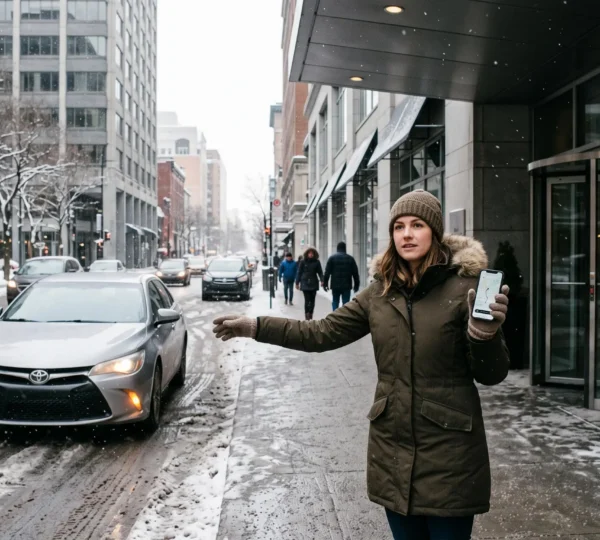
A driver reaches your hotel, but the car never appears outside the door. The map…
Read more