
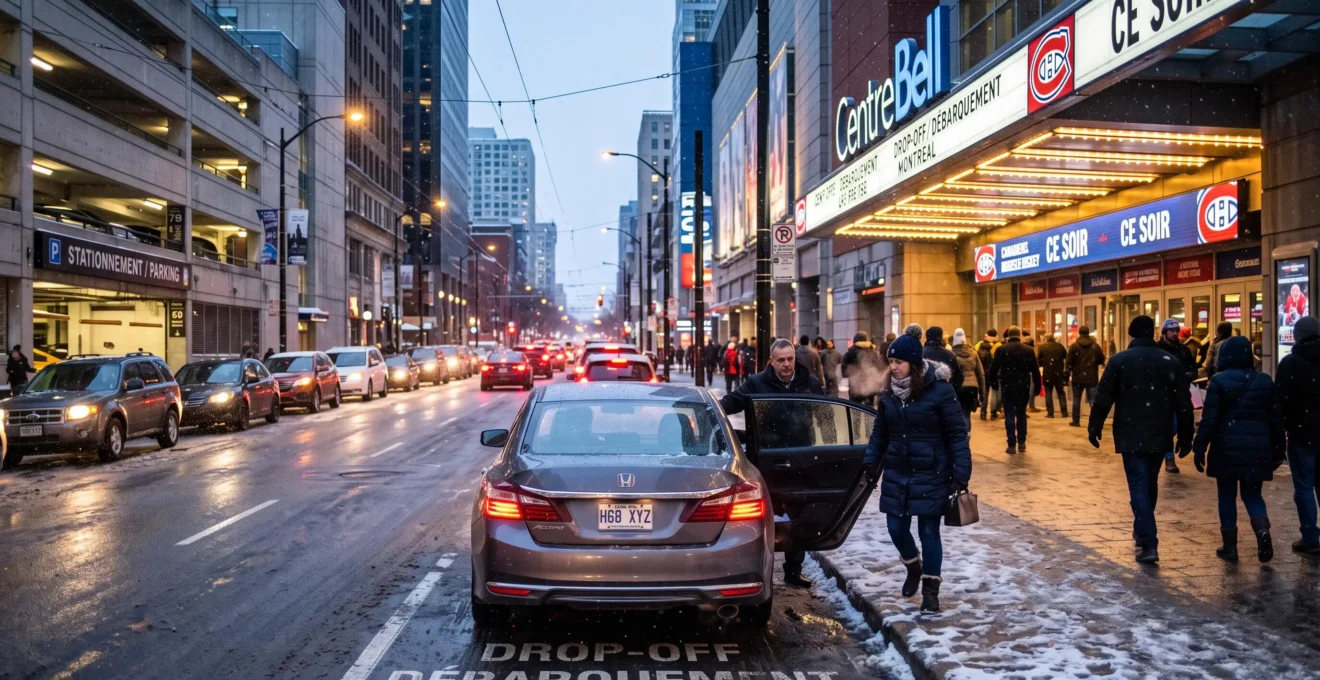
The concert starts in 30 minutes. You’re already downtown Montréal, but the parking garage entrance is backed up, the nearest available lot is farther away than expected, and everyone in the car is watching the clock. Getting close to the venue turned out to be only part of getting inside.
A pre-arranged drop-off service changes that experience. Instead of driving around for parking, paying for a space and walking back through busy streets, passengers travel to an agreed, legally accessible stopping point and continue directly toward their entrance. Pickup can be coordinated separately for the end of the event.
Saving 40 minutes is a useful planning scenario, not a guaranteed result. The actual difference depends on traffic, parking availability, walking distance, the event’s crowd size and how efficiently pickup is arranged. At venues such as Bell Centre and Place des Arts, the practical benefit is often removing unpredictable parking tasks from an evening with a fixed schedule.
Montréal event transportation: What matters most
- Compare complete journeys. Parking costs include more than the posted garage fee: entry delays, walking, and the time required to leave afterward also matter.
- Plan both ends of the trip. A specific drop-off point, flexible pickup window and backup meeting location make event transportation more predictable.
- Choose according to the event. Venue access, weather, passenger mobility and schedule sensitivity determine whether drop-off offers better value than self-parking.
- Why $15 Parking Actually Costs $38 When You Factor in Time and Walking for Bell Centre Events
- How to Schedule Event Pickup When You Don’t Know Exactly When a Concert Ends
- Bell Centre vs. Place des Arts: Which Venue’s Parking Nightmare Makes Drop-Off Worth $45?
- The Parking Optimism Mistake That Made a Family Miss the First Period at a Canadiens Game
- When to Arrive for an 8 PM Concert: The Drop-Off Sweet Spot That Avoids Both Lines and Waiting
- $28 Parking vs. $45 Drop-Off and Pickup: The Break-Even Point for 3-Hour Downtown Appointments
- Why “Mount Royal” Isn’t Specific Enough: The 3 Parking Levels and Their Access Tradeoffs
- How City-Specialized Transportation Handles Montréal’s One-Ways, Construction, and Parking Chaos
Why $15 Parking Actually Costs $38 When You Factor in Time and Walking for Bell Centre Events
A $15 parking space can represent a $38 total inconvenience cost if the driver also assigns $23 of value to searching, waiting and walking. That difference is a hypothetical personal calculation, not a documented Bell Centre parking rate or measured average. The useful comparison is between the full self-parking experience and the complete cost of alternative transportation.
Consider a hypothetical visitor who finds a $15 parking offer, spends 20 additional minutes reaching and entering the garage, and another 10 minutes walking to the venue and returning later. If the visitor values those 30 minutes at $46 per hour, the time component is $23.
The calculation is straightforward:
Total effective parking cost = parking fee + (additional time in minutes ÷ 60 × personal hourly time value).
Under these assumptions, $15 plus $23 equals $38. This excludes fuel associated with searching, potential walking discomfort and any additional delay when leaving the garage.
It is essential to distinguish the hypothetical example from actual prices. Event-night parking around Bell Centre depends on the garage, location, reservation conditions and event. A $15 advertised space should not be treated as a guaranteed rate, and last-minute price increases should not be assumed without checking the operator’s terms.
Availability creates another type of cost. A driver unsure of finding parking may leave significantly earlier, accept a less convenient garage or choose a more expensive option simply to protect the event’s start time. Even if the eventual parking fee is reasonable, the uncertainty has influenced the entire evening.
Drop-off does not remove downtown congestion, but it can eliminate the need to search for and occupy a parking space. A driver who drops passengers off still needs somewhere lawful to proceed or wait, and service conditions should make that arrangement clear.
The strongest comparison therefore uses the same start and finish locations, accounts for all passenger time, and includes any driver waiting or pickup charges.
Once the hidden parking variables are visible, the next planning challenge becomes equally important: arranging the return trip without knowing precisely when the event will finish.
How to Schedule Event Pickup When You Don’t Know Exactly When a Concert Ends
Schedule concert pickup around an agreed time window rather than a precise finishing minute. Use the organizer’s published schedule as a starting point, confirm how the driver handles changes, and establish a specific legal meeting location. Build in enough time for the audience to leave the venue, because the last song ending and passengers reaching the curb are two different events.
A concert includes several moving parts: opening performances, stage changes, the main set and potentially encores. An advertised starting time alone cannot reliably establish when every attendee will be outside.
The practical method is to work backward from the complete passenger journey. First, check whether the organizer has published an approximate end time. Then agree on a flexible pickup interval and how updates will be communicated.
There are three distinct moments to coordinate:
- Performance end: when the show actually finishes, not when the ticket says it begins.
- Passenger readiness: when the group has passed through the crowd, collected its belongings and reached the agreed exit area.
- Vehicle arrival: when the driver can legally approach the meeting point without stopping in a restricted lane.
These moments rarely align automatically. For instance, if the organizer anticipates a performance ending around 10:30 p.m., the group might request an initial pickup window beginning after that time, with the exact margin agreed with the operator. This is a planning illustration, not a prediction of any particular concert’s duration.
A reliable arrangement also accounts for the driver. Ask whether the service permits changes, how waiting charges work, and whether a vehicle can approach the selected pickup location after the event. Never assume that a curbside space or taxi stand is available for private-vehicle waiting.
At Bell Centre, the crowd leaving an arena can complicate both garage departures and curbside collection. A pre-arranged pickup may bypass garage exit queues for passengers, but it will not necessarily bypass traffic on surrounding streets.
A fallback plan makes the difference when congestion becomes unusually severe. Agree on a second legal meeting point and keep an independent taxi, rideshare or public-transit option available if the original driver cannot reach the location.
Five actions for a reliable concert pickup
- Check the organizer’s latest event information and record the scheduled start and any published finish estimate.
- Select an exact pickup point, including the street, side of the street and a recognizable landmark, and save its location.
- Agree with the driver on a flexible pickup window and obtain written confirmation of the waiting policy.
- Choose an alternative legal meeting location and save it alongside the primary point.
- Confirm a communication method and a backup transportation option before entering the venue.
Good pickup planning becomes easier when the venue itself is understood. Bell Centre and Place des Arts create different patterns of congestion, and those differences affect the value of drop-off.
Bell Centre vs. Place des Arts: Which Venue’s Parking Nightmare Makes Drop-Off Worth $45?
Neither Bell Centre nor Place des Arts makes a $45 round-trip drop-off automatically worthwhile. Bell Centre can generate concentrated arrivals and departures around a major arena event, while Place des Arts may experience overlapping demand from several performances. Drop-off becomes more attractive when parking uncertainty, difficult weather, limited mobility or the need for a punctual arrival outweigh its additional price.
The two destinations require different access strategies. At Bell Centre, a large event may produce a concentrated flow of vehicles before and immediately after the performance. The relevant question is not simply whether nearby garages exist, but whether their entrances and exit routes fit the group’s timing.
Place des Arts presents a different pattern. Its halls can host simultaneous performances, distributing activity across a wider cultural complex while still creating periods of shared parking demand.
According to Place des Arts’ official parking information, the venue recommends arriving at least 45 minutes before a performance, particularly when several shows begin around the same time. Its published performance parking rate is CAD 20, including eligible advance purchases, subject to current conditions.
45 minutes
The minimum pre-event arrival margin recommended by Place des Arts for visitors using its parking facilities. This is advance-arrival guidance, not a measured delay or a confirmed drop-off time saving.
Place des Arts, official indoor parking guidance.
Its underground parking connects directly to the complex, which can considerably reduce winter exposure compared with walking from a remote outdoor lot. This means self-parking at Place des Arts may be more convenient than a simplistic comparison suggests.
The following decision grid focuses on actual access considerations rather than assuming one venue always has worse parking.
| Criterion | Bell Centre | Place des Arts |
|---|---|---|
| Event congestion | Concentrated demand around a major arena event. | Potential overlap between performances across several halls. |
| Parking arrangement | Compare independent garage locations, rates and availability for the specific event. | On-site underground parking with advance-purchase options. |
| Walking in winter | Depends on the selected garage and entrance. | Internal garage connections can limit outdoor exposure. |
| Vehicle collection | Requires a verified stopping point away from prohibited areas. | Requires coordination with venue access arrangements and event restrictions. |
| Drop-off advantage | Potentially avoids finding and exiting an event-area garage. | Potentially avoids parking demand, but convenient on-site parking is a strong alternative. |
For a group, compare the complete trip cost rather than dividing the convenience benefit by the number of passengers without considering the actual fare. A $45 round-trip quote may feel more attractive to a family travelling together than to a single visitor with inexpensive parking available.
January conditions also change the equation. Snow, ice, wind and winter clothing can make even a moderate outdoor walk inconvenient. In June, the same route may be entirely manageable.
Mobility requirements and entry accessibility should take priority over small price differences. A short vehicle approach is only beneficial if the permitted stopping area provides a usable route to the destination.
For events with an immovable start time, however, the most expensive parking mistake may have nothing to do with the fee. It may be the assumption that reaching the neighborhood means arriving at the event.
The Parking Optimism Mistake That Made a Family Miss the First Period at a Canadiens Game
The crucial mistake is treating an ordinary driving-time estimate as the time required to reach a seat during a major sporting event. A family may arrive near Bell Centre before puck drop yet still miss part of the first period because parking entry, walking, security and movement through the building were excluded from the plan. The example below is hypothetical, not a documented incident.
Hypothetical case: A family arriving for a Canadiens game
A family checks its navigation application before leaving home. The estimated drive suggests the group will reach the Bell Centre area shortly before the scheduled start. Everyone assumes that arriving in the neighborhood means the timing is safe.
Traffic slows near the arena. The selected garage has a queue, and the family spends additional time finding an available space. Once parked, the group must walk to the entrance, pass security and locate its seats. The game has already begun when they arrive.
The teaching point is not a particular number of lost minutes. It is that several unbudgeted steps can combine to defeat an otherwise reasonable driving estimate.
The underlying error is planning optimism: expecting each step to go approximately as smoothly as it does under familiar, uncongested conditions. For a fixed-start event, this assumption creates a fragile itinerary.
The journey actually contains several separate stages:
- Travel from home to the event neighborhood.
- Navigate event-area traffic to a parking entrance.
- Enter the garage, locate a space and reach the pedestrian exit.
- Walk to the venue’s appropriate public entrance.
- Complete security screening and find the assigned seats.
A drop-off plan removes the parking-space search and garage walk from the passenger journey. It replaces those tasks with a different obligation: choosing a legal stopping point and coordinating a predictable arrival.
The distinction matters for families with children, older relatives or anyone who cannot comfortably hurry through winter conditions. A clearly communicated drop-off location also makes it easier to coordinate a group arriving together.
Drop-off cannot eliminate security queues or guarantee unrestricted vehicle access near an arena. The family still needs an entry buffer based on the event organizer’s instructions.
Sports events deserve particular attention because the start time is meaningful. Missing the first period of a hockey game may carry a greater penalty for a fan than missing the opening minutes of a concert whose main performer appears later.
The transferable rule is to calculate arrival at the seat, not arrival by car. Working backward from the scheduled puck drop exposes exactly where the journey needs extra margin.
That lesson also applies to concerts, although the ideal arrival time is different when doors open well before the main performance.
When to Arrive for an 8 PM Concert: The Drop-Off Sweet Spot That Avoids Both Lines and Waiting
For an 8 PM concert, the best drop-off time depends on when doors open, whether the ticket holder wants to see the opening act and how much time is needed for security, food or merchandise. There is no universally optimal arrival minute. Drop-off allows visitors to remove the garage-entry buffer while retaining enough time to enter comfortably.
First, distinguish the advertised performance start from the doors-opening time. An 8 PM listing does not necessarily mean the main performer appears at 8 PM, nor does it establish how long the queue will be.
Check the ticket and organizer updates for the confirmed schedule. Then build an arrival target around what the group intends to do before the performance.
| Visitor priority | Arrival strategy | Main consideration |
|---|---|---|
| See every opening performance | Plan to enter before the first scheduled performance begins. | Allow time for security and movement to the seats. |
| Purchase merchandise or food | Use an earlier entry window. | Concession and merchandise queues remain possible after drop-off. |
| Attend mainly for the headliner | Use the published running order, if available, to choose a later entry. | Performance schedules may change. |
| Minimize outdoor waiting in winter | Coordinate with confirmed door-opening information. | Avoid assuming that early arrival guarantees immediate indoor entry. |
A self-parking visitor must account for driving to the garage, entry queues, finding a space and walking to the venue. A drop-off passenger can generally omit the parking-specific steps, although the vehicle still faces surrounding traffic and legal access restrictions.
That difference can justify a later departure from home or a more comfortable pre-event stop, but only after allowing for congestion near the destination. Rather than assuming a fixed 60-to-90-minute traffic surge, examine the actual doors schedule and competing events nearby.
For illustration, a group targeting entry around 7:15 PM for an 8 PM concert could schedule drop-off to allow time to reach the entrance and complete screening. That target is a personal planning example, not an official recommendation for all Montréal venues.
Pickup and drop-off should be planned as one itinerary. The same event information used to choose arrival time should inform the return meeting point and flexible collection window.
When possible, arrange pickup in an area that passengers can identify independently, even if the original driver becomes temporarily unreachable. This reduces confusion after the crowd disperses.
The same time-value calculation becomes relevant outside entertainment venues, particularly when an appointment has financial or professional consequences.
$28 Parking vs. $45 Drop-Off and Pickup: The Break-Even Point for 3-Hour Downtown Appointments
If three hours of downtown parking costs $28 and a complete drop-off-and-pickup service costs $45, the difference is $17. Drop-off becomes economically competitive when the time and inconvenience it saves are worth at least that amount to the traveler. Both prices are illustrative variables, not verified quotations for a particular Montréal location or transportation provider.
A business meeting, medical appointment or conference session differs from a concert because its schedule can carry distinct consequences. Being late to a client meeting may create professional disruption, while arriving hurriedly for a medical appointment may add stress for a passenger with mobility needs.
The initial price comparison is simple:
Break-even value of time saved = drop-off and pickup fare − parking cost.
Under the hypothetical $45-versus-$28 scenario, drop-off carries a $17 premium before considering other costs.
If it saves 30 minutes, that premium corresponds to a personal time value of $34 per hour. If the actual saving is only 15 minutes, the equivalent threshold is $68 per hour.
These are calculations based on stated assumptions, not measured Montréal travel-time savings.
A more complete comparison can also include walking in professional clothing, transporting presentation materials, navigating an unfamiliar building or reaching an accessible entrance.
Parking duration affects the result. A short appointment may qualify for inexpensive hourly parking, while a longer visit can accumulate charges until a daily maximum applies. Conversely, event-specific flat-rate parking may remain unchanged across a broad time window.
That means a three-hour business appointment and a three-hour concert should not automatically be priced using the same parking assumptions.
The alternatives are not limited to self-parking and a $45 private round trip. Depending on the destination and passenger’s needs, public transit, a one-way taxi, or parking farther away and completing the final leg by another mode may be cheaper or more convenient.
For example, Place des Arts can be accessed directly through the Place-des-Arts metro station. For a visitor whose origin and destination are both well served by transit, that option may avoid both parking and private pickup coordination.
The appropriate comparison therefore begins with a realistic fare quote, the actual parking tariff for the intended duration and a clear definition of how much passenger time each option requires.
Price comparisons matter only when the destination itself is correctly identified. At large, multi-access sites, an ambiguous destination can undermine even a carefully priced drop-off plan.
Why “Mount Royal” Isn’t Specific Enough: The 3 Parking Levels and Their Access Tradeoffs
“Mount Royal” is too vague for reliable passenger pickup because the park covers different access areas, elevations and destinations. A useful planning model separates lower perimeter approaches, intermediate access areas and higher viewpoints, each with different walking and vehicle-access constraints. These are three practical access categories, not three officially designated parking levels.
Mount Royal Park illustrates why specifying only the attraction name can produce confusion. A visitor going to a viewpoint may need a different access point from someone meeting friends near Beaver Lake.
According to Ville de Montréal’s Mount Royal Park information, the park has five paid parking lots: two near the Lac-aux-Castors pavilion, two at Maison Smith and one at Belvédère Camillien-Houde.
Those five actual parking facilities should not be confused with the three-category access model below.
| Access category | Potential advantage | Tradeoff to verify |
|---|---|---|
| Lower perimeter approaches | Can be convenient when arriving from surrounding city streets. | May involve a longer uphill route or stairs to higher destinations. |
| Intermediate park access | Can balance vehicle proximity with pedestrian access to central park destinations. | Requires confirmation of the correct road, parking area and onward walking route. |
| Upper viewpoints and elevated destinations | May reduce walking distance to a particular lookout when permitted access is available. | Vehicle access, restrictions, seasonal conditions and stopping opportunities can be more limiting. |
The key is to identify the actual destination before selecting an approach. A passenger requesting a ride to Beaver Lake should name that destination explicitly rather than simply asking for Mount Royal.
Likewise, someone visiting Maison Smith or Belvédère Camillien-Houde should verify which legal access point serves the intended activity and whether private-vehicle stopping is permitted.
The park’s municipal information identifies accessible parking and drop-off facilities, but this does not imply that all trails, viewpoints or park destinations can be reached directly by car.
Winter conditions add another variable. Paths can become icy, walking routes may be harder to use, and construction or operational restrictions can change access arrangements. A suitable summer drop-off point may therefore require reconsideration in January.
The most reliable instruction contains a destination, a specific meeting point and a confirmed vehicle-access route. Where mobility is limited, also check the accessible pedestrian connection between the stopping location and the destination.
This level of precision is equally valuable for large exhibition sites, wedding venues, hospitals and conference complexes.
Knowing where the vehicle should go is only half the task. The final improvement comes from understanding how Montréal’s changing street conditions affect whether it can reach that location.
Key takeaways before choosing a Montréal transportation service
- Define the destination by its actual entrance or permitted meeting point, not merely by the venue’s name.
- Check road restrictions and access conditions for the specific event date; a familiar route may no longer be practical.
- Assess the transportation provider’s coordination process, not just its advertised fare or vehicle comfort.
How City-Specialized Transportation Handles Montréal’s One-Ways, Construction, and Parking Chaos
City-specialized transportation can simplify Montréal event access by combining current route information, familiarity with local one-way streets and carefully selected passenger meeting points. Its advantage is operational planning rather than an automatic ability to drive faster. A knowledgeable driver may help passengers avoid unnecessary parking searches and navigation mistakes, but construction and event congestion can still delay any vehicle.
Downtown Montréal presents a changing street environment. One-way streets limit approach directions, construction can alter traffic circulation, and major events may generate temporary restrictions near entrances.
A route that worked well during an earlier visit is not necessarily appropriate for the next event. Even an accurate destination pin cannot guarantee that the final street segment will be available to vehicles on arrival.
Montréal provides an official mechanism for checking these conditions through Ville de Montréal’s road obstruction and construction information service. It allows travelers to research affected locations and projects based on municipal obstruction records.
The service is useful but not exhaustive: work controlled by certain other authorities is outside its coverage. Event organizers and the relevant venue may also publish access instructions that should be checked separately.
A transportation provider accustomed to local venues can use this information to choose an appropriate approach, coordinate arrival with passengers and identify an alternative meeting point when the preferred street becomes inaccessible.
Local experience can be valuable because it connects several small decisions. The driver must consider the correct side of the street, permitted stopping locations, vehicle approach direction, nearby crowd movement and the passenger’s walking route.
However, familiarity should not be mistaken for guaranteed superiority over navigation technology. The best approach combines current traffic information, official restrictions and the driver’s practical knowledge. A provider who repeatedly checks changing conditions may offer better coordination than one who relies on a familiar route without verification.
The 40-minute saving in the article’s title can be understood as a hypothetical combination of avoided tasks. For example, a traveler might avoid 15 minutes of parking search, 10 minutes of garage-related waiting, 10 minutes of additional walking and five minutes of navigation confusion.
Those illustrative values total 40 minutes, but they are not measured averages, and some visitors will save substantially less or encounter delays of their own during drop-off and pickup.
The actual benefit comes from shifting the passenger’s attention away from vehicle storage toward three manageable decisions: where to be dropped off, when to be ready and where to meet afterward.
Before booking transportation for a Montréal concert, Canadiens game, wedding or conference, compare the full return fare with the available parking alternatives. Confirm the exact entrance, legal stopping point, pickup window, waiting fees and backup arrangement. When those details are settled, drop-off can offer a more predictable event experience without relying on a guaranteed time-saving claim.
Does drop-off service always save 40 minutes at Montréal venues?
No. Forty minutes is a hypothetical saving that may be achieved when a traveler avoids several parking-related delays. Actual savings depend on garage availability, traffic, walking distance, passenger needs and pickup coordination. A convenient reserved parking space may make self-parking equally practical or faster.
Can a private driver use the taxi zones at Place des Arts?
Not automatically. Place des Arts identifies taxi areas on Saint-Urbain Street, but their existence does not establish permission for every private transportation operator to wait there. Passengers should confirm the applicable access rules and agree with their driver on a lawful meeting location.
Is advance parking reservation a good alternative to drop-off?
Yes, particularly when the chosen garage provides convenient access. Place des Arts offers advance performance parking under published availability conditions. Reserving can reduce uncertainty about finding a space, although the driver must still account for traffic, garage access and the departure journey.
What should visitors do if their pickup driver cannot reach the venue?
Use the alternative meeting location agreed upon before the event, provided it remains lawful and accessible. Contact the driver through the agreed communication channel, avoid unsafe roadside waiting and switch to a verified taxi, rideshare or public-transit option if the original arrangement fails.
Is drop-off suitable for guests attending weddings or conferences?
It can be, especially when guests face limited parking, unfamiliar entrances, formal clothing or mobility constraints. For weddings and conferences, identify the exact entrance or reception point and coordinate arrivals with the organizer. Group transportation and accessible vehicle requirements should be confirmed before making reservations.