
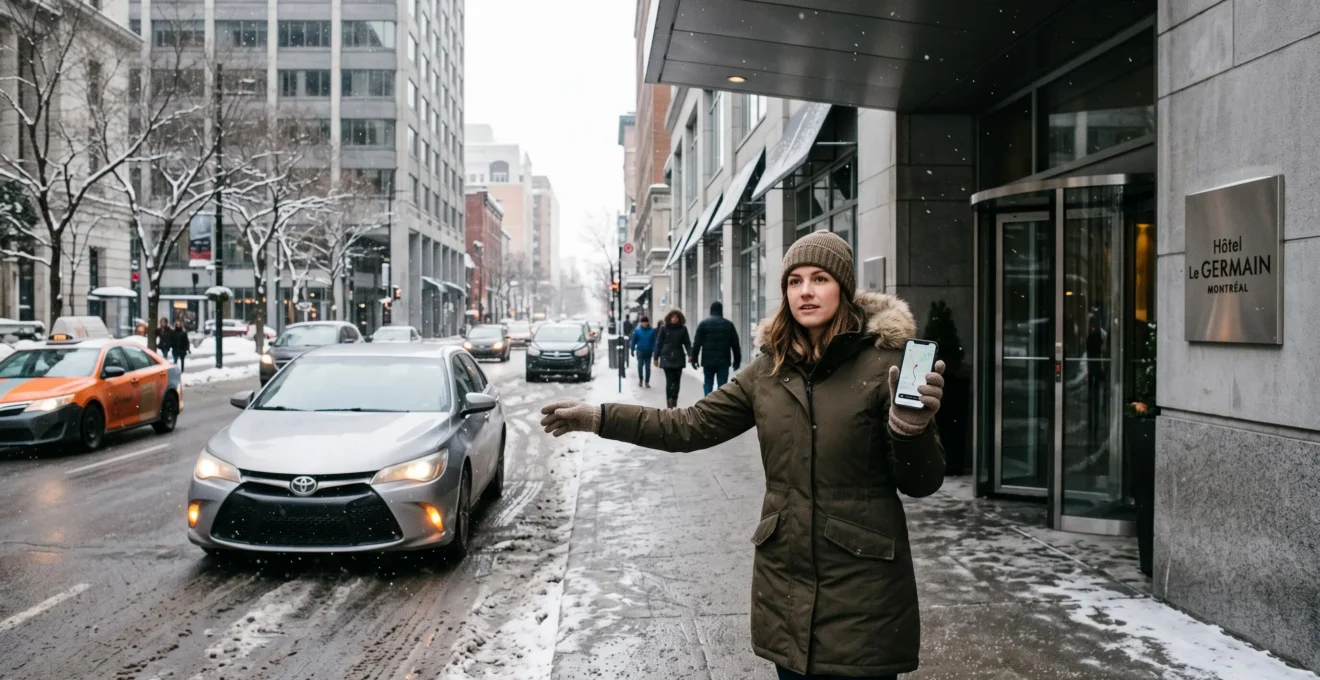
A driver reaches your hotel, but the car never appears outside the door. The map shows the vehicle nearby, your message says “main entrance,” and neither person knows whether the other is standing on the correct street. In downtown Montréal, this confusion can arise at hotels, office towers, underground-connected complexes, and event venues.
Precise pickup instructions identify a reachable curb, a specific pedestrian exit, and a recognizable landmark. They replace a building name with information a driver can actually use: street, intersection, door, and appropriate stopping location. A carefully positioned pickup pin reinforces those directions.
The frequently repeated scenario of a 15-minute driver search affecting 40% of rides is not established by the available documentation. Those figures should not be treated as measured Montréal statistics. The underlying problem, however, is practical: two people can navigate to the same property while approaching entirely different entrances.
The following methods help travellers avoid that mismatch without relying on an assumed time saving.
Pickup instructions that prevent avoidable confusion
- Specify the street-level entrance, nearest intersection, and visible door landmark instead of naming only the hotel or venue.
- Verify that the pickup pin corresponds to a legally reachable stopping point, and send a brief instruction before the driver approaches.
- Coordinate your departure from the building using the live vehicle position, accounting for traffic, winter weather, and venue restrictions.
- Why “Fairmont Queen Elizabeth” Isn’t Enough: The 4-Entrance Problem at Major Montréal Hotels
- How to Direct Your Driver at Place Ville Marie: Tower, Door, and Street-Level Exit Instructions
- Main Lobby vs. West Service Entrance: Which Hotel Pickup Point Saves 8 Minutes in Traffic?
- The “123 Rue Sainte-Catherine” Mistake That Sent Your Driver to the Wrong End of a 15-Block Street
- When to Walk to the Lobby: The 2-Minute Rule for Meeting Your Driver Without Waiting
- Bell Centre vs. Place des Arts: Which Venue’s Parking Nightmare Makes Drop-Off Worth $45?
- Why “Mount Royal” Isn’t Specific Enough: The 3 Parking Levels and Their Access Tradeoffs
- How Drop-Off Service Saves 40 Minutes of Parking-Search Stress at Montréal’s Busiest Venues
Why “Fairmont Queen Elizabeth” Isn’t Enough: The 4-Entrance Problem at Major Montréal Hotels
A major hotel can have several pedestrian approaches without having the same number of vehicle pickup entrances. At Fairmont The Queen Elizabeth, connections to downtown streets, Central Station, and the underground network create distinct arrival routes. The useful instruction is therefore not simply the hotel name but the exact street-level meeting point.
Fairmont The Queen Elizabeth is located at 900 René-Lévesque Boulevard West, near Mansfield Street. Its published transportation information identifies a Mansfield-side taxi entrance, direct access to Central Station, and access from Bonaventure metro station. These are different circulation contexts, not proof of four interchangeable vehicle pickup doors.
The hotel’s official location and transportation information provides the address and approach details needed to identify a suitable arrival area. A taxi entrance should not automatically be assumed available to every ride-hailing vehicle.
The distinction matters because navigation software generally recognizes properties and addresses, while passengers think in terms of where they entered or exited. A driver may reach the hotel frontage while a traveller waits at an entrance connected to a station or another internal passage.
Before requesting the ride, open a map and inspect the property at street level. Satellite imagery or available indoor maps can help identify the surrounding streets, but neither establishes whether stopping is currently permitted. Look for a recognizable awning, numbered door, cross street, or permitted passenger loading area.
Choose an entrance according to vehicle access, not only walking distance. The closest door to the lobby may face a busy curb, whereas another accessible entrance may offer a clearer meeting location. Confirm the choice with hotel staff when restrictions are uncertain.
When two people wait at different entrances, unnecessary calls and repositioning can follow. A cancellation fee or additional fare is possible under the applicable service rules, but neither outcome is inevitable.
The transferable rule is simple: a property address gets the driver to the building; a street-level entrance description gets the driver to the passenger.
How to Direct Your Driver at Place Ville Marie: Tower, Door, and Street-Level Exit Instructions
At Place Ville Marie, identify the pedestrian exit that reaches the street rather than relying on the tower name or underground shopping level. Send the driver the street, nearest intersection, and recognizable door feature, then confirm that the pickup pin represents an accessible curb. Parking access and passenger pickup access must remain distinct.
Place Ville Marie has multiple circulation layers: office buildings, Esplanade PVM, Galerie PVM, and connections to Montréal’s underground pedestrian network. A traveller navigating internally may be physically near the destination while still needing to locate the intended street exit.
The campus publishes 1 Place Ville Marie as its address. Its official parking entrance is on Cathcart Street at McGill College Avenue, according to Place Ville Marie’s access and parking information. That entrance is for parking and must not be presented as an approved ride-hailing pickup area.
To choose a meeting point, first locate the street-level exit you can reach from your current position. Verify its street name and a nearby intersection. Next, confirm where a vehicle may legally stop. Only then select the corresponding pickup location in the app.
A useful message follows a short, consistent structure: street and intersection first, then door and visible landmark. A hypothetical instruction might read: “Pickup on [verified street], near [cross street], outside [specific street-level door]. I am beside [visible landmark].” Replace every bracketed element with a location you have personally confirmed.
A pin on the building footprint may represent an entrance that is inconvenient or inaccessible to vehicles. Inspect its position on the map and adjust it to the appropriate pickup area where the application allows. Do not assume a digital pin authorizes stopping at that curb.
Uber‘s official guidance explains that riders can enter a pickup address before requesting a trip and, in supported circumstances, modify the pickup location afterward. Post-request editing is subject to restrictions, so it is better to establish the location correctly from the outset.
Five checks before confirming an office-tower pickup
- Identify your exit. Record the exact street-level door or entrance name you can physically reach.
- Verify the intersection. Write down the nearest cross street and confirm it against the map.
- Check vehicle access. Identify a reachable, permitted stopping location rather than a parking ramp or restricted lane.
- Position the pickup pin. Confirm that its displayed location matches the agreed meeting area.
- Send one concise instruction. Prepare and send a message containing the street, intersection, and door landmark before the driver approaches.
Short instructions reduce interpretation. Drivers should read messages only when it is safe to do so, and riders should not rely on last-second corrections to an already approaching vehicle.
Main Lobby vs. West Service Entrance: Which Hotel Pickup Point Saves 8 Minutes in Traffic?
A side entrance can be faster than a main hotel lobby when it is accessible, clearly identified, and served by a legal stopping area. However, an eight-minute saving is not established by the available evidence. The main entrance may be preferable when the alternative has locked doors, loading restrictions, poor visibility, or an inconvenient pedestrian route.
Hotel pickup selection involves two journeys: the rider’s movement through the building and the driver’s approach through surrounding streets. Optimizing one while ignoring the other can make the overall pickup less efficient.
A prominent lobby entrance offers a familiar landmark and usually clearer directions. Its drawbacks may include concentrated pedestrian traffic, competing taxis, and curb restrictions. A side entrance can reduce those obstacles in some circumstances, but a service or loading entrance may not be accessible to guests at all.
Compare the options before choosing:
| Decision criterion | Main lobby | Secondary entrance |
|---|---|---|
| Ease of identification | Usually recognizable | May require a precise door description |
| Pedestrian access | Often straightforward | Must be checked for guest access |
| Vehicle stopping | May be congested or restricted | Potentially easier, but not necessarily permitted |
| Street approach | May involve busy frontage | Depends on one-way streets and access |
| Evening suitability | May offer staffed, visible access | Could be locked or poorly lit |
One-way streets deserve particular attention in downtown Montréal. An entrance that appears closer on a pedestrian map may require the driver to circle a block or approach from another direction. The shortest walking route does not necessarily produce the shortest vehicle route.
Accessibility, lighting, and operating hours can override potential time savings. Never direct someone toward an unverified loading dock, locked service passage, or isolated entrance simply because the map suggests a shorter route.
For a frequently used hotel, compare the options under normal traffic and again during a busy period. Record the actual pickup time and any accessibility problems, then save the better verified location in your preferred mapping or ride application when that feature is available.
A reliable default is one that remains usable across ordinary conditions, not one that produced the fastest isolated pickup.
The “123 Rue Sainte-Catherine” Mistake That Sent Your Driver to the Wrong End of a 15-Block Street
A civic number alone can misdirect a pickup when the selected address, street direction, or map result is incorrect. On a long Montréal street such as Sainte-Catherine, specify the full street designation and nearest intersection, then verify the actual map pin. The example of a driver arriving 15 blocks away is hypothetical, not a documented incident.
Montréal’s street network requires particular attention to east-west directions. Boulevard Saint-Laurent serves as a central reference for many address designations. Confusing Sainte-Catherine Street East with Sainte-Catherine Street West can therefore produce a materially different destination.
Avoid treating an autocomplete suggestion as a verified pickup location. Search interfaces may offer multiple similarly named destinations, and a plausible result is not necessarily the location where you are standing.
Use a three-part address description:
- Full civic address: include the street name and applicable East or West designation.
- Nearest cross street: name the intersection or describe the block between two streets.
- Physical meeting point: identify the relevant entrance and vehicle-accessible curb.
For example, instead of sending “123 Rue Sainte-Catherine,” a rider would first verify the address and then communicate the actual directional designation, cross street, and entrance. No particular intersection should be attached to that sample number without confirming where the address exists.
French and English street names, abbreviations, and device autocorrection can introduce additional mistakes. When copying an address from a hotel confirmation or event ticket, inspect the resulting pin rather than trusting that the text was interpreted correctly.
Street side also matters. Depending on one-way circulation and stopping restrictions, the opposite curb may be inaccessible from the driver’s direction of travel. Crossing toward a different entrance is only helpful if it can be done safely and the location is communicated before the vehicle arrives.
A precise address is a starting point; the final check is whether the pin, pedestrian position, and vehicle approach all identify the same curb.
When to Walk to the Lobby: The 2-Minute Rule for Meeting Your Driver Without Waiting
The two-minute rule is a practical decision threshold, not a guaranteed pickup formula. When the driver’s estimated arrival falls below roughly two minutes, move toward the agreed exit only if you can reach it safely before the vehicle arrives. If travel through the building takes longer, prepare earlier without changing the meeting point unexpectedly.
The correct departure time depends on your walking distance, elevator availability, lobby congestion, and the driver’s actual route. A displayed ETA is an estimate rather than a promise of arrival at a precise moment.
For a large hotel or shopping complex, begin moving toward the verified exit before the driver reaches the final approach. This reduces the chance of the vehicle waiting in an area where stopping time is limited. In a small building, remaining indoors until the car is genuinely close may be more comfortable.
A useful visual confirmation is the vehicle turning onto your street. This provides stronger evidence of its immediate approach than an ETA that has remained unchanged while the driver navigates nearby traffic.
Keep the destination fixed once the driver is close unless access restrictions make a change necessary. A passenger walking around the building while the driver circles in the opposite direction creates a moving-target problem that no precise address can solve.
Montréal winter conditions require extra caution. Snow, ice, and freezing temperatures can make an otherwise short walk uncomfortable or hazardous. Passengers with luggage, mobility limitations, or children may reasonably prioritize a sheltered, accessible pickup even if the vehicle approach takes longer.
Ride applications may also impose waiting-time or cancellation conditions. Check the terms applicable to your trip rather than assuming that walking to the curb at the last second carries no consequence.
The objective is synchronized arrival: a passenger at the agreed exit when the vehicle reaches a location where it can safely stop.
Bell Centre vs. Place des Arts: Which Venue’s Parking Nightmare Makes Drop-Off Worth $45?
A CAD 45 drop-off may be worthwhile at Bell Centre or Place des Arts when parking, fuel, walking time, and congestion make self-driving less attractive. It is not a universal break-even price. The answer depends on the event, the available parking arrangement, the actual ride fare, and the ease of finding a permitted drop-off location.
The two venues present different access considerations. Bell Centre events can generate concentrated spectator departures near its entrances. Place des Arts operates within the Quartier des spectacles, where festivals and temporary road restrictions can change vehicle access.
Place des Arts identifies two taxi areas along Saint-Urbain Street: one near Maison symphonique and Salon urbain, and another south of Sainte-Catherine Street. Its official transportation and access information also advises visitors to check street closures during festival periods.
Those taxi areas should not automatically be treated as available to every ride-hailing service. A rider must confirm the applicable stopping arrangements and any temporary restrictions.
Compare the actual travel options rather than assuming either venue always has a worse parking problem.
| Factor | Bell Centre | Place des Arts |
|---|---|---|
| Potential access challenge | Concentrated event crowds | Festival-related street restrictions |
| Pickup consideration | Avoid conflicting pedestrian and vehicle flows | Verify the current approach to Saint-Urbain and nearby streets |
| Alternative travel planning | Check parking and public transportation options | Check metro access and reservable parking |
| Return-trip concern | Demand and congestion after the event | Demand plus possible road closures |
Consider a hypothetical CAD 45 ride. Suppose parking costs CAD 25, fuel adds CAD 5, and you personally value the time spent searching and walking at CAD 20. Your self-driving comparison becomes CAD 50, making the CAD 45 ride attractive for that journey. These amounts are illustrative inputs, not observed venue prices.
The calculation should account for the full journey. A one-way drop-off fare does not cover the return trip, while parking generally allows the traveller to retrieve the same vehicle afterward. If the return ride is expensive or difficult to obtain, the initial saving can disappear.
Dropping off before an event may be easier than arranging a pickup immediately afterward. If nearby streets are congested, a preselected side-street location can provide an alternative, provided the walking route and stopping place are safe and accessible.
Cost matters, but the decisive operational detail remains the same: identify a lawful, reachable meeting point before the vehicle enters the event traffic.
Why “Mount Royal” Isn’t Specific Enough: The 3 Parking Levels and Their Access Tradeoffs
“Mount Royal” refers to a broad area, not a single pickup address. A driver needs a named entrance, an adjacent street, or a specific accessible facility to identify where to meet. Parking levels can matter at individual facilities, but there is no basis for treating Mount Royal as one destination with exactly three universal parking levels.
Mount Royal includes park areas, roads, walking routes, institutions, and surrounding neighbourhood streets. A pin placed in the middle of a park or on a pedestrian path may not correspond to a location that a vehicle can reach.
Start with the exact destination. Is the pickup near a park entrance, an institutional building, a parking facility, or a residential street? Identify the street-accessible boundary rather than asking the driver to navigate toward an undefined point on the mountain.
Where a particular facility has multiple parking levels, those levels can have different practical characteristics:
- Open-air or upper parking: pedestrian routes may be easier to recognize, but exposure to winter weather can be greater.
- Intermediate parking: access may depend on the building’s specific circulation design and exit arrangement.
- Lower or enclosed parking: shelter may be better, but pedestrians may need elevators, stairs, or ramps to reach an appropriate meeting point.
These are general tradeoffs, not a verified description of a particular Mount Royal parking facility. Restrictions on vehicle height, reserved spaces, and pedestrian access must be checked for the individual property.
Seasonal conditions can also change the sensible meeting location. Snow clearing, icy paths, temporary closures, and event restrictions may make a previously convenient access point impractical.
Before travelling, confirm current vehicle access and select a recognizable street entrance. A reliable instruction identifies where the passenger will stand, not simply the broader attraction being visited.
For destinations spread over a large area, geographical precision should precede any attempt to optimize the pickup time.
Key takeaways before choosing drop-off
- Count only time genuinely removed from the trip, such as parking searches and walking from a distant lot.
- Confirm that the intended drop-off location remains accessible under current event and traffic conditions.
- Plan the return journey separately: successful arrival does not guarantee an equally convenient departure.
How Drop-Off Service Saves 40 Minutes of Parking-Search Stress at Montréal’s Busiest Venues
Drop-off service can eliminate the need to search for parking and walk from a distant space, but a 40-minute saving is not guaranteed. Its benefit depends on the event, local traffic, available stopping areas, and parking alternatives. It does not eliminate venue entry queues, road congestion, or the need to organize transportation afterward.
Self-driving to a popular Montréal venue can involve several separate stages: approaching the destination, locating parking, reaching the entrance, and later returning to the vehicle. Drop-off changes some of these stages, not all of them.
The difference becomes clearer when each stage is considered independently.
| Journey stage | Self-driving | Drop-off service |
|---|---|---|
| Road traffic | Still encountered | Still encountered |
| Finding parking | Required unless parking is arranged | Not required for the passenger |
| Walking from parking | Depends on parking location | Replaced by walking from the drop-off point |
| Venue admission | Required | Required |
| Departure planning | Return to parked vehicle | Arrange a return ride or alternative |
A hypothetical example illustrates the distinction. If parking search takes 15 minutes and walking from a remote lot takes 10 minutes, a suitable drop-off could remove up to 25 minutes of those activities before accounting for the time needed to reach the designated drop-off area. These figures are assumptions for calculation, not measured Montréal averages.
The method works best when the passenger and driver agree on a reachable stopping zone. A generic venue pin may route the vehicle toward a closed street, a pedestrian plaza, or an entrance with no suitable stopping space.
Before choosing drop-off, assess the actual ride price, available parking, current weather, event-specific restrictions, and whether you need access to your own vehicle later. Public transportation may provide another practical option, particularly where the venue connects directly to metro services.
Departure requires its own plan. Immediately after an event, high demand and congestion may complicate pickup. Identify a secondary meeting street in advance, taking pedestrian safety and accessibility into account. Where an application supports advance scheduling, review its terms rather than assuming the scheduled ride guarantees a fixed pickup time or fare.
Finally, keep directions concise and consistent between the map and driver message. An accurate pin, a confirmed legal stopping point, and a passenger waiting at the agreed location contribute more to operational reliability than an unsupported promise of minutes saved.
For your next Montréal trip, save one verified pickup location and its street-level description before requesting the vehicle. Repeat that process for the return journey when the destination involves a major venue or a complex building.
Can a pickup pin be changed after requesting an Uber ride?
Uber’s documented procedure allows eligible riders to select Edit beside the pickup location, enter a different address or move the pin within the permitted grey-circle area, and confirm the change. The documentation describes a one-time adjustment limit and certain service restrictions. Availability should be verified in the current app before relying on this option.
Should the driver receive a street address or a GPS pin?
Use both when possible. The GPS pin communicates a mapped position, while a short street, intersection, and door description explains the intended physical meeting point. Check that they agree and that the curb can legally be used for pickup.
What should a passenger do if the driver reaches the wrong entrance?
Remain in a safe, identifiable location and contact the driver through the application’s available communication tools. State the exact street and entrance, then agree on one accessible meeting point. If the pickup location must change, use the application’s supported procedure rather than expecting the driver to follow an informal pin correction.
Is it better to wait inside a Montréal hotel during winter?
Waiting inside can be sensible during snow, ice, or extreme cold, provided you can reach the agreed exit before the vehicle arrives. Check the live map, account for elevators and lobby walking time, and avoid leaving the driver waiting at a restricted curb. Accessibility and safety should take priority over an arbitrary two-minute threshold.
Does a precise pickup instruction guarantee a shorter wait?
No. It can reduce ambiguity about the meeting location, but waiting time also depends on driver availability, traffic, road restrictions, weather, and service conditions. The available source documentation does not establish a universal 15-minute reduction or prove that 40% of rides experience a driver-search delay.