
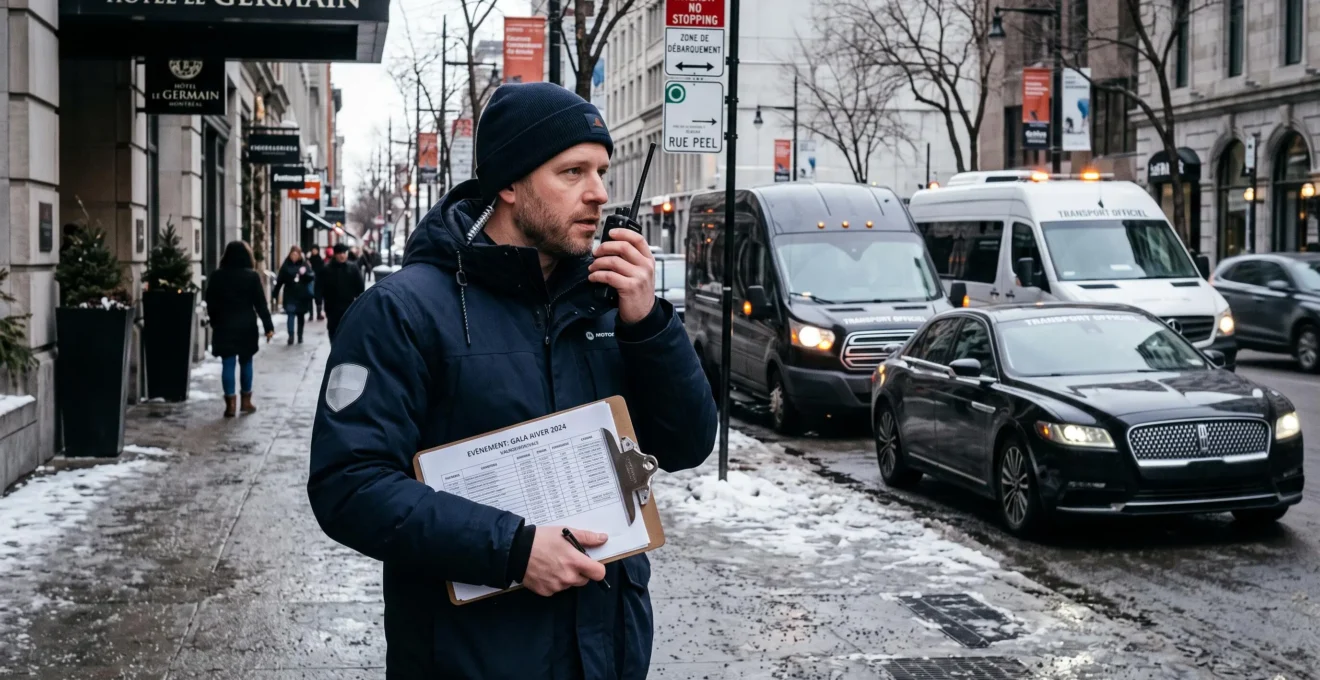
Coordinating six or more vehicles for a wedding, conference or corporate event is fundamentally different from booking six separate rides. The challenge is keeping passenger assignments, departure windows, loading locations and contingency vehicles synchronized while guests move between hotels, airports and venues.
For an event involving 30 to 200 guests across Montréal, effective transportation coordination begins with a single operational command structure. Every vehicle needs a defined assignment, every pickup needs an accountable contact, and every disruption needs a clear escalation path.
That structure becomes particularly important when afternoon traffic, winter road conditions or restricted hotel loading zones affect multiple vehicles simultaneously. A delayed shuttle should trigger a coordinated adjustment, not six independent conversations.
The practical objective is to make transportation predictable for guests while giving organizers enough visibility to intervene before a missed pickup becomes a late arrival.
Multi-Vehicle Event Coordination: Essential Decisions
- Use centralized dispatch when several vehicles share tight arrival windows, interdependent routes or limited loading areas.
- Assign vehicles according to passenger timing, accessibility, luggage and operational requirements rather than guest status alone.
- Build pickup schedules backward from required arrival times, with dispatch authority, verified routes and a documented recovery plan.
- Why Radio-Dispatched Fleets Outperform App-Based Coordination for 5+ Vehicle Events
- How to Assign Vehicles to Guest Tiers: VIPs, Speakers, General Attendees, and Families
- Simultaneous Dispatch vs. Staggered Deployment: The Right Strategy for Your Event Size
- The Coordination Mistake That Left 40 Wedding Guests Stranded for 35 Minutes
- When to Start Hotel Pickup Rotations for a 6 PM Event With 80 Guests Across 3 Hotels
- Why Individual Pickups for 6 People Cost $420 While Coordinated Grouping Costs $280
- Why Your Shuttle Doesn’t Visit Stops in Geographic Order: The Route Optimization Logic Explained
- How to Transport 12 Passengers Across Montréal Without Splitting Groups or Overpaying for Capacity
Why Radio-Dispatched Fleets Outperform App-Based Coordination for 5+ Vehicle Events
A centrally dispatched fleet can reduce coordination risk at events requiring five or more synchronized vehicles because one dispatcher manages driver communications, assignments and disruptions. Individual ride-hailing bookings may still be practical for flexible transfers, but they generally require more organizer-side coordination when passengers must arrive together or vehicles depend on one another.
The operational difference is control. In a dispatched arrangement, the coordinator can maintain communication with participating drivers, verify their positions and issue revised instructions when a hotel entrance becomes inaccessible. The organizer communicates with one transportation contact instead of independently contacting every vehicle.
Radio communications can be valuable where underground parking or building layouts interfere with cellular connectivity, provided the fleet’s radio coverage and communication procedures have been tested. A radio alone does not guarantee reliability: the dispatcher must also know which vehicle is assigned to each pickup.
With independently booked app rides, each reservation may have separate arrival information, driver communications and cancellation conditions. A planner can monitor those bookings, but the drivers do not necessarily share a coordinated operating plan.
Montréal introduces additional variables, including winter conditions, downtown loading restrictions and construction-related detours. The Québec 511 interactive road conditions map provides roadwork, road restrictions and condition information that dispatchers can review before vehicles depart.
| Operating requirement | Independent app bookings | Centralized dispatched fleet |
|---|---|---|
| One or two flexible transfers | Often manageable | May be unnecessary |
| Six synchronized arrivals | Requires separate booking oversight | One dispatcher can coordinate arrivals |
| Unexpected driver delay | Planner manages replacement or adjustment | Dispatcher can assess fleet-wide alternatives |
| Shared loading area | Arrivals may require manual sequencing | Vehicle arrivals can be sequenced centrally |
The practical threshold is not a scientifically established vehicle count. Below approximately three independent vehicles with flexible timing, individual bookings may be sufficient. With five or six vehicles sharing a fixed schedule, the benefits of centralized coordination become more significant.
The best arrangement is the one that provides verified driver accountability and real-time recovery options, regardless of whether communication happens by radio, telephone or an integrated dispatch system.
How to Assign Vehicles to Guest Tiers: VIPs, Speakers, General Attendees, and Families
Assign event vehicles according to how strictly each passenger must follow the schedule, then account for accessibility, luggage, child restraints and service expectations. Speakers with fixed presentation times may need dedicated transfers, while general attendees can use shared shuttles. Families and passengers with specific mobility needs require individually verified vehicle arrangements.
A guest’s title does not automatically determine their transportation priority. A keynote speaker scheduled to appear at a precise time may require more rigid transportation than a senior executive attending a flexible reception.
Separating operationally incompatible passenger groups also prevents cascading delays. If a shuttle carrying general attendees must wait for a late VIP, the delay can affect the next scheduled rotation.
A workable assignment system distinguishes the following categories:
- Speakers and time-critical participants: Direct transfers with a confirmed arrival deadline and named backup contact.
- VIP guests: Preassigned vehicles, discreet driver instructions and clearly identified pickup arrangements.
- General attendees: Shared shuttles with published departure windows and a person supervising boarding.
- Families: Capacity appropriate for passengers, luggage and applicable child restraint requirements.
- Passengers requiring accessible transportation: Verified vehicle equipment, accessible boarding arrangements and appropriate assistance.
Québec’s child restraint requirements deserve particular attention. The SAAQ‘s child safety seat legal requirements explain the general requirement for appropriate restraints until a child reaches nine years of age or a height of at least 145 cm. Vehicle-specific rules and exceptions must be checked before arranging family transportation.
Each vehicle should receive a separate assignment manifest with passenger names or identifiers, pickup address, precise loading point, boarding window, destination and an emergency contact. The dispatcher maintains the master version and confirms that drivers possess the latest revision.
This method shifts routine decisions away from the event planner. When a passenger waits at the wrong hotel entrance, the dispatcher can use the manifest to redirect them without disturbing the entire schedule.
Once assignments are stable, the next decision is whether vehicles should depart together or operate in successive waves.
Simultaneous Dispatch vs. Staggered Deployment: The Right Strategy for Your Event Size
Simultaneous dispatch works best when passengers are ready at a defined time and must reach a destination together. Staggered deployment is better when boarding readiness varies or vehicles can serve several pickup rounds. Larger Montréal events often benefit from a hybrid plan: early priority transfers followed by scheduled general-attendee shuttle rotations.
Simultaneous dispatch means activating multiple vehicles for a coordinated departure or arrival window. It is especially useful when a ceremony, conference opening or organized group movement cannot accommodate widely separated arrival times.
Staggered deployment releases vehicles across a defined period. This can improve vehicle utilization when hotel guests have different readiness times, but it requires disciplined dispatch to protect the final arrival deadline.
The decision should be based on observable demand rather than guest count alone.
| Event condition | Preferred starting strategy | Operational consideration |
|---|---|---|
| One pickup point, fixed departure | Simultaneous | Stage vehicles and control boarding |
| Three hotels, variable readiness | Staggered | Publish pickup windows and reserve final capacity |
| Speakers plus general attendees | Hybrid | Prioritize speakers, then operate shuttle waves |
| Flight arrivals at different times | Staggered | Review actual arrival information and passenger readiness |
| All passengers must arrive together | Simultaneous or tightly synchronized waves | Confirm sufficient seats and loading access |
For a hypothetical corporate event, dedicated vehicles might move presenters first while minibuses collect attendees through successive hotel rotations. A dispatcher can hold a reserve vehicle at a suitable location for passengers who miss their assigned departure.
Reserves must be planned rather than assumed. If every vehicle is committed to a full loop, dispatch cannot guarantee that a replacement is available when the last guests are ready.
There are costs in both directions. Sending vehicles too early can create billable waiting time. Over-staggering can leave the final passenger wave without enough remaining capacity to arrive before the event begins.
A reliable hybrid plan defines both the first departure and the latest acceptable pickup, then checks that vehicle capacity remains available throughout that interval.
The Coordination Mistake That Left 40 Wedding Guests Stranded for 35 Minutes
A scenario involving 40 wedding guests waiting 35 minutes illustrates how transportation can fail even when enough vehicles were originally booked. The critical weakness is often unclear communication authority: drivers, vendors and organizers each possess partial information, but nobody is responsible for reorganizing pickups when the planned sequence breaks down.
The following example is hypothetical and should not be interpreted as a documented incident. Its purpose is to test whether a wedding transportation plan can recover from an ordinary operational disruption.
Hypothetical Wedding Transfer: 40 Guests Waiting 35 Minutes
A wedding organizer books transportation through several independent providers. After the ceremony, 40 guests gather at the designated pickup point. One vehicle is delayed, another driver has been given a different loading location, and the organizer is occupied with the reception.
Although vehicles remain in service, no individual has authority to rearrange their routes or communicate a unified recovery plan. The guests wait 35 minutes before a workable departure sequence is established.
In an alternative centrally dispatched arrangement, a coordinator receives the same disruption, checks remaining vehicle capacity, assigns an available vehicle where feasible and communicates revised pickup instructions. This could reduce uncertainty and potentially waiting time, although no specific improvement is guaranteed.
The underlying failure is not necessarily a shortage of vehicles. It is the absence of an executable plan when the original instructions stop matching reality.
Three safeguards are particularly important: a written run sheet accessible to backup contacts, verified driver communication details and a designated on-site person responsible for locating guests.
The organizer should also know who can authorize route changes, additional vehicle time or replacement transportation. Without that authority, identifying a problem does not automatically resolve it.
Five Pre-Event Checks That Make the Fleet Recovery-Ready
- Verify every vehicle assignment. Produce a confirmed fleet roster with vehicle identifier, driver contact, passenger capacity and pickup location.
- Distribute a shared run sheet. Deliver a version-controlled schedule naming each stop, departure window and responsible coordinator.
- Confirm loading contacts. Obtain the name and telephone number of the person supervising each hotel or venue pickup.
- Test the delay escalation chain. Ask who contacts whom if a driver is 20 minutes late, and document the agreed response.
- Approve a fallback arrangement. Record available backup capacity, authorization procedures and the method for informing affected guests.
A five-minute tabletop failure drill can reveal whether vendors understand these responsibilities. The organizer describes a late driver, requests the exact escalation sequence and checks whether everyone identifies the same decision-maker.
The most effective recovery plan does more than move a replacement vehicle: it tells guests where to wait, explains which departure has changed and identifies when they will receive their next update.
When to Start Hotel Pickup Rotations for a 6 PM Event With 80 Guests Across 3 Hotels
For a 6 PM Montréal event serving 80 guests across three hotels, calculate the first pickup by working backward from the required venue arrival time. Include boarding, travel, unloading, traffic uncertainty and the number of trips each vehicle must complete. The exact departure time cannot be determined without hotel addresses, vehicle capacities and route estimates.
Start by defining when guests must be inside the venue, not merely when the event begins. If registration, security checks or seating require additional time, the last vehicle must arrive before those activities become critical.
Next, estimate passenger distribution across the three hotels. Eighty guests divided unevenly between locations can require a different schedule from eighty guests distributed equally.
The available fleet also changes the calculation. Six vehicles with different legal passenger capacities, loading arrangements and travel routes cannot be treated as interchangeable units.
Consider the following purely illustrative backward schedule, using assumed—not verified—travel and boarding allowances.
| Planning milestone | Illustrative time | Assumption |
|---|---|---|
| Event begins | 6:00 PM | Fixed event schedule |
| Guests ready inside venue | 5:45 PM | 15-minute pre-event allowance |
| Last planned vehicle arrival | 5:35 PM | 10 minutes for unloading and entry |
| Last vehicle departure from hotel | 5:00 PM | 35-minute illustrative travel allowance |
| Last boarding window begins | 4:50 PM | 10-minute illustrative boarding allowance |
This sample only calculates the last wave. The first hotel pickup must begin earlier if vehicles need to complete multiple rotations. That additional interval depends on each round trip and the number of seats offered per wave.
The dispatcher must then decide whether each hotel receives a dedicated shuttle or several hotels share a loop. Dedicated assignments simplify guest instructions but may underutilize vehicles. Shared loops can improve capacity use but introduce additional boarding stops and schedule dependencies.
Starting with the farthest hotel can sometimes protect longer-distance passengers, but the hotel with the largest passenger group may deserve priority instead. The decision should follow calculated arrival deadlines, not a universal farthest-first rule.
For late-afternoon travel, routes potentially affected by the Ville-Marie or Décarie expressways should be checked against conditions representative of the event’s departure period. An off-peak quotation is not an adequate substitute for a route-specific estimate.
Publish one clear departure time per hotel, identify the exact loading entrance and request that a greeter assemble passengers before boarding begins. A short early-stop buffer can absorb modest readiness variation, but repeated unscheduled waiting across hotels can invalidate the entire rotation.
The resulting schedule should show each vehicle’s planned location at every stage, along with the latest departure that still protects the event’s required arrival time.
Why Individual Pickups for 6 People Cost $420 While Coordinated Grouping Costs $280
Six individual pickups costing 420 CAD compared with one coordinated group arrangement costing CAD 280 represent an illustrative saving of CAD 140, approximately one-third of the individual-booking total. This difference is not a verified Montréal market price. It demonstrates how combining compatible pickup requests can reduce the number of paid vehicle movements.
The cost mechanism depends on how transportation is purchased. Individual ride-hailing bookings generate separate trip quotations, while a group charter may be priced according to vehicle class, time on duty, distance and contractual extras.
Uber’s own documentation on upfront pricing in Québec describes how estimated travel time, distance, local traffic and the balance between demand and available drivers influence quoted fares. That explanation does not establish a universal rate or prove that charter transportation is always cheaper.
Illustrative Six-Passenger Cost Comparison
Assume six compatible individual transfers are quoted at CAD 70 each. Their total is CAD 420. Assume an appropriately sized group vehicle can complete the agreed pickup arrangement for a total contract price of CAD 280.
Under these hypothetical assumptions, grouping saves CAD 140, or about 33.3%. The calculation excludes any unquoted extras and should not be interpreted as an actual transportation offer.
The apparent saving comes from consolidating transport requirements, but the pickup addresses must be reasonably compatible. A group vehicle serving widely separated passengers may spend more time driving between stops than transporting them toward the destination.
To compare actual proposals, assemble all pickup addresses, count passengers and luggage at each location, and establish the permitted departure window. Request individual trip estimates and a complete group charter quotation for the same service requirements.
For charter proposals, check minimum booking duration, overtime thresholds, fuel surcharges, gratuity arrangements, waiting charges and cancellation conditions. Compare the final expected payable amount rather than advertised hourly prices.
Grouping can be the more expensive choice when passengers are geographically dispersed, require very different arrival times or need specialized vehicles. Savings depend on compatible demand, not simply the number of passengers.
A dispatcher adds value when consolidation remains practical without making passengers wait excessively or jeopardizing their arrival deadlines.
Why Your Shuttle Doesn’t Visit Stops in Geographic Order: The Route Optimization Logic Explained
A shuttle may bypass a nearby hotel because the fastest or most reliable route is not always the shortest geographical sequence. One-way streets, traffic restrictions, loading access, vehicle capacity and passenger arrival deadlines can make a less obvious stop order operationally preferable. The correct sequence depends on the objective being optimized.
A route that appears inefficient on a map may avoid an awkward turn, a restricted loading zone or a congestion-prone approach. Particularly in central Montréal, reaching the correct curbside entrance can matter more than the straight-line distance between buildings.
Vehicle routing research provides a useful technical foundation. Published research on vehicle routing with pickup and delivery time windows examines passenger assignments, carrying capacity, time-dependent travel conditions and routing as interconnected optimization decisions.
The underlying methodology is general and should not be mistaken for a measurement of Montréal event shuttle performance.
There are also two objectives that planners must distinguish:
- Minimizing fleet operating time: Reduce overall vehicle travel and waiting time, potentially improving resource utilization.
- Minimizing passenger travel burden: Limit excessive onboard time or lengthy detours for particular guests, even if the vehicle travels farther overall.
For inbound journeys to a fixed conference opening, the strongest constraint is often that every passenger arrives before a defined deadline. For outbound journeys after an event, minimizing lengthy waits and unnecessary time aboard may become more important.
Seasonal construction, changes in available loading zones and congestion near bridges or tunnels can alter feasible routes. Dispatch should reassess planned sequences when relevant road conditions change rather than treating a previously optimized route as permanently valid.
Request a route sheet identifying stop order, estimated arrival and departure times, expected passenger loads and the longest planned time aboard for any passenger group.
If a proposed loop produces an unacceptable journey for one hotel, consider resequencing stops, assigning a second vehicle or separating inbound and outbound route objectives.
Transparent routing decisions help organizers communicate realistic expectations and prevent guests from mistaking a planned operational detour for a driver error.
Key Takeaways Before Finalizing Vehicle Capacity
- Calculate transport demand from actual passenger manifests and equipment, not event attendance figures alone.
- Confirm seat availability, legal vehicle configurations and luggage space for the specific assigned vehicle.
- Include a contractual vehicle substitution procedure so last-minute changes do not break the transport plan.
How to Transport 12 Passengers Across Montréal Without Splitting Groups or Overpaying for Capacity
Transporting 12 passengers together across Montréal requires a vehicle with at least 12 legally usable passenger seats plus sufficient room for the group’s luggage and equipment. A properly configured minibus or another suitable passenger vehicle may be appropriate, but capacity must be confirmed for the specific vehicle supplied rather than inferred from its advertised model category.
The first consideration is whether the group must remain together. For conference speakers, wedding parties or teams carrying shared equipment, a single properly sized vehicle simplifies departure coordination and keeps everyone on the same arrival schedule.
Splitting the group across multiple vehicles introduces separate driver communications, boarding points and arrival uncertainties. Multiple smaller vehicles may still be justified when pickup locations or individual timing requirements differ substantially.
Conversely, selecting a substantially larger vehicle than necessary may increase the contracted price without improving the passenger experience. The cost difference must be checked through actual quotations rather than assumed from vehicle size.
A capacity review should include:
- Confirmed passenger count, including any accompanying staff.
- Usable passenger seats in the assigned vehicle configuration.
- Number and dimensions of suitcases, presentation cases or other equipment.
- Accessibility and assistance requirements.
- Loading restrictions at pickup and destination addresses.
- Provider-approved alternatives if the manifest changes.
A vehicle advertised as accommodating 12 passengers may not necessarily accommodate 12 passengers together with substantial luggage. Some configurations have dedicated storage, while others provide limited baggage space. Planners should request confirmation of both capacities in writing.
Likewise, a stretched limousine should not be assumed to provide the same seating, accessibility or luggage configuration as a minibus. The specific assigned unit determines what is practical.
Before signing, establish whether the provider can substitute a different vehicle class, how much notice is necessary and whether an adjustment changes the agreed price. Confirm what happens if two additional guests appear or several passengers withdraw.
The final action is to obtain a written vehicle specification and confirmed passenger manifest, then request the dispatcher’s approval of capacity, pickup locations and contingency arrangements before communicating departure instructions to guests.
How far in advance should an event planner finalize vehicle assignments?
Finalize the initial fleet plan once passenger counts, pickup addresses and venue schedules are sufficiently stable. Set a separate deadline for confirming the vehicle roster and driver contacts, then agree with the operator on how late changes will be handled. No universal number of days guarantees availability or readiness.
Who should communicate with guests when a shuttle is delayed?
The dispatcher should communicate operational changes to the designated on-site coordinator, who can update guests through the agreed event communication channel. One consistent message should identify the affected pickup, revised instructions and when another update will be provided.
Should an event keep an extra vehicle on standby?
A standby vehicle may be worthwhile when the event has strict arrival deadlines, uncertain demand or limited opportunities to recover missed departures. The decision depends on available fleet capacity, standby charges and the consequences of delayed passengers. Confirm whether reserve service is contractually guaranteed.
How can event planners prevent guests from waiting at the wrong hotel entrance?
Provide the precise loading entrance, address, recognizable meeting landmark and departure time before the event. Assign a greeter when practical and ensure the dispatcher, driver and hotel contact use the same pickup instructions. An address alone may be insufficient for properties with multiple entrances.
What information should a Montréal event transportation contract specify?
The agreement should identify vehicle classes and capacities, service dates, pickup locations, operating windows, charges and possible extras, cancellation conditions, dispatcher responsibilities and vehicle substitution arrangements. It should also establish how changes are authorized and how service disruptions are communicated.