
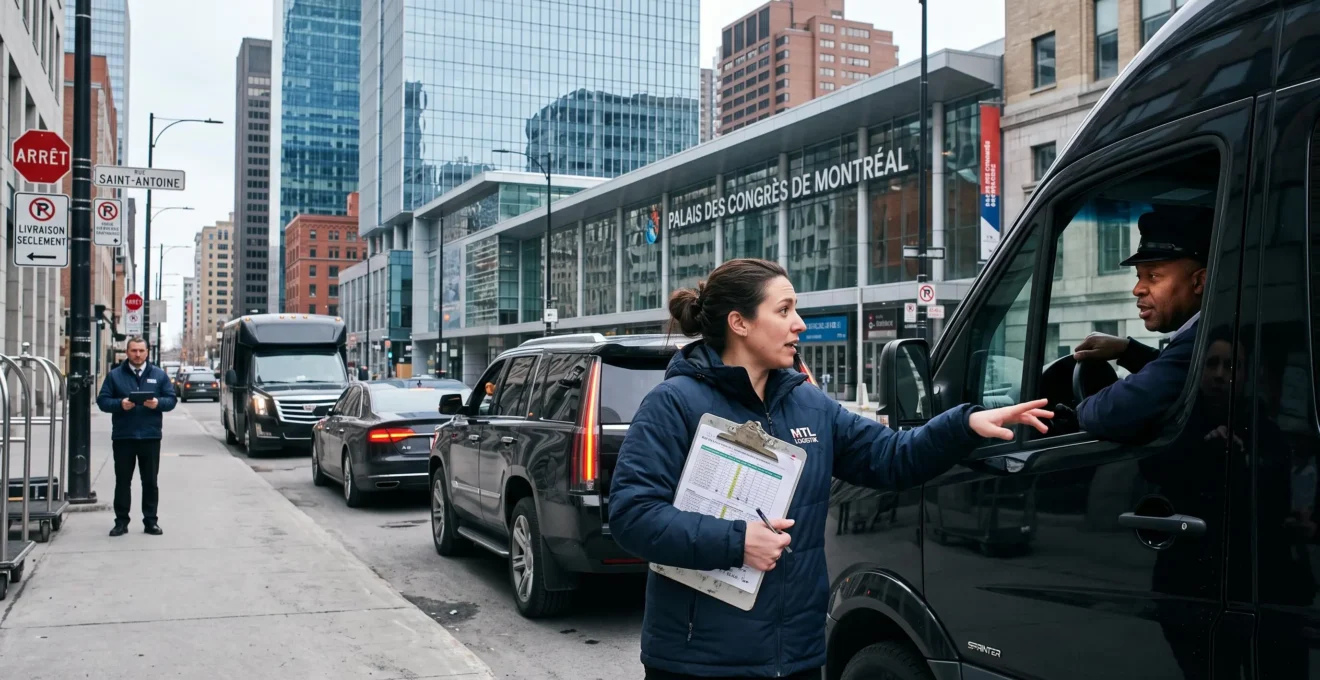
A conventional shuttle schedule assumes that venues, passenger volumes, pickup locations and departure times are reasonably predictable. An unprecedented event may satisfy none of those assumptions. Guests might move between locations that change during production, VIP departures may depend on confidential decisions, and equipment deliveries may compete with passenger movements for limited venue access.
Custom transportation design addresses these challenges by building an operating system around the event rather than forcing the event into an existing service package. Routes, vehicles, personnel, contingency capacity and communication responsibilities are designed as interconnected decisions.
In Montréal, that architecture must also account for festival activity, downtown street restrictions, winter conditions and venue-specific access arrangements. The objective is not to promise that disruptions cannot occur. It is to make critical movements dependable by identifying what could fail, deciding how the operation will respond and testing whether the proposed alternatives are actually workable.
Custom event transportation: essential decisions
- Allow approximately three to six weeks for a substantial custom design process, while treating municipal authorizations and early vehicle reservations as separate planning requirements.
- Choose between modified standard and fully custom transportation according to operational uncertainty and the consequences of delay, not guest numbers alone.
- Assign vehicles, backup capacity and dispatch authority according to critical timing, passenger requirements and verified venue access.
- Why Custom Transportation Planning Takes 3-6 Weeks: The 5-Phase Design Process Explained
- How to Know if You Need “Modified Standard” or True Custom Transportation Solutions
- Fixed Price vs. Hourly Custom Design: Which Pricing Model for Unpredictable Transportation Projects?
- The Custom Plan Failure That Happened Because 3 Critical Requirements Weren’t Mentioned
- When to Start Custom Transportation Planning for Your June Event: The January Design Window
- How to Assign Vehicles to Guest Tiers: VIPs, Speakers, General Attendees, and Families
- Backup Vehicle Strategy for Itineraries Where Delay Costs $50,000 or More
- How Event Planners Coordinate 6+ Vehicles Without Delays, Confusion, or Lost Guests
Why Custom Transportation Planning Takes 3-6 Weeks: The 5-Phase Design Process Explained
A three-to-six-week design window is a practical planning allowance for a complex custom transportation project, not a universal industry requirement. The time is spent resolving dependencies: passenger requirements determine routes, routes constrain vehicle choices, and those choices determine viable contingencies. Compressing the process without resolving these dependencies can leave an apparently complete schedule with no workable recovery plan.
The five-phase design process provides a framework for coordinating those decisions.
- Discovery. Establish passenger categories, guest counts, production requirements, security expectations, accessibility needs, critical deadlines and decision-making authority. The deliverable is a validated requirements brief.
- Route mapping. Identify pickup and delivery points, access restrictions, loading windows, road closures and practical alternatives. The deliverable is a route matrix with documented assumptions.
- Vehicle matching. Select vehicles based on passengers, baggage, equipment, accessibility and operating conditions. Confirm that the proposed fleet can use the designated access points.
- Contingency design. Model late arrivals, inaccessible pickup areas, vehicle failures and weather disruptions. Assign alternative routes, reserve capacity and escalation triggers.
- Confirmation. Validate driver assignments, venue permissions, passenger instructions, dispatch contacts and the final run-of-show.
These phases can overlap, but they cannot be treated as independent checkboxes. A late venue change may invalidate route mapping, vehicle allocation and backup positioning simultaneously.
90 days
Advance application requirement for metropolitan-scale public events on public property in Montréal. This is a municipal authorization deadline, not a transportation design duration, and does not automatically apply to private events or routine shuttles.
Montréal-specific scheduling can introduce additional dependencies. Grand Prix weekend, summer festivals and winter operations call for different routing assumptions. Convention activity can also complicate vehicle sourcing and venue coordination. Where public property is involved, applicable permissions must be checked separately from the transportation design schedule.
Clients control the timely disclosure of guest manifests, venue schedules, security constraints and changes to the production plan. Providers control route validation, proposed fleet configuration, dispatch design and supplier coordination. When either side delays a critical input, the entire design sequence may move.
A useful screening question is: “Which dependencies have you verified, and which are still assumptions?” A provider promising a complete custom design in a few days may be using a suitable existing framework, but the short turnaround alone does not establish that the project’s unique risks have been resolved.
Once those deliverables are understood, the next decision becomes clearer: whether the event actually needs a new operating design or an intelligently adapted standard service.
How to Know if You Need “Modified Standard” or True Custom Transportation Solutions
Modified standard transportation is appropriate when existing routes, vehicle types and dispatch procedures remain valid after limited adjustments. True custom transportation is warranted when unusual timing, access, passenger or production requirements invalidate those assumptions. The determining factor is the operational risk the event team would otherwise need to manage, not simply the scale or prestige of the event.
A conventional conference shuttle may work well when hotel pickups are fixed, attendance is predictable and departures can be grouped. That same shuttle becomes harder to standardize when the venue changes daily or a speaker must reach an inaccessible entrance within a narrow arrival window.
The following grid helps distinguish the two approaches.
| Operational trigger | Modified standard | True custom |
|---|---|---|
| Venues and addresses | Fixed, verified locations | Changing or not yet confirmed locations |
| Timing tolerance | Flexible departure windows | Critical windows with less than 15 minutes of tolerance |
| VIP movements | Independent of public-event restrictions | Dependent on security, discretion or restricted access |
| Passengers and equipment | Conventional passenger and luggage loads | Mixed production cargo, special equipment or unusual access requirements |
| Itinerary stability | Recurring, predictable movements | Daily changes and conditional departures |
| Contingency ownership | Event team resolves unusual disruptions | Provider designs and operates defined alternatives |
One practical diagnostic is to document the assumptions behind a standard service: fixed destination, stable passenger count, predictable schedule, normal curb access and no unusual authorization requirements. If three or more assumptions are broken, use that as a prompt for a formal custom-design assessment, not as an automatic purchasing rule.
Venue constraints can overturn an apparently simple plan. The Palais des congrès de Montréal identifies its main entrance at 1001 Place Jean-Paul-Riopelle and its loading and unloading dock at 163 rue Saint-Antoine Ouest. Its official access information illustrates why passenger reception, deliveries and vehicle parking must be assessed separately. A published access point does not, by itself, authorize a transportation operator to use it.
The cost comparison should therefore include more than the supplier’s quote. Modified standard may reduce upfront planning expenditure but leave the production team responsible for unexpected access, coordination and recovery costs. True custom design can allocate those responsibilities explicitly and reserve resources for foreseeable disruptions.
After determining the appropriate design depth, the commercial agreement must establish who pays when the remaining assumptions change.
Fixed Price vs. Hourly Custom Design: Which Pricing Model for Unpredictable Transportation Projects?
Fixed-price custom design generally fits projects with an agreed scope, stable routes and clearly defined deliverables. Hourly design fees are often better suited to projects where venues, guest numbers or security requirements remain unresolved. The choice determines who absorbs the financial consequences of uncertainty: the provider through a defined fixed scope, or the client through additional billable work.
Neither model automatically produces a lower final cost. A fixed-price provider may incorporate uncertainty into the initial quotation. An hourly agreement may appear more economical initially but grow as decisions change.
| Consideration | Fixed-price design | Hourly design |
|---|---|---|
| Best project stage | Scope substantially defined | Requirements still evolving |
| Initial budget certainty | Higher for agreed deliverables | Lower without a spending limit |
| Changes | Managed through agreed variation clauses | Usually reflected in additional hours |
| Client oversight | Milestone and deliverable approval | Time reports, estimates and spending controls |
| Main risk | Excluded work and costly scope changes | Accumulating design expenditure |
For an unprecedented Montréal event, a hybrid structure may offer a useful balance: hourly discovery and feasibility work, followed by a fixed execution proposal once core assumptions have been validated. This separates the cost of solving unknowns from the cost of operating an agreed transportation plan.
Scope-change clauses deserve particular attention. A venue substitution, additional vehicle, revised operating window or new security protocol may materially change the provider’s obligations. The agreement should establish how each change is requested, priced, approved and incorporated into the run-of-show.
Seasonality also affects commercial decisions. During Montréal’s busy festival and convention periods, the required vehicle category may become harder to source. An early agreement can reduce availability uncertainty when actual vehicles and dates are contractually confirmed; a fixed design fee alone does not reserve fleet capacity.
A sound contract distinguishes design services, vehicle operations, standby resources, driver overtime, waiting time and cancellation terms. It should also state which assumptions remain provisional.
Commercial clarity is valuable only when the requirements themselves are complete. The next risk is often an essential operating constraint that neither party thought to discuss.
The Custom Plan Failure That Happened Because 3 Critical Requirements Weren’t Mentioned
A custom transportation plan can fail despite accurate routes and confirmed vehicles when essential requirements were never disclosed. Three especially consequential omissions are VIP confidentiality, equipment dimensions and passenger mobility needs. The failure mechanism is straightforward: the provider designs around stated conditions, while the client assumes that unspoken requirements are already understood.
The following example is hypothetical, illustrating an omission pattern rather than documenting an actual incident.
Hypothetical case: three omissions, one unusable plan
A Montréal event producer books executive transportation between a hotel, a convention venue and a private evening reception. The proposed schedule appears feasible. Shortly before the event, three constraints emerge: a featured guest cannot use the public entrance, a speaker travels with oversized equipment, and another guest requires accessible vehicle accommodation.
The assigned sedan cannot carry the equipment, the confidential arrival requires a different access arrangement, and the accessible vehicle was never reserved. The original transportation plan may be internally consistent, but it cannot satisfy the actual assignment. Recovery now depends on available replacement vehicles, confirmed venue permissions and whatever time remains before the scheduled appearances.
The lesson is not that every event needs more vehicles. It is that requirements must be translated into operational specifications before vehicles and routes are committed.
A pre-kickoff disclosure review should cover people, vehicle capacity, venue restrictions, timing, confidentiality and weather-related alternatives. The checklist below converts that discussion into deliverables the production team can verify.
Five actions to complete before approving a custom transport design
- Identify passenger mobility, child-restraint, luggage and assistance requirements; produce a passenger-needs matrix that avoids unnecessary personal information.
- Measure production cases, technical equipment and unusual baggage; produce a load specification showing dimensions, quantities and handling requirements.
- Confirm approved pickup points, accessible entrances, loading areas and venue contacts; produce an access register with unresolved permissions marked clearly.
- Identify critical arrivals, departure dependencies and acceptable delay margins; produce a priority-coded movement schedule.
- Document confidentiality expectations, weather restrictions and fallback decision-makers; produce a signed requirements and escalation brief.
Late disclosure creates unequal consequences. During design, an additional requirement may call for a vehicle reassignment or route revision. On event day, the same change can require emergency repositioning, a missed appointment or an alternative that is no longer available.
A focused 30-minute alignment meeting can expose assumptions through deliberately specific questions. What happens if a principal guest arrives 40 minutes late? Who authorizes an alternative entrance? Can two groups share a vehicle if their departures conflict? Who decides whether an equipment case may travel with passengers?
Once requirements are explicit, the next priority is to place design, authorization and supplier commitments on a calendar that leaves room for revisions.
When to Start Custom Transportation Planning for Your June Event: The January Design Window
January is a useful starting point for a complex June event because it creates time for discovery, venue coordination, design revisions and early supplier discussions before Montréal’s summer event activity intensifies. It is not a mandatory industry deadline. The appropriate start date depends on the event’s complexity, applicable authorizations and how early critical vehicle capacity must be secured.
The advantage of a January start is the ability to sequence decisions rather than commit every operational detail immediately. An event still negotiating its venues can begin with requirements and feasibility while preserving flexibility over its final routes.
| Period | Main decisions | Expected deliverable |
|---|---|---|
| January | Define requirements, critical movements and early supplier needs | Initial logistics brief and risk register |
| February | Validate venues, fleet options and route feasibility | Provisional design with outstanding decisions |
| March | Freeze core operating assumptions; confirm relevant authorization obligations | Approved design baseline and permit responsibility register |
| April | Confirm vehicle commitments, dispatch structure and venue arrangements | Supplier and operational confirmation records |
| May | Rehearse critical routes and finalize passenger instructions | Tested run-of-show and contingency matrix |
| June | Recheck access conditions, weather exposure and final assignments | Dispatch-ready operating plan |
The specific dates should be adjusted to the event and the applicable requirements. For example, Montréal’s metropolitan public-event application procedure has a 90-day advance requirement within its defined scope. That regulatory clock is independent of vehicle reservation and transportation design.
For an event outside June, work backward from the first commitment that cannot be postponed. Identify seasonal demand, venue deadlines, potential authorization processes, vehicle dependencies and rehearsal requirements. Then allocate time for design and revision before those commitments become irreversible.
A late start changes priorities, not necessarily feasibility. The producer may need to secure the essential vehicles and core routes first, simplify noncritical movements and limit itinerary changes. Detailed rehearsals, secondary alternatives and preferred vehicle choices may become harder to preserve.
The consequences should be explicit. A shortened plan can still be operationally responsible if its limitations are understood, decision-makers accept the residual risks and no critical movement depends on an unverified assumption.
With design milestones established, the fleet must be assigned to the different passenger groups according to what each journey needs to accomplish.
How to Assign Vehicles to Guest Tiers: VIPs, Speakers, General Attendees, and Families
Vehicles should be assigned according to the consequences of delay, operational requirements and passenger needs rather than guest status alone. A keynote speaker with a fixed stage appearance may require a more protected transfer than a senior executive with a flexible schedule. General attendees can often share departures, while families may need specialized vehicles, child restraints and separate timing.
A useful tiering system begins with a simple question: which passengers can safely and practically be delayed together?
| Guest group | Primary operational requirement | Potential vehicle strategy |
|---|---|---|
| VIPs and principals | Privacy, controlled access and critical arrival times | Dedicated vehicle with an approved alternative |
| Speakers and performers | Session deadlines, preparation time and accompanying materials | Scheduled dedicated or small-group transfer with buffers |
| General attendees | Predictable boarding, capacity and clear departure information | Shared shuttles or coordinated group transportation |
| Families | Age-appropriate restraints, luggage, accessibility and variable departure times | Suitably equipped vehicles scheduled around individual requirements |
Speaker movements deserve particular attention because their schedules contain hard dependencies. A presenter may need to reach a preparation room before a panel begins, and transporting them to the building entrance at the published session time is not enough. The plan must account for unloading, security procedures, walking distance and equipment handling.
Family transportation has different constraints. Québec’s SAAQ child safety requirements for passenger cars specify appropriate child safety seats until a child reaches 145 cm in height or nine years of age, subject to applicable vehicle-specific rules. Taxi exceptions and requirements for other passenger vehicle categories must be checked rather than assumed.
Vehicle suitability also depends on luggage and boarding practicalities. A passenger count alone does not establish whether the vehicle can accommodate child restraints, strollers, equipment, accessibility requirements and baggage simultaneously.
Sharing vehicles can reduce resource requirements but creates linked risks. If a principal guest and several speakers share one vehicle, a delay affecting any pickup can compromise multiple scheduled appearances. Dedicated assignments are most valuable where this dependency is unacceptable.
Once primary assignments are established, backup planning can concentrate on the movements where failure would create the greatest financial or production impact.
Backup Vehicle Strategy for Itineraries Where Delay Costs $50,000 or More
When a transportation delay could create a loss of $50,000 or more, backup planning should be driven by exposure and recovery time, not simply by the number of spare vehicles available. Estimate the consequence of each 15-minute delay, identify when the loss becomes irreversible, and select backup capacity capable of responding before that threshold is reached.
Consider a hypothetical live production in which missing a critical transfer window could jeopardize a $50,000 commitment. If the relevant loss materializes after a single unrecoverable 15-minute delay, an on-call vehicle far from the venue may provide little protection, even if its reservation costs less than an on-site standby.
The calculation is not automatically a linear financial rate. Some events accumulate incremental delay costs, while others have a fixed deadline after which most of the loss occurs. The production team should identify which mechanism applies before allocating contingency budgets.
Three levels of redundancy provide different response capabilities.
| Redundancy level | Operating model | Principal limitation |
|---|---|---|
| On-call reserve | Vehicle available for dispatch within an agreed service area | Repositioning time may exceed the recovery window |
| Pre-positioned standby | Vehicle and driver stationed at an approved nearby location | Requires staging arrangements and paid availability |
| Shadow vehicle | Separate vehicle operating alongside the critical movement plan | Higher resource consumption and possible shared route exposure |
The appropriate level depends on the failure being addressed. A shadow vehicle following the same congested route will not necessarily solve a road closure. Similarly, a spare van with no accessible pickup arrangement does not protect an accessible transfer.
Montréal conditions make location-specific contingency design essential. Winter storms may require more conservative travel assumptions and a different operational schedule. Festival-related downtown restrictions can invalidate otherwise familiar routes. Congestion or disruption around a major crossing such as the Samuel De Champlain Bridge may require an alternative routing strategy, with feasibility verified for the actual event date.
Every reserve vehicle should have a named driver, validated communication channel, appropriate passenger capacity and confirmed access arrangements. Dispatch must also know who can activate the backup and under what conditions.
A strong contingency plan specifies an activation trigger, not merely a telephone number. For example, a dispatcher might be instructed to initiate a preapproved alternate pickup when the primary vehicle cannot reach its designated access point within the remaining operational tolerance.
Redundancy reduces the consequences of individual failures, but it only works when all vehicles operate within a coherent communication and command structure.
Key takeaways before live operations
- Assign one person final authority over dispatch changes, rather than leaving conflicting decisions to individual drivers or guest representatives.
- Give each vehicle, pickup point and contingency movement an unambiguous identifier shared across operational materials.
- Test guest boarding instructions and physical access arrangements before relying on real-time tracking to solve confusion.
How Event Planners Coordinate 6+ Vehicles Without Delays, Confusion, or Lost Guests
Coordinating six or more event vehicles requires a centralized dispatch structure, one synchronized operating schedule and clear communication responsibilities. The principal challenge is no longer simply finding enough vehicles; it is controlling information across drivers, coordinators, venues and guests. Reliable operations depend on knowing who makes decisions, how changes are communicated and where passengers must go.
A practical command structure has one accountable dispatch coordinator, a defined escalation contact for production decisions and drivers who receive updates through agreed channels. Venue contacts and guest-facing staff should know how to reach dispatch without issuing conflicting instructions directly to drivers.
The operational toolkit should include a controlled run-of-show, unique vehicle identifiers, confirmed pickup locations, live vehicle status and a backup communication method. Where live tracking is used, one coordinator should interpret the information and authorize changes rather than distribute competing updates through multiple channels.
Consider a six-vehicle operation involving two airport transfers, a speaker vehicle, a VIP vehicle and two attendee shuttles. Every movement needs an assigned identifier, departure condition, driver contact and fallback instruction. If a speaker’s flight arrives late, dispatch should know whether another vehicle can absorb that journey without compromising its own critical assignment.
Guest-facing coordination must be designed separately from vehicle dispatch. Passengers need clear boarding instructions, recognizable vehicle numbers, identifiable greeters and a defined contact when they cannot locate the pickup point. A tracking system may show precisely where a vehicle is, but that information does not help a guest standing at the wrong entrance.
Venue geography makes this especially important in downtown Montréal, where passenger entrances, delivery points, pedestrian approaches and vehicle-access arrangements may differ.
A pre-event rehearsal should test the operation as passengers and drivers will experience it. Walk the actual pickup approaches where access is permitted, verify vehicle turning constraints, identify potential conflicts with deliveries and confirm that signage remains visible from the guest’s likely arrival direction.
At locations involving restricted ramps, loading docks or controlled intersections, the rehearsal should also verify the applicable access authorization. A theoretically shorter route offers no advantage if the vehicle cannot legally or physically complete it.
Drivers and coordinators should then rehearse exception handling. Test how dispatch responds to an absent guest, a late vehicle, an inaccessible entrance or a last-minute schedule change. The critical test is whether the correct person receives the information quickly enough to act.
Operational control also requires restraint. Not every minor deviation justifies a fleet-wide update. The coordinator should distinguish between routine driver adjustments, passenger-facing changes and incidents requiring production-level decisions.
Before finalizing the transportation operation, request a single approved run-of-show, a complete vehicle and driver register, confirmed pickup instructions and a documented escalation procedure. These are the practical foundations for coordinating an unprecedented event without depending on improvisation when conditions change.
Can custom transportation planning begin before all event venues are confirmed?
Yes. Discovery, passenger requirements, fleet feasibility and preliminary risk analysis can begin while venue decisions remain open. However, final routing, access confirmation and some vehicle commitments may need to wait until locations are sufficiently defined. Unconfirmed assumptions should be recorded explicitly, with deadlines for resolving them.
Does every private event shuttle in Montréal require a municipal event permit?
No universal requirement of that kind is established by the municipal metropolitan public-event procedure. Authorization obligations depend on the event, its location and any proposed use of public property. Construction-related public-property occupancy has separate, borough-dependent procedures, described in Montréal’s construction-related public-property occupancy permit procedures. Those rules should not be treated as a general permit framework for passenger pickup zones.
What should an event organizer provide before requesting a custom transportation quote?
Provide the event schedule, expected passenger categories, known pickup and destination points, critical arrival deadlines, accessibility and family requirements, luggage or equipment specifications, security constraints and outstanding venue decisions. Mark uncertain information rather than presenting it as confirmed. This allows the provider to distinguish known operating costs from unresolved design work.
Can a vehicle backup guarantee that an important guest will arrive on time?
No. Backup capacity reduces specified risks but cannot eliminate simultaneous road restrictions, severe weather, denied access or other disruptions affecting both primary and alternative arrangements. Effective redundancy requires an independent feasible route or pickup strategy where appropriate, a ready driver and enough remaining time to recover before the critical deadline.
How should an organizer handle major itinerary changes shortly before the event?
Route changes through one authorized coordinator. Assess the consequences for vehicle availability, driver assignments, passenger notifications, venue access and existing contingency arrangements before approving the revision. Publish one updated operating schedule, identify what changed and require the affected teams to acknowledge it. When a change cannot be validated, communicate the residual operational risk rather than assuming the original plan still works.