
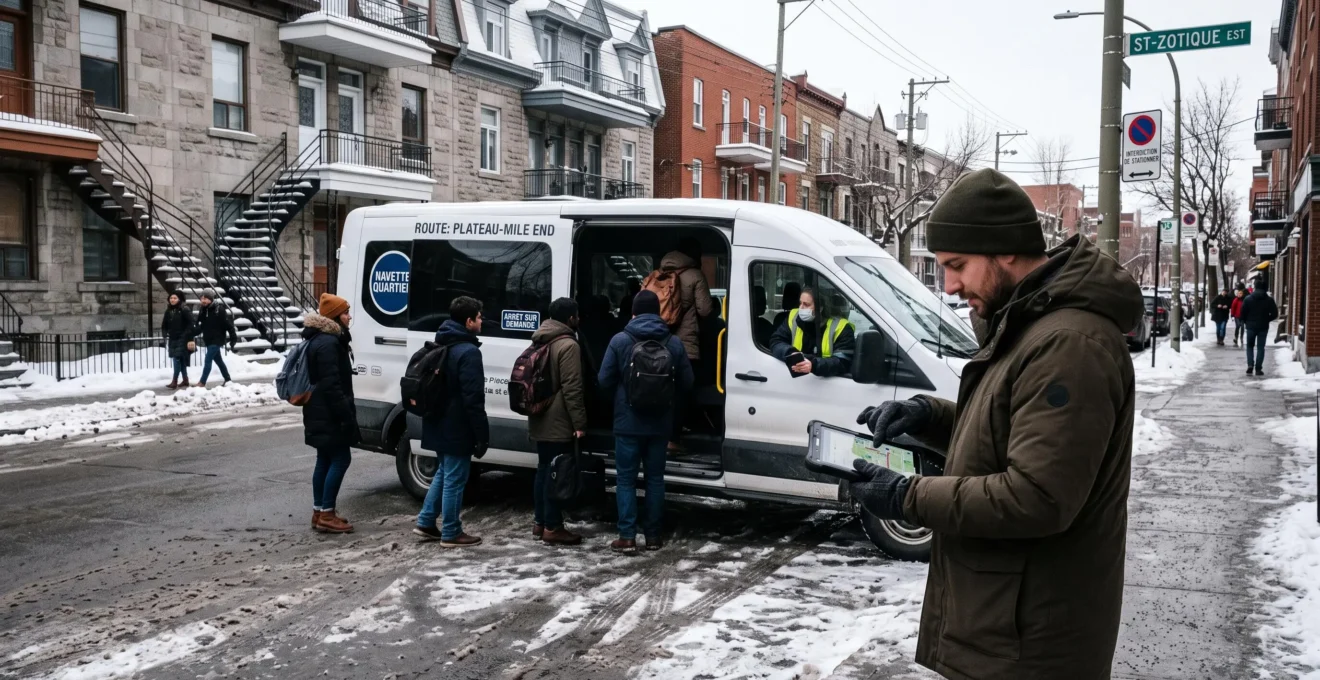
A shuttle can visit every scheduled stop, collect every passenger, and still waste considerable time. The problem often lies in the sequence of stops rather than the number of destinations. A route that looks geographically sensible on a map may require unnecessary turns, repeated crossings of congested streets, or detours that become expensive during Montréal‘s rush hours.
Route optimization software addresses this problem by calculating stop sequences against travel times and operational constraints. Instead of relying exclusively on a dispatcher’s intuition, the software evaluates feasible alternatives using information such as pickup windows, vehicle capacity, road access, and estimated journey duration. Some systems can also reconsider routes when traffic conditions or reservations change.
A 31% reduction in shared-ride time is a useful performance scenario, but it is not an independently established industry-wide result. The actual improvement depends on how inefficient the original route was, the quality of the input data, and the constraints imposed on the new itinerary. Operators can establish their own results through controlled comparisons between manual and optimized plans.
Shuttle route optimization at a glance
- Stop sequence matters: Algorithms evaluate road travel time and operational constraints rather than simply arranging stops by apparent proximity.
- Dynamic routing adds flexibility: Connected systems can reassess feasible routes when incidents or new reservations affect existing plans.
- Measured savings matter more than headline percentages: Compare manual and optimized routes using actual operating data, passenger travel time, and service reliability.
- Why Your Shuttle Doesn’t Visit Stops in Geographic Order: The Route Optimization Logic Explained
- How to Choose Between Fixed Routes and Dynamic Optimization for Your Shuttle Service
- How Dynamic Routing Saves 22 Minutes When Unexpected Traffic Closes a Planned Route
- The Manual Route-Planning Mistake That Added 18 Minutes to Every Shuttle Loop
- When to Lock Routes vs. Allow Real-Time Changes: The 2-Hour Planning Window Strategy
- Why the Order of Your Stops Can Add 90 Minutes to Your Montréal Itinerary
- Chronological Order vs. Geographic Clustering: Which Routing Cuts 35 Minutes From 6 Stops?
- How to Design a Multi-Stop Transportation Route That Saves 40% Travel Time Across Montréal
Why Your Shuttle Doesn’t Visit Stops in Geographic Order: The Route Optimization Logic Explained
A shuttle does not necessarily visit stops in geographic order because the shortest-looking path is not always the fastest feasible route. Optimization software evaluates road travel times, legal movements, passenger pickup windows, and vehicle capacity. It may therefore select a seemingly irregular sequence that reduces overall travel time without changing the destinations served.
Consider a shuttle collecting passengers from several Montréal neighbourhoods before heading downtown. A dispatcher examining a map might choose the visually closest stop first, then continue toward increasingly distant locations. That approach assumes proximity determines travel time. In practice, two nearby stops can require a lengthy road connection because of one-way streets, turning restrictions, construction, or congestion.
Montréal’s streets make these distinctions operationally significant. A route involving Décarie, Notre-Dame, or approaches to major bridges can face different travel-time conditions depending on the direction and hour of travel. A routing engine using suitable road-network data can compare these alternatives instead of treating distances as straight lines.
Google’s vehicle routing documentation explains how optimization problems incorporate constraints such as vehicle capacity, multiple vehicles, and time windows. These constraints distinguish passenger transportation planning from merely finding a short path between points.
The algorithm’s freedom is conditional. A passenger who must arrive before an appointment cannot simply be collected whenever the vehicle passes nearby. Capacity limits, mandatory stops, pickup-before-drop-off requirements, and applicable access restrictions also determine which permutations are feasible.
Illustrative stop-sequencing calculation
Assume a manually sequenced shuttle loop requires 100 minutes to serve an unchanged set of stops. An alternative sequence takes 69 minutes while satisfying the same passenger and vehicle constraints. The difference is 31 minutes, or 31% of the original loop duration.
This is a hypothetical calculation, not a measured Montréal operating result. It illustrates how a 31% improvement could arise from sequencing alone without reducing the number of passengers or destinations.
Even sophisticated solvers do not guarantee a globally optimal solution to every complex routing problem. Their practical value comes from producing feasible, competitive routes using explicit inputs that dispatchers can inspect and validate.
Once the sequencing logic is clear, the next decision is how much of that optimization should remain fixed and how much should respond to changing demand.
How to Choose Between Fixed Routes and Dynamic Optimization for Your Shuttle Service
Choose fixed routes when destinations, departure times, and passenger demand are predictable. Choose dynamic optimization when reservations and pickup locations change substantially between trips. A hybrid system is often appropriate when passengers need dependable departure points but operators still benefit from adjusting stop sequences to reflect daily demand.
The choice depends on operational behaviour rather than software sophistication alone. A recurring employee shuttle serving the same workplaces may value consistent pickup times more than marginal reductions in kilometres. An on-demand service collecting passengers across Montréal may face enough daily variation that repeatedly following one fixed circuit creates avoidable detours.
The following comparison helps identify the appropriate approach.
| Operating criterion | Fixed routing | Dynamic or hybrid routing |
|---|---|---|
| Passenger demand | Stable and recurring | Variable by trip or time of day |
| Destinations | Predictable | Changing or geographically dispersed |
| Advance bookings | Most trips known well ahead | Frequent late reservations |
| Stop density | Consistent demand at established stops | Uneven demand across multiple areas |
| Passenger expectations | Published pickup times and locations | Communicated pickup windows and updates |
| Typical operational priority | Service consistency | Adaptability and efficient vehicle use |
Passenger predictability has measurable operational value. Regular commuters travelling to downtown offices, universities, or hospitals may organize their entire day around a dependable pickup time. Continually changing those times can undermine service quality even when the resulting route is shorter.
A hybrid design can preserve a fixed departure corridor or designated collection points while dynamically sequencing secondary stops. This creates a balance between reliable passenger information and opportunities to reduce unnecessary driving.
Each model also has failure conditions. An entirely dynamic service without a clear booking cutoff may generate constantly shifting arrival estimates. Conversely, a fixed route can continue serving low-demand locations unnecessarily during seasonal fluctuations or disruptive winter weather.
Operators should therefore compare models using passenger punctuality, vehicle occupancy, operating time, and the proportion of reservations received after the planning deadline. The best model is the one that manages these objectives together, not simply the one with the lowest theoretical driving time.
With the service model established, traffic disruptions become the next test of whether the routing system can make useful decisions under real-world pressure.
How Dynamic Routing Saves 22 Minutes When Unexpected Traffic Closes a Planned Route
Dynamic routing can save 22 minutes in a hypothetical disruption scenario by detecting an obstruction, calculating a feasible detour, and updating the affected schedule before the shuttle reaches the blocked section. The savings depend on available alternatives, incident location, remaining stops, and how quickly a dispatcher would otherwise respond.
The process begins with incident detection. Depending on the system, traffic feeds may identify a sudden slowdown, or a driver may report a closure. The software then evaluates alternative paths against the commitments already made to passengers.
Reoptimization is not simply a command to avoid one road. The engine must consider whether a detour changes pickup times, vehicle availability, passenger travel durations, or the feasibility of subsequent stops. If an alternative is accepted, dispatchers and passengers need updated instructions.
Research published in the Transportation Research Procedia study on dynamic dial-a-ride optimization describes an online algorithm evaluated using a real demand-responsive transportation system. The research demonstrates an approach to handling incoming requests and ongoing computational optimization, without establishing a universal time saving from road-closure diversions.
For a Montréal shuttle operator, seasonal construction, unexpected road restrictions, and changing traffic conditions provide practical reasons to maintain this flexibility.
Hypothetical 22-minute disruption recovery
Suppose a blocked street would add 30 minutes to the remaining shuttle journey under the original plan. A feasible detour calculated after incident detection adds only 8 minutes. The difference is 22 minutes of avoided delay.
The calculation assumes both journeys serve the same required stops and satisfy their passenger constraints. It is not a documented result from a specific Montréal road closure.
To estimate actual recovery performance, operators can record the disruption time, the time a replacement route became available, the predicted delay under the original plan, and the realized delay after diversion. Comparing similar incidents helps distinguish software response speed from genuine journey-time improvement.
Excessive reoptimization creates its own risk. A system that changes routes for every small traffic fluctuation may repeatedly revise passenger arrival estimates. A minimum improvement threshold and automated notifications can help maintain stability. Thresholds should reflect the service’s tolerance for schedule changes rather than an assumed universal setting.
However, not every unnecessary delay comes from an unexpected closure. Some are built into a manually planned route and repeated day after day.
The Manual Route-Planning Mistake That Added 18 Minutes to Every Shuttle Loop
A common manual planning mistake is retaining a familiar central stop or detour even when current passenger demand no longer justifies it. Such decisions can add 18 minutes to a shuttle loop in an illustrative scenario. Because the route still works, the inefficiency can remain unnoticed across repeated departures.
Manual planners often inherit routes designed around historical passenger patterns. A familiar meeting point becomes part of the standard loop, while new pickup requests are appended in the order they arrive. Eventually, the shuttle may travel through an area primarily because it has always done so.
The error is especially persistent when drivers compensate for awkward scheduling through experience. Passengers still arrive, and no invoice explicitly identifies the extra detour. Yet the service may require more driver hours, consume more fuel, and reduce the number of rotations a vehicle can complete.
Consider a hypothetical shuttle that loses 18 minutes per loop through an unnecessary deviation. For four daily loops, the additional time equals 72 minutes per operating day. Across 250 operating days, that becomes 300 vehicle-hours annually. These are arithmetic assumptions, not observed results from a shuttle company.
To estimate the corresponding operating expense, multiply the excess annual vehicle-hours by the applicable incremental hourly operating cost. Fuel and distance-related costs should be evaluated separately where they are not already included, avoiding double counting.
A practical audit uses a week of actual reservations and completed routes. The dispatcher reconstructs each manual itinerary and then produces a software-generated alternative using identical stops, capacities, pickup constraints, and departure assumptions.
Comparisons should identify both reduced driving time and any changes in passenger service. A shorter route that causes missed appointment windows is not a successful optimization.
The decisive test is repeatability. An isolated improvement may reflect unusual demand or traffic. Repeated differences across comparable operating days offer stronger evidence that a planning habit is systematically expensive.
Once these inefficiencies are identified, route stability becomes important: optimization must occur early enough to capture savings without making passenger commitments unreliable.
When to Lock Routes vs. Allow Real-Time Changes: The 2-Hour Planning Window Strategy
A two-hour planning window can serve as an operational starting point for freezing shuttle stops and confirmed passenger assignments before departure. It is not a universal industry standard. The appropriate cutoff depends on reservation patterns, trip complexity, expected traffic volatility, and how reliably updated instructions reach drivers and passengers.
Before the cutoff, a dispatcher can consolidate reservations, adjust stop assignments, and optimize the route around confirmed demand. Once the window closes, substantial changes should face stricter acceptance rules because they may affect multiple passengers simultaneously.
For example, a service departing at 5:00 p.m. might use 3:00 p.m. as its initial planning cutoff. Requests received before that deadline enter the planned rotation. Later requests are assessed against remaining capacity and pickup commitments; those that cannot be accommodated reliably are offered the next appropriate departure.
The distinction between changing stop order and changing stop membership is essential. Reordering existing stops may be feasible late in the process when pickup windows remain satisfied. Adding a new stop creates additional travel, capacity, and scheduling requirements, so it generally deserves stricter controls.
Montréal’s operating conditions further complicate the decision. Winter travel disruptions and peak-period traffic can increase the uncertainty surrounding arrival predictions. Rather than using one immutable cutoff throughout the year, operators can test different planning windows by season, route type, and departure period.
The goal is not to freeze every part of the itinerary. Safety-related diversions and essential responses to closures may remain possible after the booking plan is locked. This separates ordinary demand management from incident handling.
A useful scheduling policy clearly communicates the reservation cutoff, circumstances under which a pickup may change, and how passengers receive updates. The policy should be evaluated against missed pickups, late arrivals, route changes after confirmation, and booking rejection rates.
A stable planning window protects commitments, but geographical complexity still determines how expensive the underlying stop sequence can become.
Why the Order of Your Stops Can Add 90 Minutes to Your Montréal Itinerary
A poorly ordered multi-stop itinerary can theoretically add 90 minutes when it repeatedly sends a shuttle across congested corridors or requires avoidable backtracking. The figure represents a high-impact hypothetical scenario, not a documented average for Montréal. Actual penalties depend on stop dispersion, departure time, road restrictions, and available connections.
Montréal’s island geography introduces practical constraints that a simplistic map-based sequence may overlook. Travel between neighbourhoods follows a defined street network, while journeys involving off-island destinations depend on limited crossing points. Roadworks and changes to accessible connections can further affect the fastest feasible sequence.
Consider a vehicle collecting passengers across different parts of the island before delivering them to a shared destination. If stops are arranged only according to booking order, the vehicle may move toward downtown, return to a previous collection area, and then cross another congested corridor. Grouping compatible stops can avoid some of this repeated travel.
The effect can increase during rush hours because two routes with similar distances may have very different travel durations. This is why operators should measure road-network travel time rather than assuming that minimizing straight-line distance automatically minimizes passenger journey time.
The Ville de Montréal’s 2026 Plateau-Mont-Royal roadworks information identifies municipal infrastructure projects and directs users toward official information on closures and detours. This provides a concrete reason to check current road accessibility before committing to a calculated route.
To investigate a potential 90-minute sequencing penalty, operators can perform a straightforward diagnostic:
- Record the exact stops, departure point, destination, and operating time.
- Calculate the expected duration of the existing stop order.
- Reorder the same stops using an appropriate optimization tool.
- Apply identical time windows, vehicle restrictions, and traffic assumptions.
- Compare feasible journey durations and review the result with the driver.
A 90-minute difference would require an especially unfavourable original configuration relative to the optimized alternative. It should never be treated as a typical saving without operational evidence.
Geographic dispersion is only part of the problem. The order in which customers reserve their seats can create an entirely different and equally costly pattern of unnecessary travel.
Chronological Order vs. Geographic Clustering: Which Routing Cuts 35 Minutes From 6 Stops?
Geographic clustering can outperform chronological booking order when six shuttle stops are spread across distinct neighbourhoods. Booking order reflects when reservations were received, not how locations connect by road. A 35-minute reduction is possible in an illustrative comparison, but actual savings depend on stop dispersion, traffic, pickup windows, and passenger commitments.
Chronological planning appears convenient because dispatchers process requests in the order they arrive. Unfortunately, the first passenger to book may live far from the second, while the third may be located near the first. Following reservation order can therefore create repeated crossings between collection zones.
Geographic clustering groups nearby pickup locations before determining their sequence. Instead of treating every reservation as an independent routing decision, it considers which passengers can be served within the same general corridor without violating their requirements.
Clustering does not eliminate scheduling constraints. Passengers travelling to medical appointments, workplaces, or transportation connections may need different arrival times. A cluster is useful only when its proposed sequence still meets those obligations.
One approach is to communicate pickup windows by service zone. For example, passengers within a particular neighbourhood could receive a collection interval rather than an exact pickup time established before demand is known. Such intervals require realistic estimates and clear communication.
Illustrative six-stop comparison
Assume a six-stop shuttle loop requires 110 minutes when stops are visited in reservation order. Geographic clustering and constraint-based sequencing reduce the calculated duration to 75 minutes. The hypothetical saving is 35 minutes.
This comparison assumes the same six stops, departure conditions, and passenger requirements. The example does not establish a typical result for Montréal shuttle services.
Before selecting clustering, an operator can measure the distances and estimated travel times between consecutive stops, the spread of locations across service areas, and the variability of those distances. Greater geographic dispersion may indicate an opportunity, but the expected gain must still be calculated against road and timing constraints.
Modern waypoint optimization can provide a useful reference. Google Maps Platform’s documented approach can reorder intermediate stops according to routing criteria including travel time, distance, and turns. However, waypoint reordering alone does not solve the full passenger transportation problem involving capacities and pickup-before-drop-off requirements.
The final challenge is translating these routing principles into a repeatable planning process that improves performance without creating unacceptable passenger inconvenience.
Key takeaways before implementation
- Evaluate the actual manual route before assuming that software will deliver a particular percentage improvement.
- Protect passenger commitments by separating booking changes from incident-driven detours.
- Validate calculated routes against Montréal road access, realistic travel times, and driver knowledge before expanding deployment.
How to Design a Multi-Stop Transportation Route That Saves 40% Travel Time Across Montréal
Designing a faster multi-stop shuttle route requires accurate passenger data, an appropriate routing model, realistic operating constraints, and measured comparisons against existing service. A 40% travel-time reduction is an ambitious illustrative outcome for a highly inefficient baseline, not a documented general result. Well-managed operations may have substantially less room for improvement.
The implementation process begins with the data behind each journey. An optimization engine cannot reliably improve a route if pickup addresses are inaccurate, passenger windows are missing, vehicle capacities are incorrect, or travel-time assumptions ignore local road restrictions.
For services operating in Montréal, input preparation should also consider the difference between a technically reachable street and a practical shuttle stopping location. Narrow streets, loading restrictions, limited curb access, and seasonal construction may make a mathematically attractive stop difficult to serve safely.
Driver validation is therefore indispensable. Dispatchers should review proposed routes with drivers familiar with the actual pickup and drop-off locations, particularly in dense areas such as the Plateau-Mont-Royal and Old Montréal.
The next decision is whether the service requires fixed, dynamic, or hybrid routing. Once that model is selected, the operator defines when bookings close, which changes remain permissible near departure, and how updated instructions reach passengers.
Performance measurement should compare equivalent operating conditions. A route carrying fewer passengers should not automatically be credited as more efficient simply because its total driving time is shorter.
Five actions for a verifiable shuttle optimization pilot
- Build a route-data register: Compile pickup and drop-off addresses, booking times, passenger requirements, vehicle capacity, and completed trip durations into a dated operating dataset.
- Document the manual baseline: Record existing stop sequences, passenger travel times, total vehicle time, and empty kilometres in a baseline comparison sheet.
- Configure the routing model: Select fixed, dynamic, or hybrid planning, document the constraints, and produce a proposed optimized itinerary for the same demand.
- Validate and test one rotation: Review street access and stopping feasibility with the driver, then complete a controlled operational test supported by a trip log.
- Calculate and approve the outcome: Compare total passenger time, service punctuality, vehicle time, and empty kilometres, producing a pilot results report with an explicit expand-or-revise decision.
For the percentage calculation, use the same metric on both sides of the comparison:
Travel-time reduction (%) = (baseline travel time − optimized travel time) ÷ baseline travel time × 100.
For example, reducing a hypothetical 150-minute operating loop to 90 minutes represents a 40% reduction in loop duration. This does not necessarily mean each passenger spends 40% less time travelling. Passenger time, vehicle operating time, and cumulative passenger-minutes must be evaluated separately.
Where passenger experience is the primary objective, a useful pilot metric is the average time from pickup to drop-off per completed passenger journey, accompanied by punctuality measures. Operators should also track vehicle occupancy, empty kilometres, and service exceptions to reveal whether improvements in one dimension create costs elsewhere.
The pilot should begin with one representative rotation or operating day rather than replacing the entire routing system immediately. Results can then be compared against similar manual journeys and reviewed for operational feasibility.
Start by selecting a representative Montréal shuttle route, assembling its actual stop and travel-time records, and running a controlled manual-versus-optimized comparison. The measured result—not a headline percentage—should determine whether expanding algorithmic planning will meaningfully improve the service.
Does route optimization software guarantee a 31% reduction in shared-ride time?
No. A 31% reduction is an illustrative benchmark rather than a verified universal outcome. Savings depend on the existing route’s inefficiency, passenger requirements, road conditions, and optimization settings. Operators must compare actual manual and optimized performance to establish their own results.
Can a shorter shuttle route increase an individual passenger’s travel time?
Yes. A route minimizing total vehicle travel time can still increase the onboard time of an individual passenger if additional pickups occur before that person’s destination. Appropriate optimization constraints should therefore account for acceptable ride duration and pickup or arrival commitments, not vehicle travel time alone.
What information does shuttle routing software need?
Core inputs include pickup and drop-off locations, passenger demand, vehicle capacities, departure points, and any relevant pickup or arrival windows. More sophisticated applications may also incorporate traffic predictions, travel-time matrices, service durations, vehicle restrictions, and real-time operational information.
Should passengers receive a new pickup time after every route recalculation?
Not necessarily. Recalculating internal route estimates does not require changing every confirmed pickup commitment. Operators can establish minimum-benefit thresholds, preserve feasible pickup windows, and notify passengers when a material schedule change actually affects them. The objective is to balance operational efficiency with predictable service.
How can a small Montréal shuttle operator test route optimization without replacing its dispatch system?
The operator can export a representative set of completed trips, reproduce their stops and constraints in a suitable routing tool, and compare proposed sequences with existing routes. A small operational pilot, followed by driver review and measurement of passenger travel times, can identify the potential benefit before any wider software deployment.