
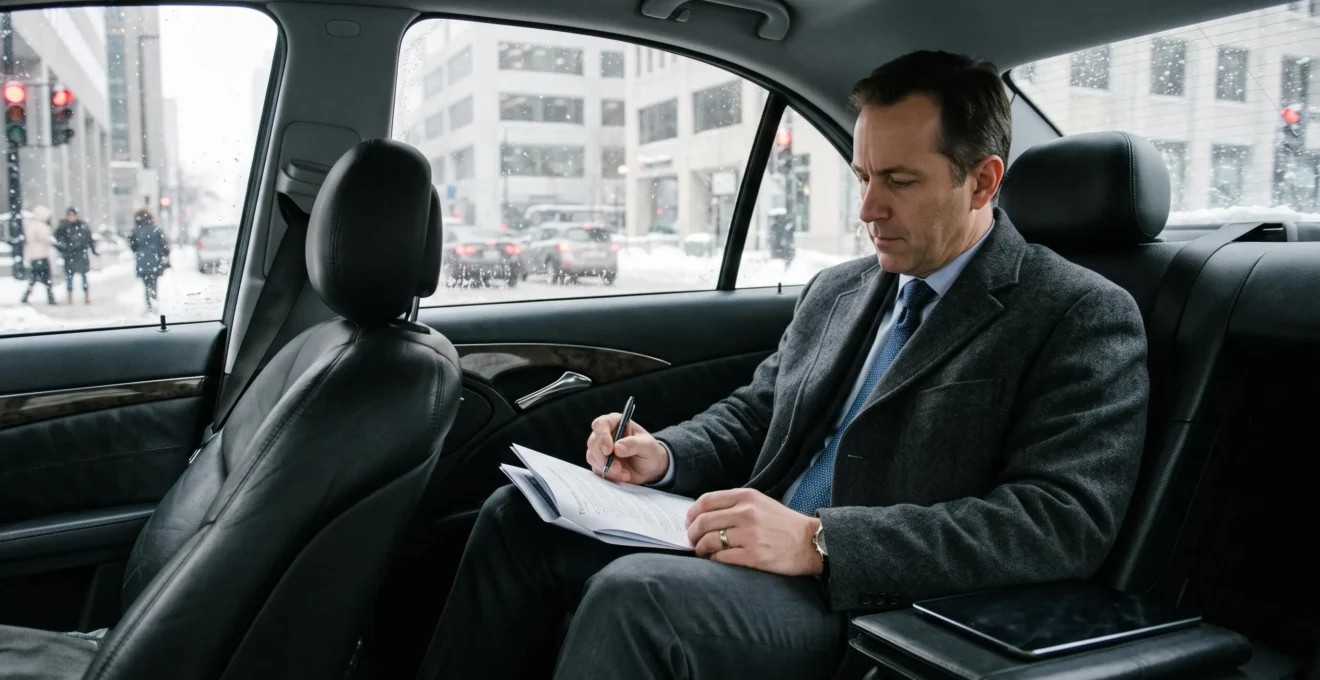
Arriving at an important meeting on time does not guarantee arriving ready. An executive can reach a client’s building at the scheduled hour yet spend the opening minutes recovering from traffic, locating the entrance, managing winter clothing, or mentally reconstructing the negotiation strategy.
Pre-meeting transportation strategy protects the transition between travelling and performing. It combines realistic departure planning, a suitable transportation mode, time for building access, and a deliberate period of mental preparation. The objective is not simply punctuality. It is to enter the room with attention available for the people, information, and decisions that matter.
Research provides a reason to take avoidable stress seriously. A 2024 systematic review examined 44 articles concerning acute stress and decision-making mechanisms. However, it did not test executive transportation or establish that transportation planning reduces arrival stress by 67%. That figure should therefore be treated as an unverified performance claim, not an established outcome.
For professionals navigating downtown Montreal, the South Shore, Laval, and changing winter conditions, the practical opportunity is measurable: reduce avoidable uncertainty before a high-stakes meeting and evaluate whether preparation, punctuality, and perceived stress improve.
Meeting-ready transportation: the essentials
- Plan for the time required to become ready, not just the estimated journey. Security, parking, weather, and preparation all affect the arrival margin.
- Select transportation according to the meeting’s stakes and the mental state it allows. Driving and chauffeured travel offer different advantages.
- Protect the entire meeting cycle with a predefined backup, realistic inter-meeting transfers, and a post-meeting reflection window.
- Why Executives Who Arrive 18 Minutes Early Outperform Those Who Arrive “On Time”
- How to Calculate Time Buffers: 40 Minutes for Client Meetings, 20 Minutes for Internal
- Self-Drive vs. Chauffeur for Your $2M Pitch: Which Arrival State Wins More Deals?
- The “It’s Only 25 Minutes” Mistake That Made You Late to 40% of Client Meetings This Year
- When to Schedule Your Pickup After Major Meetings: The 15-Minute Reflection Buffer Strategy
- The Backup Vehicle Strategy That Saves 95% of Business Meetings From Transportation Failures
- Why Your 5-Stop Itinerary Finished 47 Minutes Late Despite Each Stop Running “Only 8 Minutes Over”
- How Corporate Travel Managers Reduce Logistics Errors by 85% With Centralized Transportation
Why Executives Who Arrive 18 Minutes Early Outperform Those Who Arrive “On Time”
Arriving 18 minutes before a meeting can create a useful transition between transportation and professional performance. That margin allows for building access, a final review, and a quieter mental reset. It does not guarantee better results, however, and 18 minutes is not a scientifically established optimum. The appropriate margin depends on the venue, conditions, and meeting responsibilities.
Consider the difference between reaching an office tower at 8:59 a.m. for a 9:00 a.m. negotiation and reaching the surrounding area at 8:42 a.m. Both journeys might satisfy a navigation application’s arrival estimate. Only the second provides meaningful room for unexpected friction.
Entering a downtown Montreal tower may involve finding the visitor entrance, passing security, waiting for elevators, removing winter clothing, locating the correct floor, and silencing a phone. These tasks require attention even when they are routine.
A practical planning assumption is to reserve approximately 10–15 minutes for the final transition at an unfamiliar venue. This is a suggested working allowance, not a measured physiological recovery period.
The distinction between arrival time and readiness time becomes particularly important when an executive is leading the meeting. A host may need to check equipment, confirm seating, or coordinate colleagues. A guest may need only a short review and enough time to enter without disruption.
The scientific context supports caution about entering demanding situations under acute stress. The 2024 systematic review of acute stress and decision-making examined neuropharmacological mechanisms across 44 articles. It offers a rationale for reducing unnecessary stress, but provides no direct estimate of how early executives should arrive.
Arriving excessively early creates another problem. Sitting in a client’s reception area for more than 30 minutes may impose an awkward hosting obligation or create unnecessary waiting. An executive can instead remain at a nearby café, review materials privately, and approach reception at an appropriate time.
The most effective arrival margin is the shortest reliable interval that allows building access, preparation, and a composed entrance without inconveniencing the host. Finding that interval requires a better calculation than simply subtracting the drive time from the meeting start.
How to Calculate Time Buffers: 40 Minutes for Client Meetings, 20 Minutes for Internal
A 40-minute client-meeting buffer and a 20-minute internal-meeting buffer can serve as initial planning allowances, but neither is universally required. The appropriate total depends on travel-time uncertainty, building access, weather, and meeting stakes. Calculate each component separately, then adjust the allowance using your own arrival records rather than relying on a fixed number indefinitely.
The essential distinction is between commute time and arrive-ready time. Commute time covers physical travel. Arrive-ready time covers everything required to become prepared to participate effectively once the journey ends.
Use the following five-component calculation:
- Estimated travel: obtain a current route estimate for the expected departure period rather than recalling an unusually fast previous trip.
- Parking and access: include garage entry, the walk to the correct entrance, security procedures, and elevators.
- Weather adjustment: add an allowance appropriate to snowfall, slippery surfaces, and winter clothing.
- Stakeholder adjustment: protect additional time when a delayed arrival would affect a client, negotiation, or executive presentation.
- Preparation window: reserve deliberate time for reviewing objectives, key figures, and the intended opening.
For example, a hypothetical client visit might involve a 25-minute drive, 8 minutes of parking and building access, 7 minutes for weather-related uncertainty, and 10 minutes of preparation. The resulting planning total is 50 minutes. The figures illustrate the method; they are not Montreal-wide travel averages.
In Montreal, the route itself can introduce substantial planning uncertainty. A trip crossing between downtown and the South Shore or Laval may involve bridges, tunnels, or major road corridors. Before departure, consult Quebec 511 Montreal road conditions for applicable restrictions, construction, and road warnings.
Public transit can be a useful alternative when parking or road congestion creates uncertainty, but its reliability depends on the route and current service conditions. During winter, the STM winter travel advice warns that major snowstorms and subsequent snow removal may reduce the accuracy of real-time bus schedules.
Internal meetings generally justify smaller margins because the direct consequences of minor delays may be more manageable. Nevertheless, repeated internal lateness can undermine colleagues’ confidence, especially when those colleagues participate in later client engagements.
Build your personal arrival-buffer standard
- Record the next five scheduled meetings, including start times, destinations, and meeting stakes. Deliverable: a five-row meeting log.
- Save a departure-time route estimate for each journey. Deliverable: a baseline travel-time column.
- Log actual parking, entrance, security, and elevator time separately. Deliverable: a building-access record.
- Write down the arrival margin and whether preparation was completed before each meeting. Deliverable: an arrival-readiness score for each visit.
- Review the results after one month and revise allowances by building, neighbourhood, and season. Deliverable: an updated personal buffer guideline.
Once the time budget is realistic, the next decision is how to use the journey itself. Transportation mode matters because it determines whether the final approach to a meeting consumes attention or protects it.
Self-Drive vs. Chauffeur for Your $2M Pitch: Which Arrival State Wins More Deals?
For a hypothetical $2 million pitch, a chauffeur may offer the stronger arrival state when travel time can be used for rehearsal, final review, or decompression. Self-driving may be preferable for a familiar, short journey when privacy and personal control are more valuable. Neither option has a demonstrated deal-winning advantage; choose the mode that protects the preparation activity most important to the meeting.
The difference begins with the responsibilities each option places on the executive. A self-driving professional must manage navigation, traffic, parking, and the final transfer from vehicle to building. With a chauffeur, those operational tasks are largely assigned to another person.
In downtown Montreal, the final parking sequence can be more complicated than the drive itself. An underground garage may require finding the correct entrance, selecting a payment method, locating pedestrian exits, and walking through outdoor conditions before entering the destination tower.
A professionally arranged drop-off can remove several of those decisions. However, a chauffeur does not eliminate traffic, guarantee punctuality, or make every passenger more relaxed.
The relevant comparison is therefore not simply the cost of a vehicle. It is the quality and usability of the time spent travelling.
| Decision factor | Self-driving | Chauffeured travel |
|---|---|---|
| Preparation during travel | Limited to safe, non-distracting activities | Allows reading, note review, or appropriate calls |
| Arrival responsibilities | Includes parking and navigation | Usually limited to drop-off and building access |
| Privacy | Personal space without another occupant | Depends on vehicle configuration and service practices |
| Coordination | Direct personal control | Requires pickup instructions and driver communication |
| Best-fit situation | Familiar, straightforward journeys | Complex journeys where passenger time can be productive |
For some executives, driving a familiar route creates mental separation from earlier work. Introducing a driver could replace that routine with awkward conversation, coordination messages, or uncertainty about vehicle arrival.
Others benefit from having 20–45 minutes of passenger time available for reviewing deal assumptions, organizing questions, or preparing a calm opening statement. That time range is an illustrative meeting-planning scenario, not an established productivity benchmark.
A useful decision test is to identify the activity that would most improve readiness, then ask which transportation mode makes it realistically possible. Reviewing confidential documents, for example, also requires consideration of the privacy of the vehicle environment.
Transport mode should support the meeting strategy rather than symbolize seniority. Even the best-selected vehicle, however, cannot compensate for a departure plan built around an unrealistic journey estimate.
The “It’s Only 25 Minutes” Mistake That Made You Late to 40% of Client Meetings This Year
The “it’s only 25 minutes” mistake occurs when an executive plans around a remembered journey instead of the complete, variable door-to-door trip. A previously fast drive becomes the default expectation, while parking, building access, and scheduling conflicts disappear from the estimate. A 40% lateness rate should not be assumed without checking actual meeting records.
A single successful journey is a weak planning baseline. The remembered 25-minute drive may have happened outside peak traffic, during favourable weather, or before construction altered the route. Repeating that estimate ignores the conditions that made the original trip unusually convenient.
The problem becomes clearer when each transfer is visible.
Hypothetical example: the 25-minute journey
An executive remembers that driving to a client’s office takes 25 minutes. On the meeting day, reaching the car takes 4 minutes, leaving the garage takes 3, traffic extends the drive to 31, parking takes 6, and reaching the meeting floor takes another 8.
The resulting door-to-door journey is 52 minutes rather than 25. The additional 27 minutes emerge from several ordinary stages, not one extraordinary disruption. This is a constructed illustration, not an observed Montreal trip.
These small variations matter because the meeting deadline is fixed while the journey duration is not. Replacing memory with an updated mapping estimate is a useful first correction. Adding the non-driving segments is the second.
For repeated routes, record both actual journey time and arrive-ready time. Compare the results for similar departure periods, then use a conservative planning estimate appropriate to the meeting stakes.
The most revealing diagnostic may be the calendar rather than the roadway. A meeting that finishes at 1:00 p.m. followed by another across town at 1:30 p.m. may leave insufficient time even if the second location is described as a 25-minute drive.
In that situation, leaving more promptly cannot solve the underlying scheduling conflict. The meeting sequence must change, or one appointment must move to a remote format.
To assess whether lateness affects 40% of client meetings, audit the previous quarter. Count meetings with a recorded late arrival, divide by meetings with sufficient records, and examine the failing routes and time slots. If actual arrival records are unavailable, label the result incomplete rather than reconstructing punctuality from memory.
A realistic travel plan should also account for what happens after the meeting. Protecting the next departure prevents the stress of one appointment from spilling into the following commitment.
When to Schedule Your Pickup After Major Meetings: The 15-Minute Reflection Buffer Strategy
Scheduling pickup approximately 15 minutes after a major meeting’s expected finish can create time to capture decisions, organize follow-up actions, and leave without rushing. This is a practical starting allowance, not a scientifically validated optimum. Extend it when negotiations run long, stakeholder conversations continue, or building access and winter pickup arrangements require additional time.
A high-stakes meeting does not necessarily end when the formal discussion closes. Participants may exchange final comments in the hallway, clarify responsibilities, or raise an issue that changes the follow-up strategy.
Leaving immediately for the next appointment can interrupt this valuable consolidation period. A short pause allows the executive to separate confirmed commitments from tentative ideas and record details before they become difficult to reconstruct.
A simple reflection sequence can cover three questions: What was agreed? What remains unresolved? Who must receive which follow-up?
However, the pickup schedule must remain flexible enough to accommodate the meeting’s actual finish. When an important negotiation runs over, preserving a full 15-minute buffer may be less valuable than communicating promptly with the next stakeholder.
Prearranged transportation also creates a useful departure boundary. An executive can close a conversation without appearing abrupt by clearly identifying the next step and mentioning a scheduled departure.
For example: “The next steps are clear. I’ll send the revised points this afternoon, and I need to leave for my scheduled pickup.”
Montreal’s winter conditions make pickup location as important as pickup timing. Waiting outside while snow falls or sidewalks become slippery can undermine the calm that the reflection window was intended to protect.
Where access is permitted, an indoor-connected pickup point, sheltered entrance, or designated garage meeting area can reduce exposure. Some downtown buildings connect to portions of Montreal’s underground pedestrian network, but access and vehicle pickup arrangements vary by property.
When booking chauffeured transportation, confirm the exact pickup point, permitted waiting arrangements, driver contact method, and procedure if the meeting overruns. A flexible pickup window is often more useful than an exact departure time with no adjustment option.
The objective is to leave with clear next actions rather than carry unresolved mental clutter into the next journey. Maintaining that continuity also requires a predetermined alternative when the original transportation arrangement fails.
The Backup Vehicle Strategy That Saves 95% of Business Meetings From Transportation Failures
A predefined backup transportation strategy can reduce the risk of missing an important meeting when the primary route or vehicle becomes unavailable. It must specify an alternative mode, the route or booking method, and the latest time to switch. The 95% protection figure is not established by the supplied evidence and should be tested against actual transportation incidents rather than treated as a guarantee.
Many professionals believe they have a backup because they can order another car if necessary. That is not a complete contingency plan. If the primary vehicle fails, the executive must still find an available alternative, confirm its arrival time, and determine whether the journey remains feasible.
A decision-ready backup removes that uncertainty in advance. It identifies the next action before the failure happens.
The most useful component is a trigger time: a predefined point at which continuing with the original route becomes too risky.
For example, a hypothetical plan might state: “If the assigned vehicle has not arrived by 8:10 a.m., check the alternative booking. If the replacement cannot meet the required building-arrival time, use the confirmed transit route or notify the meeting organizer immediately.”
The threshold should come from the actual arrival deadline and alternative travel times, not an arbitrary number selected during the disruption.
Montreal requires more than one generic contingency. A snowstorm may affect road travel and vehicle availability simultaneously. A major festival or Grand Prix-related street restriction can make a nearby pickup point inaccessible. A metro service disruption may favour a road-based alternative, while a bridge or tunnel restriction could make an entirely different route more appropriate.
| Planning element | Routine internal meeting | High-stakes client meeting |
|---|---|---|
| Primary arrangement | Usual reliable travel mode | Confirmed route or booked transportation |
| Alternative | One identified viable option | Independently viable second mode or provider |
| Switch trigger | Simple departure deadline | Predefined threshold based on ready-arrival time |
| Communication | Notify organizer if delay becomes likely | Prepare stakeholder contact and escalation procedure |
Over-engineering every journey would create unnecessary administrative work. Reserve detailed dual-mode planning and, where justified, pre-booked alternatives for meetings where failure carries substantial consequences.
A backup protects one journey. When several meetings share the same day, a wider itinerary design is necessary to prevent small delays from cascading across appointments.
Why Your 5-Stop Itinerary Finished 47 Minutes Late Despite Each Stop Running “Only 8 Minutes Over”
Five appointments running eight minutes over create 40 minutes of direct meeting overruns. A total delay of 47 minutes can arise when an additional seven minutes are lost to compressed transfers, slower exits, or other journey friction. This is a hypothetical arithmetic example, not an observed outcome. The critical problem is that repeated overruns eliminate the recovery capacity between stops.
A multi-stop itinerary often appears feasible when every appointment is considered independently. The difficulty emerges when the first overrun affects departure for the second, leaving less time for travel, preparation, and unplanned interruptions.
The following example illustrates how the day can deteriorate.
Hypothetical five-stop delay calculation
Five meetings each exceed their scheduled duration by eight minutes, producing 5 × 8 = 40 minutes of direct overrun.
Later departures and compressed transitions produce seven additional minutes of delay across the day. The final appointment sequence therefore finishes 47 minutes later than planned. The seven minutes are a stated scenario assumption, not a mathematically inevitable consequence of the overruns.
That distinction matters. Delays do not automatically multiply. Instead, they accumulate, consume available slack, and may cause secondary losses when later connections or appointments cannot absorb the change.
One way to limit the impact is to protect the most consequential meeting by scheduling it first when practical. Flexible internal visits or lower-stakes discussions can follow, with explicit permission to move or shorten them if necessary.
A second technique is to create collapse points: predetermined moments when a nonessential stop can be cancelled without compromising the rest of the itinerary.
Another useful design is the float stop. Rather than adding a separate large buffer before every appointment, the calendar can reserve a flexible lunch, workspace session, or administrative period that absorbs accumulated delay. It should remain genuinely movable rather than becoming another fixed commitment.
For a chauffeured multi-stop itinerary, the driver should know the priority order, destination access instructions, and permissible changes from the outset. When conditions change, the driver can assess alternate routes while the passenger handles stakeholder communications.
For example, routing via Décarie rather than secondary downtown streets may sometimes be appropriate, but the choice must reflect live traffic, road conditions, and destination access. No corridor should be designated permanently superior.
After the day, compare planned versus actual departure and ready-arrival times for each stop. This reveals whether the itinerary needed better travel estimates, fewer meetings, or more flexible scheduling.
When multiple executives or assistants coordinate these arrangements, the next challenge is organizational rather than individual: ensuring everyone works from the same transport instructions and schedule.
Key takeaways before scaling the process
- A reliable individual transportation plan can still fail if an assistant, executive, and driver hold different versions of the itinerary.
- Standardized venue instructions reduce repeated clarification, especially for complex downtown buildings and winter pickup locations.
- Operational performance should be measured through actual incidents and arrival outcomes, not assumed percentage improvements.
How Corporate Travel Managers Reduce Logistics Errors by 85% With Centralized Transportation
Centralized transportation coordination can reduce logistics errors by giving executives, assistants, and drivers a common itinerary and a defined point of contact. The mechanism is fewer conflicting instructions and clearer responsibility at operational handoffs. An 85% error reduction is not supported as a universal result; travel managers should measure baseline incidents and test whether centralization improves their own operations.
Many transportation failures begin before the journey. An executive books a vehicle independently, an assistant updates the meeting location, and the driver receives an outdated pickup address. Each participant believes the arrangement is correct, but no one has the complete current picture.
A centralized process addresses this problem by establishing one authoritative itinerary that reflects all confirmed changes.
That record should contain the meeting destination, building entrance, pickup point, passenger instructions, responsible coordinator, relevant contact details, and the latest confirmed schedule. Access to sensitive information should be limited to the people who need it.
Recurring venues also benefit from standardized instructions. A downtown office complex may have different addresses for visitor reception, underground parking, and approved vehicle pickup. Recording the correct operational details prevents every booking from repeating the same discovery process.
Centralization must extend beyond reservation. If a driver cannot access a pickup point or an executive’s meeting overruns, someone needs authority to resolve the issue while the journey is underway.
However, centralized booking can introduce a different failure mode: administrative delay. A rigid approval sequence may be inappropriate for an urgent same-day trip, and executives who value flexibility may bypass a process that cannot adapt.
A hybrid operating model can preserve both coordination and responsiveness. Planned high-stakes travel follows the centralized process, while approved on-demand services remain available for defined exceptions. Both routes should feed confirmed journey details back into the shared record.
To test the 85% reduction hypothesis, establish a quarter-long baseline for missed pickups, incorrect locations, late arrivals, and booking changes that produce confusion. Then introduce the coordinated process to a pilot group and compare incident rates using consistent definitions.
For example, a hypothetical pilot with 20 incidents before implementation and 3 afterward would represent an 85% decrease in incident count. However, if the groups completed different numbers of journeys, raw counts alone would be misleading. Compare incidents per completed journey, account for differences in meeting complexity, and avoid claiming that the process caused the entire change without adequate evaluation.
The strongest operational measures include verified arrival margins, incident frequency, time spent resolving failures, and whether executives had sufficient preparation time.
Start with a limited group of recurring high-stakes journeys, establish clear ownership of changes, and review actual outcomes after the pilot. The goal is not simply fewer bookings to manage, but a transportation process that consistently delivers professionals to meetings prepared, calm, and able to concentrate on the decisions ahead.
Can transportation planning really reduce arrival stress by 67%?
The supplied research does not establish a 67% reduction in arrival stress from transportation planning. To evaluate this claim, an organization would need a defined stress measure, comparable journeys, and before-and-after observations. Transportation planning may remove avoidable stressors, but the size of any improvement must be measured rather than assumed.
Should executives enter the client’s office as soon as they arrive early?
Not necessarily. If arrival is substantially earlier than expected, waiting at a nearby café or another appropriate location may be preferable to remaining in reception. Confirm any advance security-registration requirements and approach the host at a reasonable time.
What should change when a Montreal meeting takes place during heavy snowfall?
Recheck road conditions and transit service, increase the travel allowance when conditions justify it, confirm the building entrance, and select a sheltered pickup location where possible. During major snowstorms, real-time bus arrival predictions may also become less dependable. If conditions make the journey unsafe or impractical, consider rescheduling or participating remotely.
How can an executive assess whether a chauffeur is worth booking regularly?
Compare several similar journeys using actual total cost, door-to-door duration, preparation completed, arrival margin, and perceived stress. Account for coordination requirements and whether passenger time is genuinely useful. A chauffeured service is most valuable when it solves a recurring operational or preparation problem, not merely because the meeting is important.
What is the most useful metric for a corporate meeting-transportation program?
Ready-on-time arrival rate is a useful primary measure: the proportion of journeys in which the professional reaches the venue with the agreed preparation margin intact. Supporting measures should include missed pickups, incorrect destinations, journey disruptions, and the time spent resolving incidents. These metrics distinguish genuine meeting readiness from simple vehicle punctuality.