
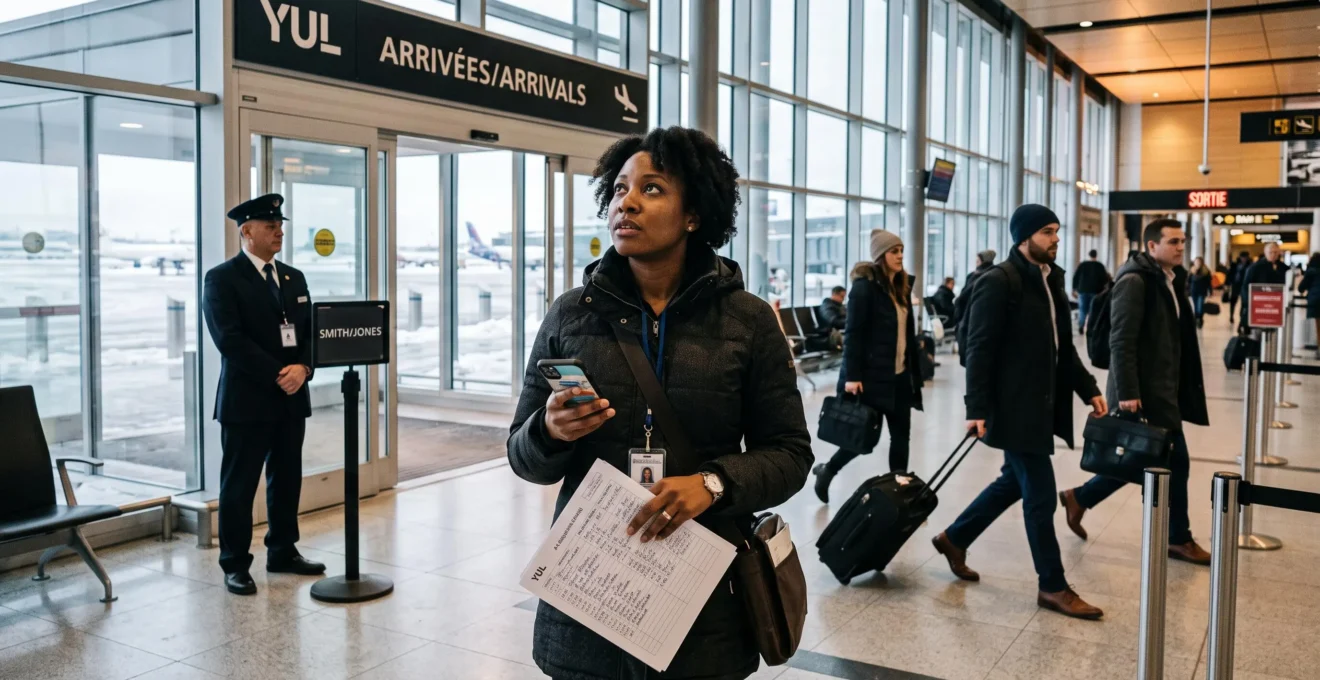
Eight executives, four incoming flights, different landing times and potentially different destinations: arranging their transportation through Montréal-Trudeau International Airport (YUL) requires more than reserving eight seats. Every flight introduces uncertainty in baggage collection, passenger readiness, vehicle availability and the timing of onward journeys.
The practical solution is to build a coordinated arrival manifest, group travelers according to when they can realistically leave the terminal, and assign vehicles with sufficient passenger and luggage capacity. Each group needs a confirmed meeting point, an authorized pickup arrangement, a designated coordinator and a backup if one flight falls behind schedule.
For an eight-person delegation, the objective is not necessarily to place everyone in one vehicle. It is to minimize unnecessary trips without forcing early arrivals into excessive waiting or putting important meetings at risk. That requires comparing transportation costs against waiting time, service reliability and the consequences of a missed connection.
Executive airport transfer coordination: essential decisions
- Plan around estimated passenger readiness, not simply scheduled flight landings. Four flights may require two pickup waves rather than one.
- Compare individual sedans, shared vans and mixed fleets using actual quotations, luggage requirements and executive waiting costs.
- Confirm an indoor meeting point, commercial pickup permissions and a communication backup before travelers depart.
- Why Individual Pickups for 6 People Cost
420
𝑊
ℎ
𝑖
𝑙
𝑒
𝐶
𝑜
𝑜
𝑟
𝑑
𝑖
𝑛
𝑎
𝑡
𝑒
𝑑
𝐺
𝑟
𝑜
𝑢
𝑝
𝑖
𝑛
𝑔
𝐶
𝑜
𝑠
𝑡
𝑠
420WhileCoordinatedGroupingCosts280 - How to Design a 60-Minute Arrival Window Strategy for 5 Passengers on Different Flights
- Individual Sedans vs. One Shared Van: The Break-Even Point for 7 Passengers Within 90 Minutes
- The Coordinator Mistake That Left 3 Executives Stranded When One Phone Died at YUL
- When to Finalize Group Airport Pickup Plans: The 24-Hour Lock-In Rule for Multi-Passenger Coordination
- When to Start Hotel Pickup Rotations for a 6 PM Event With 80 Guests Across 3 Hotels
- When to Share Vehicles Between Executives: The 20-Minute Rule for Cost Savings
- How to Transport 12 Passengers Across Montréal Without Splitting Groups or Overpaying for Capacity
Why Individual Pickups for 6 People Cost
420
𝑊
ℎ
𝑖
𝑙
𝑒
𝐶
𝑜
𝑜
𝑟
𝑑
𝑖
𝑛
𝑎
𝑡
𝑒
𝑑
𝐺
𝑟
𝑜
𝑢
𝑝
𝑖
𝑛
𝑔
𝐶
𝑜
𝑠
𝑡
𝑠
420WhileCoordinatedGroupingCosts280
Six separate pickups can cost more than coordinated transportation because each vehicle may incur its own minimum booking charge, airport pickup costs, waiting time and journey expenses. The proposed CAD 420 versus CAD 280 comparison illustrates how grouping could reduce spending by CAD 140, or one-third, but these are hypothetical booking totals rather than established Montréal executive transfer rates.
Consider a hypothetical arrangement in which six individual transfers cost CAD 70 each, producing a CAD 420 total. If the same passengers can travel in fewer suitable vehicles for a combined CAD 280, the saving comes from reducing duplicate vehicle journeys and related charges, not from assuming that a particular percentage discount always applies.
The calculation changes if the travelers arrive too far apart, need different destinations or require more luggage capacity than the proposed shared vehicle provides. A booking that initially looks cheaper may become more expensive once prolonged waiting, additional stops or a replacement vehicle is included.
Montréal offers an official point of reference for ordinary taxi transport. According to YUL’s official taxi fare information, published fares between the airport and downtown Montréal are CAD 49.45 during the day and CAD 56.70 overnight. Those figures concern taxis, not privately chartered executive cars or group shuttles.
CAD 49.45 / CAD 56.70
Published YUL-to-downtown taxi fares for daytime and overnight travel respectively; not executive transfer quotations.
ADM Aéroports de Montréal, airport taxi fare information, updated May 14, 2026.
When comparing six separate reservations against one coordinated booking, request an itemized quotation for both scenarios. Identify the vehicle class, passenger capacity, permitted luggage volume, included waiting allowance, overtime charges, airport pickup arrangements and any additional stops. Commercial authorization and regulatory compliance should be checked separately rather than assumed to represent a standardized per-trip surcharge.
For an eight-executive arrival plan, apply the same logic to groups formed from actual flight readiness. Travel on Montréal’s Autoroutes 20 and 520 can become less predictable during heavy traffic, making schedule buffers especially important when deciding whether to combine or separate transfers.
The lowest vehicle price is only useful when the arrangement also delivers executives to their destinations within acceptable time limits. The next decision is therefore how to group flights into practical pickup windows.
How to Design a 60-Minute Arrival Window Strategy for 5 Passengers on Different Flights
A 60-minute arrival window works when five passengers on different flights can realistically reach a common meeting point within one hour. Build the window from estimated terminal-ready times, allowing for disembarkation, baggage collection and any applicable border processing. Set a clear cutoff for late flights so the other travelers are not held indefinitely.
Start with one manifest showing the airline, flight number, scheduled landing, origin, expected terminal readiness, luggage requirements, destination and contact details for every traveler. A flight’s landing time is not its passenger pickup time: domestic travelers with carry-on baggage may be ready much earlier than international arrivals who must clear border formalities.
Because actual processing varies, estimated readiness allowances should be planning assumptions reviewed against passenger circumstances and live flight information, not guaranteed airport processing times.
A hypothetical coordination schedule could look like this:
| Passenger | Flight landing | Estimated meeting readiness |
|---|---|---|
| Executive A | 14:00 | 14:30 |
| Executive B | 14:10 | 14:45 |
| Executive C | 14:15 | 15:00 |
| Executive D | 14:20 | 15:10 |
| Executive E | 14:25 | 15:20 |
In this example, all five passengers are expected to reach the meeting point between 14:30 and 15:20, a 50-minute span. A 14:30–15:30 assembly window offers some additional operational margin. The first executive could nevertheless wait almost an hour, so the arrangement requires approval from travelers whose schedules are sensitive.
Give every traveler one designated indoor meeting location and assign a coordinator responsible for attendance. Confirm that the selected transportation company can collect the group at an authorized vehicle pickup area; the passenger assembly point and the chauffeur’s loading location may be different.
For four flights carrying eight executives, build the manifest in the same way but test more than one grouping arrangement. A first wave of three passengers and a second of five may be more reliable than keeping everyone together, particularly when an international flight arrives significantly later.
Establish a cancellation or regrouping trigger before arrival day. For example, the coordinator might reconsider a shared pickup when live flight information predicts that a passenger will miss the agreed readiness cutoff by more than 20 minutes. That figure is a proposed operational threshold, not an airport rule.
Grouping is successful when it reduces duplicated travel without creating an unacceptable delay for the people already on the ground. This tradeoff becomes especially important when choosing between several sedans and one shared van.
Individual Sedans vs. One Shared Van: The Break-Even Point for 7 Passengers Within 90 Minutes
For seven executives arriving within 90 minutes, a shared van becomes financially attractive when its complete quoted cost is lower than the sum of suitable separate vehicles, after allowing for waiting charges and operational risk. There is no universal passenger-count or time-based break-even point: luggage, route differences, service expectations and individual time costs determine the better arrangement.
Seven passengers can fit only if the selected vehicle has sufficient authorized passenger seats and usable luggage space. A nominal seating capacity alone does not demonstrate that the group, its baggage and any necessary service equipment can travel comfortably.
A shared van generally reduces vehicle coordination and may simplify arrival supervision, but places the whole group on a common departure schedule. Sedans provide more individual flexibility while increasing the number of drivers and separate pickup instructions to manage.
| Decision factor | Individual sedans | Shared van |
|---|---|---|
| Departure timing | Can leave independently | Requires an agreed group departure |
| Passenger waiting | Usually easier to limit | Early arrivals may wait longer |
| Luggage | Distributed across vehicles | Must fit one confirmed layout |
| Coordination | More drivers and pickup assignments | One central group movement |
| Disruption risk | Problems may affect one subset | One vehicle failure affects everyone |
| Professional experience | Individual and flexible | Collective, consistent and organized |
To calculate break-even, compare the complete van quotation with the combined sedan quotations plus any additional coordination or waiting expenses. For illustration only, three sedans priced at CAD 110 each would total CAD 330. A van quoted at CAD 290 would appear CAD 40 cheaper before considering any differences in waiting and travel time.
Passenger time changes the result. If seven executives each wait an additional 30 minutes, the arrangement creates 3.5 passenger-hours of waiting. At a hypothetical planning value of CAD 60 per passenger-hour, that represents CAD 210 in time cost—substantially more than the hypothetical vehicle saving.
This time valuation is a management decision, not a published transfer tariff. It may be appropriate to prioritize vehicle savings for a delegation with free time before hotel check-in, but not for executives heading directly to separate appointments.
The practical break-even point is therefore the lowest total cost that still respects agreed maximum waiting times, passenger comfort, route compatibility and the consequences of disruption.
Whichever fleet configuration is selected, reliable communication remains essential. A carefully optimized schedule can still fail if passengers cannot locate their coordinator or driver after landing.
The Coordinator Mistake That Left 3 Executives Stranded When One Phone Died at YUL
A single coordinator’s unavailable phone can disrupt an entire airport pickup if it contains the only passenger manifest, chauffeur number and meeting instructions. The scenario of three executives left stranded at YUL should be treated as an illustrative failure case, not a verified incident. The prevention strategy is redundant contact information, a fixed meeting point and a written fallback protocol.
Imagine eight executives arriving on four flights. Three are supposed to meet the coordinator after collecting their bags, but their only instruction is to call the coordinator’s mobile number. If that device loses power, the travelers may have no confirmed way to locate the driver or determine whether transportation is waiting.
At Montréal-Trudeau, a physical meeting location provides a useful fallback. The airport’s designated group meeting points include an arrivals-level location near Door 24, across from Subway, as well as departures-level meeting points near Door 7 and between Doors 5 and 6.
Select one location based on the group’s actual arrivals and accessibility needs. Passengers from domestic and international journeys may complete different arrival procedures before reaching the public areas, so confirm the chosen location in advance rather than assuming all travelers will emerge together.
Each traveler should receive a compact pickup card before departure. Include the confirmed flight number, group assignment, meeting location, chauffeur or dispatch telephone number, an alternative coordinator contact and the procedure to follow if the meeting does not occur as planned. Add the vehicle description and registration number when these have been confirmed by the provider.
The communication plan should offer several independent methods rather than depending entirely on one messaging application. SMS, telephone, email and a shared itinerary may each help, but printed instructions remain valuable if internet access, roaming or battery power becomes unavailable.
Winter conditions create another reason to keep the primary meeting process indoors when practical. Any later movement to an exterior loading location should be coordinated with the driver, particularly when snow, cold weather or airport traffic complicates waiting at the curb.
Hypothetical case: three unreachable executives
Three travelers land on separate flights and attempt to contact their coordinator. The coordinator’s phone is unavailable, but each traveler has a printed instruction card naming an indoor meeting point and a secondary dispatch number.
Instead of searching for different vehicles, the passengers proceed to the agreed location. The backup contact checks the manifest and confirms the group’s collection plan. This demonstrates a possible recovery procedure, not a documented real-world outcome.
Maintain two versions of the coordination information: a passenger-facing card containing only necessary details and a more complete manifest restricted to authorized organizers and the transportation provider. This keeps the fallback usable without unnecessarily distributing everyone’s personal information.
Once meeting instructions and backup contacts are established, the final preparation task is to confirm exactly when the plan becomes operationally fixed and how late flight changes will be handled.
When to Finalize Group Airport Pickup Plans: The 24-Hour Lock-In Rule for Multi-Passenger Coordination
Finalizing a multi-passenger pickup plan 24 hours before the earliest arrival creates a useful coordination checkpoint, but it is not a universal airport requirement. By that point, confirm the manifest, vehicle assignments, flight details and passenger instructions with the transportation provider. Keep an explicit change procedure available because flight delays can still occur after confirmation.
A practical 24-hour lock-in means that all participants receive one agreed operational version of the plan. It does not mean ignoring subsequent flight changes or preventing dispatch from reallocating vehicles when circumstances demand it.
At the checkpoint, the coordinator should obtain written confirmation that the provider has received the correct flight numbers, estimated landing times, passenger counts, destination addresses, luggage details, meeting arrangements and individual service requirements.
Airport access arrangements are particularly important at YUL. The airport’s official passenger pickup instructions describe P4 and P10 express facilities, including shuttle connections from designated arrivals-level access points. These facilities must not automatically be assumed available to every commercial chauffeur service under identical conditions.
P4 is described as a pickup and drop-off area rather than a parking lot. P10 offers up to two hours of complimentary parking under its specified arrangements. Neither provision establishes a general entitlement for a commercial provider to stage an executive transport vehicle in those locations.
Confirm directly with the operator where the booked vehicle may legally wait and where passengers will actually board. The passenger meeting location and the authorized loading zone are separate logistical details.
Five-action executive arrival lock-in checklist
- Reconcile all four flights: verify each flight number, arrival date, origin and assigned traveler; produce a dated eight-passenger manifest.
- Assign vehicle capacity: confirm authorized seats and luggage allowance for every pickup wave; obtain written vehicle assignments.
- Validate pickup locations: confirm indoor meeting instructions and the provider’s permitted loading location; issue a location sheet.
- Distribute backup contacts: provide primary and secondary telephone numbers, group assignment and offline instructions; issue individual passenger cards.
- Approve disruption triggers: document waiting limits, alternate vehicle options and decision authority; circulate the final escalation procedure.
After the lock-in, track live flight updates and communicate only material changes. A delayed flight may require a revised pickup time, a reassignment to another wave or a separate vehicle. Such adjustments should be documented in the shared manifest so passengers and dispatch are working from the same information.
This structured handoff applies beyond airport arrivals. Event planners coordinating transportation from several Montréal hotels face similar constraints, with one additional difficulty: the event start time is fixed.
When to Start Hotel Pickup Rotations for a 6 PM Event With 80 Guests Across 3 Hotels
For an event beginning at 6 PM with 80 guests staying at three Montréal hotels, calculate shuttle departures backward from the required arrival time at the venue. Allow for boarding, travel, unloading and an appropriate pre-event buffer. The first hotel departure depends on actual hotel locations, passenger distribution, vehicle capacity and evening traffic rather than a fixed citywide schedule.
Begin with the time guests must be inside the event venue, not the printed event start. If the program begins at 18:00, organizers may choose an earlier guest-arrival target to allow registration, coat check and seating. That target is a planning assumption to agree with the event team.
Next, map the three hotels and the venue. Hotels located close together may be served on a common circuit, but the order should follow practical travel routes and vehicle loading access, not guest registration order.
A hypothetical schedule illustrates backward planning:
| Planning milestone | Illustrative time |
|---|---|
| Event begins | 18:00 |
| Target guest arrival | 17:40 |
| Planned final venue unloading | 17:35 |
| Assumed final hotel departure | 17:05 |
| Suggested initial boarding window | Based on preceding route cycles |
The example assumes 30 minutes between the last hotel departure and arrival for unloading. It is not a verified travel-time estimate. Actual departure times require route-specific traffic assessment, especially during the evening commute in downtown Montréal.
For 80 guests, determine vehicle capacity using the provider’s approved passenger numbers, then calculate how many trips are necessary. A shuttle advertised with a certain seating capacity may still have operational limitations involving accessibility, loading times or luggage if passengers are arriving directly from flights.
Assign an onsite boarding contact at each hotel or a clearly identified representative for each shuttle. The representative should verify passenger counts, communicate departures and report any discrepancy to the central event coordinator.
After the event, a different problem emerges: attendees may default to ride-hailing or individual transport if they cannot identify the reserved shuttle. Clear signage, announced departure times, a fixed boarding point and a named contact reduce confusion. The pickup location must also be practical for larger vehicles.
Separate outward and return schedules in the written transportation plan. The route that works before a reception may not be appropriate afterward, when guests leave in different waves and road conditions have changed.
The same sequencing method can improve individual executive movements across the city, especially when travelers have nearby destinations and compatible meeting schedules.
When to Share Vehicles Between Executives: The 20-Minute Rule for Cost Savings
A 20-minute rule can help determine whether executives should share transportation: consider grouping travelers whose departure readiness differs by no more than an agreed 20-minute tolerance and whose destinations follow compatible routes. This is a proposed planning guideline, not a universal cost-saving threshold. Sharing is worthwhile only when the complete journey remains acceptable for both passengers.
Airport arrivals and city transfers require different decisions. At the airport, readiness is affected by flights, baggage and border formalities. Within Montréal, scheduling can sometimes be adjusted around meeting end times and neighboring destinations.
For example, two executives staying at nearby downtown hotels may be suitable for a common pickup if their flights are expected to clear the terminal within a similar window. By contrast, executives with different destinations or immediate commitments may benefit from separate transportation even when their flights arrive together.
A useful grouping decision should consider three conditions simultaneously:
- Timing compatibility: neither passenger exceeds their agreed maximum waiting allowance.
- Route compatibility: the added stop does not cause an unacceptable detour or missed commitment.
- Capacity compatibility: the vehicle can accommodate passengers, luggage and any specified accessibility requirements.
The 20-minute rule can be applied as an initial filter rather than an automatic booking instruction. A 15-minute readiness difference may still be unsuitable when the passengers are traveling in opposite directions. A somewhat longer difference may be acceptable when everyone has a flexible hotel check-in time and can wait comfortably.
For senior executives, explain the pooling policy before travel. A shared vehicle should preserve the agreed service category, luggage comfort and reasonable confidentiality expectations. The saving should not be presented as a benefit if the passengers experience it as an undisclosed downgrade.
When comparing transport options, add any extra stops, waiting and possible additional charges to the vehicle quotation. Track the resulting savings separately from operational effects such as total passenger waiting minutes and arrival punctuality.
For larger delegations, these individual grouping decisions must be translated into a complete fleet plan that respects actual vehicle capacity and keeps everyone accounted for throughout the journey.
Key Decisions Before Scaling to a Larger Group
- Confirm operational passenger capacity and luggage accommodation rather than relying on the vehicle’s advertised category.
- Choose the number of vehicles after assessing flight-readiness windows, route compatibility and acceptable waiting times.
- Keep one central passenger manifest even when the group travels in separate vehicles or waves.
How to Transport 12 Passengers Across Montréal Without Splitting Groups or Overpaying for Capacity
Transporting 12 passengers across Montréal without unnecessary separation requires a vehicle or coordinated fleet with confirmed capacity for everyone and their luggage. Compare one appropriately sized shuttle with multiple smaller vehicles, considering cost, access restrictions, passenger comfort and the risk of delays. Keeping a delegation coordinated does not always require every traveler to occupy the same vehicle.
Start by distinguishing nominal seating capacity from usable passenger capacity. A vehicle described as having 12 seats may count the driver among those seats, and luggage storage may further constrain its practical suitability. Never assume that passengers can exceed approved seating or use areas not intended for passenger travel.
Ask the provider for written confirmation of the number of legally usable passenger seats, luggage allocation, seat-belt availability, accessibility arrangements and any operational restrictions affecting the itinerary. Applicable requirements vary by vehicle category and service type.
Regulatory compliance is particularly relevant to commercial airport transportation. A Québec government enforcement report concerning paid passenger transportation described a February 2024 operation at YUL in which more than 50 vehicles were inspected and 30 offence notices were issued. Those figures concern one enforcement operation, not the general compliance rate of Montréal transport providers.
Documented airport transportation enforcement at YUL
On February 24, 2024, Québec road transport inspectors and ADM airport security carried out a joint inspection operation involving more than 50 passenger transportation vehicles.
The official report recorded 30 offence notices, six vehicle seizures and six driver licence suspensions lasting seven days. Reported issues included unauthorized airport departures and failures to meet applicable driver or vehicle requirements. These results describe that specific operation and do not establish the current legal classification of every shuttle or minibus service.
For the 12-person group, request at least two comparable fleet quotations: one for a suitable large vehicle and another for two smaller vehicles. Each quotation should specify whether luggage, waiting, multiple destinations, airport collection and return journeys are included.
A single large vehicle can simplify passenger accountability and maintain a unified arrival experience. However, it may require more careful route planning around downtown hotel loading zones and busy streets. Two smaller vehicles provide some flexibility and resilience but require separate driver coordination and a clear assignment list.
The most practical decision matrix is straightforward:
| Priority | One large vehicle | Two smaller vehicles |
|---|---|---|
| Group cohesion | All travelers can remain together if capacity permits | Requires assigned passenger groups |
| Flight delays | May delay everyone sharing the departure | Can support independent pickup waves |
| Operational resilience | Vehicle failure affects the full delegation | Disruption may be contained to one group |
| Downtown access | Requires suitable large-vehicle loading locations | May offer greater flexibility |
| Commercial comparison | One complete vehicle quotation | Combined quotations and coordination costs |
The airport arrival manifest, timing windows, 20-minute sharing filter and hotel rotation schedule can all be incorporated into a single transport control sheet. Each journey should have a vehicle assignment, responsible contact, passenger list, planned departure, destination and alternative arrangement if the original transfer is disrupted.
For the original eight-executive, four-flight scenario, this means building the plan around two questions: which passengers can leave the terminal together, and which vehicle arrangement delivers them to their destinations without excessive waiting or avoidable risk? Scaling to 12 passengers changes capacity requirements but not the underlying coordination method.
The next action is to circulate one confirmed flight-and-passenger manifest to the selected transport provider, obtain written fleet and pickup approvals, and distribute individual meeting instructions to every traveler before departure.
What information should an airport transportation coordinator collect from each executive?
Collect the traveler’s name, airline, flight number, arrival date, expected arrival time, destination, luggage requirements and necessary contact details. Record relevant accessibility requirements and any strict onward appointment deadlines. Share personal information only with those who need it for the transportation arrangements.
Can a chauffeur wait at an official YUL group meeting point?
Not necessarily. Airport-designated passenger meeting points identify places where travelers can assemble, but they do not automatically grant a commercial vehicle permission to wait or load there. Confirm the operator’s authorized pickup location and whether passengers need to move from the indoor meeting point to another collection area.
Should an executive arriving on a delayed flight wait for the next shared vehicle?
Reassign the executive to a later pickup wave when one exists and the passenger’s destination and schedule remain compatible. Otherwise, consider a separate transfer. The coordinator should check the driver’s availability, the traveler’s onward commitments and any additional charges before confirming the revised arrangement.
What should happen when a passenger cannot find the airport pickup coordinator?
The passenger should follow the previously distributed fallback instructions: proceed to the designated indoor meeting point, contact dispatch using the secondary number and avoid switching to an unconfirmed vehicle. The coordinator should reconcile the passenger manifest before authorizing the group to depart.
Is booking one large van always cheaper than arranging multiple executive sedans?
No. Costs depend on vehicle category, available capacity, service duration, waiting allowances, the number of destinations and provider quotations. A shared van may reduce duplicate trips, but excessive passenger waiting or a need for additional vehicles can eliminate the saving. Compare complete quotations alongside agreed traveler time limits.