
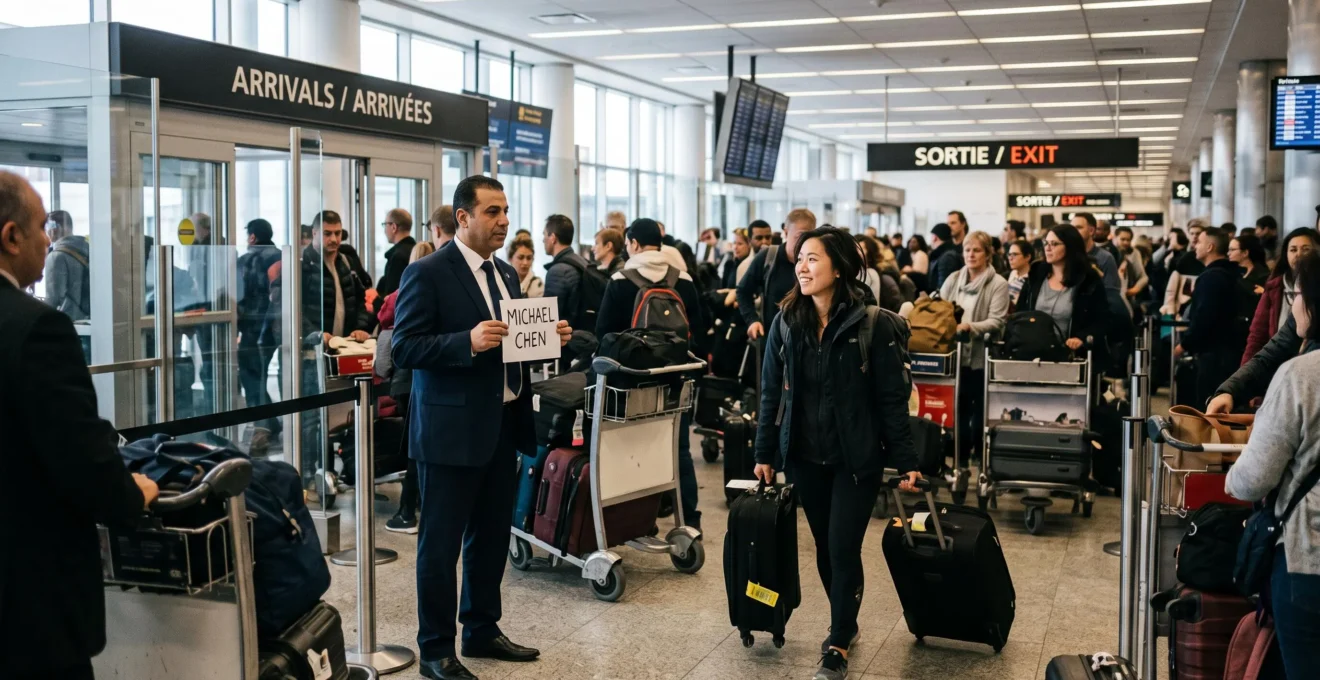
Landing at Montréal-Trudeau International Airport (YUL) should mark the end of a complicated journey, not the beginning of another one. Yet passengers still face unpredictable baggage delivery, unfamiliar pickup locations, changing road conditions, and the possibility that their ride will not be waiting when they exit the terminal.
A dedicated airport transfer service reduces these uncertainties by arranging the vehicle, pickup instructions, flight monitoring, and communication before travel begins. Instead of managing each step after landing, passengers follow an agreed meeting procedure. For departures, advance scheduling removes the need to find available transportation against a flight deadline.
The 85% anxiety reduction in the headline describes the intended scale of improvement, not a scientifically established measurement. No airport-specific study supplied here verifies that percentage. The practical benefit is more concrete: fewer decisions under pressure, clearer responsibilities, and a contingency plan when flights or roads disrupt the schedule.
For business travelers, families, and visitors unfamiliar with Montréal, the right transfer arrangement can make airport journeys considerably more predictable without promising that delays will never occur.
YUL airport transfers: the essentials
- Pre-booked meet-and-greet service replaces uncertain curbside coordination with an agreed driver, meeting location, and communication procedure.
- Allow time for aircraft arrival, customs when applicable, baggage collection, and ground traffic; use live flight tracking rather than relying on scheduled landing times alone.
- For departures, Montréal-Trudeau recommends reaching the airport three hours before flights. Confirm airline-specific deadlines and choose a pickup time that includes road and loading contingencies.
- Why Meet-and-Greet Beats Curbside Pickup for International Arrivals at YUL (and When It Doesn’t)
- How to Calculate YUL Arrival Transfer Timing: Flight Landing + Customs + Baggage + Buffer
- Private Transfer vs. REM vs. Shared Shuttle vs. Taxi: The Cost-Time-Comfort Matrix for YUL to Downtown
- The Departure Transfer Mistake: Why Guessing Your YUL Departure Timing Causes Missed Flights
- When to Book Your 5 AM Airport Transfer: The Booking Window Rule for Early and Late Departures
- When to Schedule Your Pickup: The 3 Time Windows That Determine On-Time Arrival From YUL to Downtown
- How to Estimate Your Actual Exit Time When a Flight Lands Early: International vs. Domestic Formulas
- How Real-Time Flight Tracking Eliminates Most Airport Pickup Coordination Stress
Why Meet-and-Greet Beats Curbside Pickup for International Arrivals at YUL (and When It Doesn’t)
Meet-and-greet service can simplify international arrivals at Montréal-Trudeau because the passenger meets an identified driver at a prearranged location inside the terminal rather than searching for a vehicle outside. It is particularly useful after customs and baggage collection, although its time advantage depends on driver availability, terminal access, passenger circumstances, and congestion.
Consider two travelers arriving on the same international flight. One has booked a private driver who has confirmed an indoor meeting location and identification procedure. The other must locate the appropriate taxi or rideshare pickup area, determine where to queue or wait, and establish which vehicle is theirs.
The first traveler has fewer coordination tasks, provided the booked service operates as promised. The second may face more uncertainty, although an available taxi could still provide a faster departure from the airport.
Meet-and-greet does not eliminate customs processing, baggage delays, or terminal congestion. Its principal advantage begins once the passenger is ready to meet the driver.
For passengers carrying multiple suitcases, traveling with children, or arriving after an overnight flight, that distinction matters. They can receive instructions before departure and concentrate on reaching the agreed meeting point rather than navigating several transportation decisions while tired.
The strongest arrangement identifies the exact meeting location, describes the sign or other identification method, and establishes a fallback contact if the passenger cannot locate the driver. Meet-and-greet availability and any associated parking or waiting charges should be confirmed with the provider.
By contrast, a domestic traveler with carry-on luggage arriving during a quieter period may reasonably prefer an airport taxi, rideshare, or a vehicle already waiting outside. For this passenger, the additional price of meet-and-greet may deliver little time benefit.
Likewise, no verified YUL data in the supplied evidence establishes an 18-minute universal advantage or a standard taxi wait during peak international arrivals. Actual results depend on conditions at the time.
Once the meeting procedure is settled, the next question is how long the traveler will actually need to get through the airport.
How to Calculate YUL Arrival Transfer Timing: Flight Landing + Customs + Baggage + Buffer
Estimate your YUL airport exit time by adding aircraft taxi-in, deplaning, applicable immigration and customs procedures, baggage collection, and a contingency buffer to the actual landing time. Use a range rather than a single predicted minute. A professional transfer provider should separately explain how flight changes affect driver dispatch and complimentary waiting time.
The aircraft touching down is only the beginning of the arrival process. Passengers must reach the gate, leave the aircraft, navigate the terminal, complete required formalities, and collect checked luggage before proceeding to their pickup point.
The basic calculation is:
Estimated airport exit = actual landing time + taxi-in and deplaning + border procedures, if applicable + baggage collection, if applicable + walking time + contingency.
These components vary independently. A flight may land early but reach its gate later than expected, while baggage may take longer even when border processing is quick.
For planning purposes, travelers can calculate a shorter and longer scenario using the same components. The following numbers illustrate the calculation only; they are hypothetical assumptions, not measured YUL processing times.
Hypothetical international arrival at YUL
Suppose a flight lands at 2:00 p.m. The traveler allows 10–20 minutes for taxi-in and deplaning, 15–45 minutes for border formalities, 15–30 minutes for checked baggage, and another 15 minutes for walking and contingency.
The calculation produces a planning exit window of 2:55–3:50 p.m. This is an illustrative range, not an airport performance forecast or a guaranteed driver meeting time.
For a domestic passenger with only cabin baggage, remove the international border-processing and checked-baggage components. Travelers arriving from the United States on flights precleared before departure generally do not repeat the same Canadian international-arrival process; nevertheless, the applicable arrival arrangements should be checked for the specific itinerary.
If checked baggage does not appear, the exit-time estimate becomes unreliable. The passenger may need to report the issue to the airline’s baggage service before leaving the relevant baggage or controlled area. The delay should also be communicated to the transfer dispatcher.
For airport pickup, the important distinction is between a flight-tracking service and an inflexible fixed-time booking. Tracking can establish when the aircraft arrives, but it cannot directly predict when an individual passenger completes customs or receives luggage.
The formula remains useful for notifying family, planning restaurant reservations, and estimating when a downtown meeting might realistically begin.
With that window established, transportation choice becomes a comparison of total journey cost, convenience, and current availability.
Private Transfer vs. REM vs. Shared Shuttle vs. Taxi: The Cost-Time-Comfort Matrix for YUL to Downtown
For downtown Montréal journeys in October 2026, the practical choices include pre-booked private transfers, regulated airport taxis, available shuttle services, and public transportation such as the STM 747 airport bus. The REM airport station is not yet operating, so it must not be compared as a currently available direct rail option from the YUL terminal.
According to Montréal-Trudeau Airport‘s official REM station opening update, the station is expected to become operational in 2027, subject to construction completion and network testing. No exact opening date is confirmed by that source.
Existing REM stations elsewhere in the metropolitan area do not provide a direct terminal rail connection today. Travelers should therefore compare transportation modes they can actually board at YUL.
For a useful comparison, consider the cost of transporting the entire party, including baggage, rather than simply comparing individual ticket prices.
| Transport mode | Cost for the party | Travel time and convenience | Luggage and comfort |
|---|---|---|---|
| Pre-booked private transfer | Provider-specific quoted vehicle price | Direct journey to the destination; arranged pickup, subject to road traffic | Vehicle size can be selected for passengers and baggage |
| Airport taxi | CAD 49.45 daytime or CAD 56.70 overnight for the designated downtown zone | Direct road journey; departure depends on taxi availability and traffic | Convenient for typical luggage loads; confirm larger-vehicle requirements |
| Shared shuttle, where offered | Operator-specific fare, potentially multiplied by passenger count | May require waiting, additional stops, or fixed departure times | Depends on provider baggage rules and passenger capacity |
| STM 747 airport bus | Applicable public-transit fares for each traveler | Scheduled service with stops and possible onward travel; subject to road traffic | Less convenient with bulky luggage or destinations away from stops |
| REM airport rail connection | Not applicable until service opens | Not operational at the YUL terminal in October 2026 | Future luggage policies and airport service conditions should be checked at launch |
For a couple, family, or small group, a per-vehicle taxi price offers a useful benchmark. The fare is shared across the occupants of the vehicle, whereas a public-transit or shuttle service may require separate tickets for each passenger.
However, a private transfer cannot be assumed to be cheaper without an actual quote. Vehicle class, meet-and-greet arrangements, waiting policies, and additional service charges may affect the final amount.
The REM image illustrates a future airport rail experience rather than an operating YUL service in October 2026. Any projected rail journey should remain outside a present-day booking comparison until the airport station opens and its fares, timetable, and luggage conditions are published.
CAD 49.45 / CAD 56.70
Published fixed taxi fares between YUL and the designated downtown Montréal zone: daytime from 5:00 a.m. to 11:00 p.m., and overnight from 11:00 p.m. to 5:00 a.m. These are per-vehicle prices, not per-passenger fares.
Aéroports de Montréal, official airport taxi fare information, updated May 14, 2026.
Trips outside the designated downtown flat-fare area use the applicable metered pricing structure. The published rates and zone eligibility should be verified before travel through Montréal-Trudeau Airport’s official taxi fare information.
Traffic remains another decisive variable. Both private vehicles and taxis can encounter congestion on routes serving the airport, while the 747 bus also operates on roads. A future direct REM connection would change that comparison, but its theoretical advantages should not influence an immediate booking.
For departures, however, minimizing price or average journey time is secondary to arriving before airport and airline deadlines.
The Departure Transfer Mistake: Why Guessing Your YUL Departure Timing Causes Missed Flights
The critical departure mistake is scheduling transportation from an optimistic driving estimate instead of working backward from the required airport arrival time. At Montréal-Trudeau, traffic, terminal access, check-in, baggage-drop deadlines, and U.S. preclearance can all affect the journey. A reserved car reduces booking uncertainty but cannot compensate for leaving too late.
Travelers often calculate a pickup time by subtracting an estimated drive from the earliest airport arrival they think they can tolerate. This leaves little room for loading luggage, congestion, construction-related access changes, or longer-than-expected passenger processing.
Montréal-Trudeau currently recommends arriving three hours before domestic, U.S., and international departures. The airport also advises travelers to check road conditions and access arrangements during construction.
The airport’s construction and access guidance identifies Québec 511 and the YUL Transit Planner as resources for evaluating traffic conditions and airport access options.
The departure formula should therefore begin with the flight’s scheduled departure time:
Latest planned pickup = flight departure time − airport arrival buffer − conservative road travel allowance − luggage-loading and pickup allowance.
This is a planning method rather than a guarantee. If the airline imposes a stricter deadline, or the passenger has additional accessibility, baggage, or document requirements, the calculation must reflect them.
Hypothetical early departure calculation
Suppose a flight departs at 9:00 a.m. Applying the airport’s three-hour recommendation gives a planned terminal arrival of 6:00 a.m.
If the traveler hypothetically reserves 50 minutes for the drive, another 20 minutes for traffic contingency, and 10 minutes for loading and pickup, the resulting planned pickup is 4:40 a.m. These allowances are illustrative assumptions, not measured Montréal travel times.
Airline operating deadlines create a separate risk. Air Canada publishes a standard check-in and baggage-drop cutoff of 60 minutes before scheduled departure, with a 45-minute baggage-drop exception for domestic flights. Other carriers and particular itineraries may have different rules.
For U.S.-bound passengers, preclearance introduces procedures before departure that need to be included in the airport processing plan. This does not establish that every U.S. flight requires a longer airport buffer than every international flight; the applicable itinerary and carrier instructions take precedence.
A transfer provider should monitor traffic, confirm terminal access arrangements, and communicate problems promptly. Travelers should retain a backup option and be prepared to leave earlier if conditions deteriorate.
That discipline matters even more when the scheduled pickup falls before dawn or after normal business hours.
When to Book Your 5 AM Airport Transfer: The Booking Window Rule for Early and Late Departures
For a 5:00 a.m. pickup or an overnight airport journey, arrange transportation as early as practical and reconfirm the essential details 24–48 hours beforehand. Reserving when the flight is booked is a sensible precaution for travelers who require a particular vehicle or pickup arrangement, although no universal 48-hour booking deadline guarantees driver availability.
Off-hours transfers create a different planning problem from midday journeys. Travelers may encounter fewer available vehicles, provider-specific overnight conditions, and reduced frequency on some public transportation services.
At the same time, a private car is not the only overnight option. Montréal-Trudeau identifies the STM 747 airport bus as operating 24 hours a day, seven days a week. Its suitability depends on the route, stops, luggage, schedule, and the distance between the stop and the final destination.
For a pre-booked private transfer, the most important confirmation is not simply that a reservation exists. The passenger needs to know exactly where the vehicle will stop and how the driver will identify the correct entrance.
Montréal apartment buildings may have multiple street-facing doors, external staircases, or entrances that are difficult to access by vehicle. Winter snow, temporary restrictions, and construction may further complicate the designated pickup point.
For example, the instruction “pick up at the building” leaves more uncertainty than an agreed street address, accessible entrance, vehicle stopping point, and driver contact method.
For departures, reserve enough time to respond to a driver who is late. The fallback decision point should be determined before departure day, based on the latest acceptable terminal arrival and an alternative transport option that is actually available.
For arrivals, confirm how the booking handles overnight flight delays and whether dispatch remains reachable after midnight. A service described as available around the clock is only useful if its support and operational procedures function during those hours.
Five confirmations for an early-morning YUL transfer
- Confirm the exact pickup date and local time, including any overnight date change; keep the booking confirmation.
- Specify the full address, accessible entrance, and safe vehicle stopping point; save the location instructions.
- Confirm the vehicle’s passenger and luggage capacity; retain the provider’s written acknowledgement.
- Obtain the dispatcher or driver contact method and the late-arrival procedure; save a reachable contact.
- Set a personal fallback decision time and identify an alternative service; record both in the departure plan.
The best booking policy also clarifies waiting time, cancellation conditions, and what happens if the traveler is not immediately ready. These terms are provider-specific and should not be assumed from the reservation label alone.
Once those operational details are secure, the time of day becomes the next major variable in predicting a smooth airport journey.
When to Schedule Your Pickup: The 3 Time Windows That Determine On-Time Arrival From YUL to Downtown
YUL-to-downtown pickup planning should distinguish morning commuting periods, midday or early-afternoon conditions, and evening rush-hour traffic. Each window creates different road-access risks. None guarantees an exact arrival time, so passengers with important appointments should plan around a conservative journey estimate rather than a fixed average.
For incoming passengers, the pickup time should account for airport exit readiness as well as subsequent road conditions. A driver arriving immediately when the aircraft lands may simply wait while the passenger remains inside customs or baggage claim.
The three main scheduling windows provide a practical framework:
| Arrival window | Primary planning concern | Recommended approach |
|---|---|---|
| Morning commuting period | Traffic volume and changing road conditions toward downtown | Check live road conditions, allow additional contingency, and avoid tightly scheduled meetings immediately after landing |
| Midday and early afternoon | Construction, incidents, and normal airport exit variability | Use a live drive-time estimate while preserving an independent contingency |
| Evening rush period | Congestion on downtown access routes and unpredictable journey duration | Plan against slower traffic scenarios, particularly for time-sensitive onward commitments |
These descriptions are qualitative. The supplied airport sources do not establish reliable minimum and maximum door-to-door travel times for each window. Publishing numerical ranges without measured route data would create an unsupported impression of precision.
A defensible calculation starts with the passenger’s expected airport exit window, adds a current route estimate for the relevant departure time, and applies extra contingency according to the importance of the onward commitment.
For example, a traveler heading directly to a hotel can tolerate greater arrival-time variability than someone connecting to a scheduled train at Gare Centrale. The latter should consider the train’s boarding requirements, downtown transfer arrangements, luggage handling, and alternative departure options before finalizing the itinerary.
Montréal winter conditions introduce another uncertainty. Snow, ice, poor visibility, or road treatment operations may lengthen a transfer and reduce the reliability of ordinary travel-time predictions.
The future REM airport connection may eventually offer a rail alternative to road congestion. Until the YUL station opens, however, the currently available airport transport options remain the appropriate basis for planning.
Road timing is only one side of the journey; the other is estimating when the passenger will emerge from the terminal, particularly after an early landing.
How to Estimate Your Actual Exit Time When a Flight Lands Early: International vs. Domestic Formulas
When a flight lands ahead of schedule at YUL, estimate actual airport exit time from the updated landing information rather than the original timetable. International passengers may still need border processing and baggage collection, while domestic and appropriately precleared arrivals follow a shorter process when no checked luggage or additional formalities intervene.
An early landing is useful but does not automatically produce an equally early airport exit. A quicker flight may encounter a gate delay, a longer baggage wait, or heavier-than-expected passenger processing.
The most reliable approach is to calculate different exit windows according to the arrival category.
International arrival formula: actual landing + taxi-in and deplaning + applicable border processing + baggage collection + walking and contingency.
Domestic or U.S.-precleared arrival formula: actual landing + taxi-in and deplaning + baggage collection if applicable + walking and contingency, adjusted for any special procedures required by the itinerary.
The key distinction is whether the traveler must complete border formalities after arrival at YUL. U.S. preclearance typically takes place before departure from the U.S. origin airport, so the normal arrival sequence differs from that of a flight requiring Canadian border clearance on landing.
Travelers should not treat these categories as interchangeable without checking their route and circumstances.
Hypothetical flight arriving 30 minutes early
A flight scheduled to land at 4:00 p.m. actually lands at 3:30 p.m. A traveler might expect to reach the pickup point 30 minutes earlier than originally planned.
However, if baggage or border processing takes 30 minutes longer than anticipated, that advantage disappears. The example demonstrates why the actual landing time and passenger exit time are separate variables, not a measured YUL performance pattern.
Passengers can refine their own estimates using updated flight information, available airport guidance, and any reliable baggage-delivery information supplied by their airline. Where authoritative current queue information is unavailable, it is better to preserve a wider uncertainty window than to invent a precise customs waiting time.
Professional transfer providers using flight tracking can react to an early aircraft arrival, but passengers should still confirm whether that information automatically changes dispatch timing. An early landing may require the operator to advance driver assignment, which is not always possible without adequate notice or vehicle availability.
The traveler should also understand when complimentary waiting begins: at scheduled landing, actual landing, estimated exit time, or another defined point. That contractual detail directly affects the stress and cost of an unexpectedly slow exit.
The strongest improvement comes when the transfer company uses live flight information to manage the driver’s schedule without requiring the traveler to coordinate every change.
Key takeaways before booking
- Flight monitoring and passenger exit readiness are different: a provider needs a clear policy for both.
- Confirm who adjusts the pickup when a flight arrives early, runs late, or changes status.
- Check waiting charges, cancellation rules, and dispatcher availability before relying on an advertised stress-free service.
How Real-Time Flight Tracking Eliminates Most Airport Pickup Coordination Stress
Real-time flight tracking reduces airport pickup coordination stress by allowing a transfer provider to monitor changes in flight status and adjust driver dispatch accordingly. Instead of requiring the traveler to update the driver while airborne or waiting at customs, the provider assumes responsibility for monitoring arrival information. The benefit depends on actual operating policies and reliable communication.
Airport arrivals contain two kinds of uncertainty. The first concerns the flight itself: delayed departure, changed arrival estimate, early landing, cancellation, or diversion. The second concerns the passenger: deplaning, immigration, baggage collection, and reaching the meeting point.
Flight tracking directly addresses the first category. It can help dispatch teams react before the passenger is available to communicate, reducing the coordination work that otherwise begins immediately after landing.
Three common pickup models illustrate why this difference matters.
| Pickup model | How it works | Main limitation |
|---|---|---|
| Fixed-time pickup | The driver is scheduled around a predetermined clock time | Early or delayed flights can create a mismatch between the booked time and actual arrival |
| Traveler-initiated updates | The passenger contacts the driver or dispatcher when plans change | Connectivity, roaming, and restricted phone access can interfere with communication |
| Flight-tracking dispatch | The provider monitors flight status and adjusts operations according to its policy | Tracking does not establish when the passenger will clear customs or collect baggage |
The last model shifts the responsibility for flight-status monitoring away from the passenger. It does not remove every possible delay, but it reduces the number of decisions the traveler must make during a demanding journey.
A genuinely reliable provider should be able to answer several operational questions before accepting the booking: whether early landings trigger earlier dispatch, how extended delays affect charges, whether an airline cancellation results in rebooking support, and how passengers contact dispatch after an unexpected disruption.
Diverted flights require particular attention. A system that detects the changed destination still cannot transport a passenger from an airport where the driver is not available. The service needs an explicit response policy rather than relying on flight tracking as if it solved every scenario.
Likewise, a provider cannot guarantee that vehicle access, airport operations, or road conditions will remain uninterrupted. Reliability comes from active monitoring and workable contingency arrangements, not a promise that disruptions are impossible.
Air Canada’s published operating information illustrates why this distinction also matters on the departure side. Its standard check-in and baggage-drop deadlines include a 60-minute cutoff, with a domestic baggage-drop exception of 45 minutes. Travelers should consult Air Canada‘s official check-in and boarding deadlines when the information applies to their itinerary, rather than expecting a transfer provider to recover time lost after a deadline has passed.
For incoming passengers, the most meaningful outcome is a simpler arrival process: leave the aircraft, complete the required procedures, collect luggage, follow the agreed meeting instructions, and identify the driver.
That is the operational foundation behind the anxiety-reduction claim. The service replaces several uncertain coordination tasks with a managed process, but there is no verified evidence here showing that it eliminates exactly 95% of pickup stress or 85% of total airport travel anxiety.
Before booking, request a clear written confirmation of the meeting point, flight-monitoring arrangements, included waiting time, total charges, and disruption policy. The most reassuring airport transfer is the one whose procedures remain understandable even when the flight does not go according to plan.
Can a private transfer driver wait while I clear customs at YUL?
Many airport transfer arrangements offer waiting time, but the amount included and the point at which charges begin depend on the provider. Confirm whether waiting is calculated from scheduled landing, actual landing, or another agreed time. Ask what happens if border processing or checked baggage takes longer than expected.
Is a taxi cheaper than a private airport transfer for a family?
For the designated downtown Montréal zone, the airport’s published fixed taxi fares are CAD 49.45 during daytime hours and CAD 56.70 overnight. A private transfer’s price depends on the operator, vehicle capacity, and included services. Compare the complete per-vehicle quote, including luggage requirements and additional fees, before deciding.
Can I take the REM directly from Montréal-Trudeau Airport in October 2026?
No. According to the airport authority’s January 2026 update, the YUL REM station is expected to become operational in 2027, without a confirmed opening date. Until then, passengers must use existing transport options such as taxis, private transfers, the STM 747 bus, or other available services.
What should I do if my booked airport transfer driver does not arrive?
Contact the driver’s designated number or the operator’s dispatcher, confirm the exact meeting point, and request an updated arrival status. For departures, follow the fallback decision time established in advance rather than waiting indefinitely. If necessary, switch to an available alternative that still allows sufficient time to reach the airport.
Does flight tracking mean my airport pickup time is guaranteed?
No. Flight tracking helps a provider react to aircraft arrival changes, but it cannot guarantee driver availability, predictable baggage delivery, unrestricted airport access, or clear roads. A dependable booking should combine flight monitoring with documented waiting rules, active dispatch communication, and procedures for delays, cancellations, and diversions.