
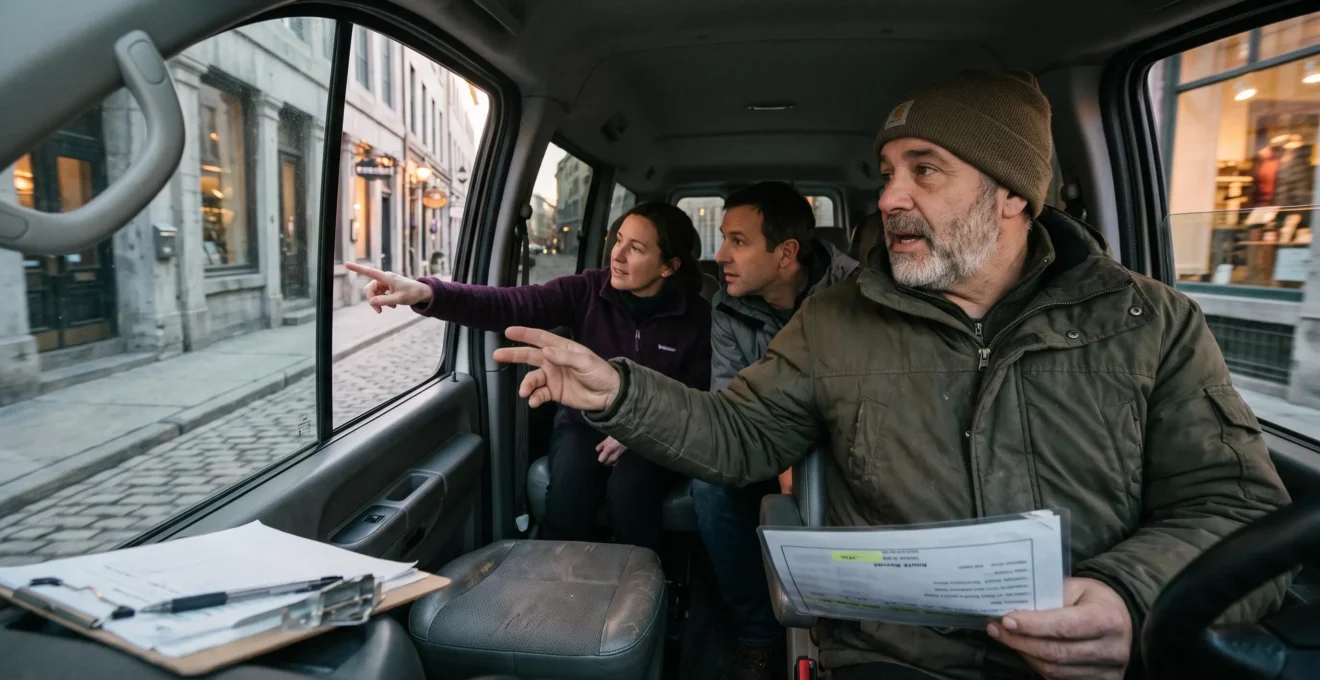
Montréal’s history is not confined to Old Montréal’s stone façades. It continues through the industrial landscapes of the Lachine Canal, the exterior staircases of Plateau Mont-Royal and the infrastructure of the modern metropolis. Travelling between these environments reveals connections that are difficult to recognize when visiting landmarks individually.
A heritage-aware transportation route can turn three hours into a coherent introduction to approximately four centuries of urban development. The essential ingredient is not speed. It is the sequence of places, the explanations connecting them and the opportunity to observe how different historical periods coexist in today’s streets.
The story begins with Indigenous histories that precede the French colonial settlement established in 1642. It then follows the city’s transformation through colonial expansion, industrialization, residential growth and modern urban development. No three-hour experience can cover this history comprehensively, but a thoughtfully narrated route can make its major transitions understandable.
Understanding Montréal’s heritage in three hours
- Combine Old Montréal, an industrial heritage area and Plateau Mont-Royal to connect different chapters of the city’s development.
- Use transportation between neighbourhoods and short walks within them, adapting the balance to weather, mobility and traffic.
- Prioritize historical interpretation and ordinary streets alongside major monuments, rather than treating sightseeing as a checklist.
- Why Old Montréal Looks Nothing Like Plateau Mont-Royal: The 5 Architectural Eras Explained Through Transportation
- How to Route Your Historical Tour: Chronological Story vs. Geographic Efficiency for Landmarks
- When to Walk vs. Ride in Old Montréal: The Weather and Mobility Threshold for 2-Hour Tours
- The Monument-Only Mistake That Misses 80% of Montréal’s Historical Character
- When Historical Tours Come Alive: Montréal’s 6 Annual Heritage Events Worth Timing Your Visit Around
- Old Montréal vs. Plateau Mont-Royal: Which District Delivers the Most “Montréal Character” in 2 Hours?
- Local Driver Stories vs. Pre-Recorded Audio Tours: Which Creates More Memorable Montréal Experiences?
- How Narrated Transportation Tours Reveal the 12 Hidden Stories Behind Montréal’s Landmarks
Why Old Montréal Looks Nothing Like Plateau Mont-Royal: The 5 Architectural Eras Explained Through Transportation
Old Montréal and Plateau Mont-Royal look different because they developed under different economic, political and residential conditions. Old Montréal preserves elements of colonial and institutional architecture, while the Plateau prominently reflects nineteenth- and twentieth-century urban housing. Travelling between them makes these changes visible, although their buildings cannot be divided into perfectly separate historical periods.
A useful sightseeing framework organizes Montréal’s built environment into five broad architectural eras. These are interpretive categories, not an official municipal classification.
| Historical layer | Visual clues | Where to look |
|---|---|---|
| New France and the colonial period | Masonry walls, pitched roofs and relatively restrained façades | Surviving historic buildings and interpreted sites in Old Montréal |
| Nineteenth-century commercial and institutional growth | Decorative stonework, larger windows and substantial commercial façades | Old Montréal’s commercial streets and civic surroundings |
| Late nineteenth- and early twentieth-century residential expansion | Duplexes, triplexes, exterior staircases and repeated façade patterns | Plateau Mont-Royal and other established residential neighbourhoods |
| Industrial and early modern transformation | Brick factories, utilitarian structures, warehouses and industrial infrastructure | Lachine Canal corridor and former manufacturing districts |
| Postwar and contemporary urban development | Larger building volumes, concrete, glass and modern infrastructure | Downtown and major redevelopment areas |
The easiest recognition technique involves three questions: What is the façade made from? How is the roof shaped? Where do residents enter the building? These details reveal differences between residential, commercial and institutional architecture even when a vehicle is moving slowly past.
Travelling north from Old Montréal toward the Plateau also reveals transitional urban landscapes. Downtown commercial development, institutional buildings and increasingly residential streets interrupt any simple chronological sequence. The historic street grid does not suddenly disappear at a single neighbourhood boundary; street widths, building scales and development patterns change across multiple blocks.
Appearance alone cannot establish a building’s age. Old Montréal contains later restorations, reconstructions and historically inspired architecture. Similarly, older buildings elsewhere may have acquired modern façades.
68,500 buildings
The Montréal urban agglomeration’s 34 adopted heritage inventories include 68,500 main and secondary buildings, primarily within a pre-1940 inventory programme. This is not a count of legally protected monuments.
Individual inventory records provide a more reliable method for checking construction periods and architectural characteristics than interpreting style from the street. The sheer scale of the inventory also demonstrates why the city’s heritage extends far beyond its familiar tourist sites.
Once those layers become recognizable, the next challenge is choosing a route that connects them without spending the available three hours repeatedly crossing the same streets.
How to Route Your Historical Tour: Chronological Story vs. Geographic Efficiency for Landmarks
The most effective three-hour Montréal heritage route combines chronological storytelling with geographically efficient travel. A strictly chronological itinerary can require unnecessary backtracking, while a route optimized only for distance may present landmarks without explaining their relationships. A hybrid route uses a few historical anchor points and lets nearby streets supply the connecting evidence.
Two routing approaches offer different benefits, depending on the visitors and the conditions.
| Decision criterion | Chronological routing | Geographic routing |
|---|---|---|
| Historical understanding | Clear founding-to-modernity narrative | Requires additional explanations to connect periods |
| Driving efficiency | May involve backtracking | Groups nearby destinations together |
| First-time visitors | Helps establish a historical framework | Useful when time or stamina is limited |
| Repeat visitors | Good for deeper thematic exploration | Convenient for focused neighbourhood visits |
| Bad weather or traffic | Less flexible when stops are fixed | Easier to adjust around access restrictions |
A hybrid itinerary can be organized around three narrative anchors: early colonial settlement in Old Montréal, nineteenth-century industrialization near the Lachine Canal and later residential growth illustrated by Plateau Mont-Royal. Modern redevelopment becomes part of the story through the connecting journey.
This order provides a meaningful historical progression without claiming that every intermediate street belongs to the same period.
Illustrative three-hour heritage itinerary
In this hypothetical itinerary, visitors spend approximately 50 minutes on Old Montréal’s colonial and archaeological landscape, 40 minutes examining the industrial chapter near the Lachine Canal and 45 minutes discovering the Plateau’s residential heritage.
The remaining 45 minutes are reserved for travel, narration between neighbourhoods and modest scheduling flexibility. These are proposed planning allocations, not verified driving times. Actual feasibility depends on pickup arrangements, traffic, walking requirements and the selected stops.
One hidden weakness of landmark clustering is that it can bypass the ordinary streets where residential and working-class history remains visible. A route that links only major attractions may save time without providing the richer historical perspective visitors expect.
Traffic conditions also matter. A route that seems efficient geographically can be disrupted by construction, festivals, pedestrianization and temporary restrictions. Before committing to a sequence, consult Montréal’s official roadworks and street-closure information and confirm the practical route close to departure.
Five checks before confirming a three-hour heritage route
- Select three historical anchor areas and record one historical question each area should answer.
- Choose the connecting streets and produce an ordered itinerary showing where transport and walking will be used.
- Check the group’s mobility requirements and record suitable drop-off and pickup arrangements.
- Review municipal road restrictions and the applicable event calendar, then note any segments requiring verification or alternatives.
- Allocate the full 180-minute window among interpretation, walking, transfers and a contingency allowance, producing a schedule that totals three hours.
A good itinerary remains flexible. Once the historical sequence is established, walking and riding decisions determine how much of that story visitors can experience comfortably.
When to Walk vs. Ride in Old Montréal: The Weather and Mobility Threshold for 2-Hour Tours
Walking is preferable in Old Montréal when visitors can comfortably navigate uneven surfaces, short distances and changing weather. Riding becomes more useful for longer transfers, winter conditions, intense heat or limited stamina. For most mixed-neighbourhood heritage experiences, combining short walks with transportation offers a more practical balance than insisting on either mode exclusively.
The relevant threshold is not a universal distance or temperature. It is the point at which walking effort begins to reduce the group’s ability to enjoy or understand the heritage being presented.
Old Montréal’s stone surfaces, intersections, narrower streets and occasional changes in grade make street-level exploration rewarding but potentially demanding. Visitors can inspect masonry, interpret façades and experience public spaces at a pace impossible from a vehicle.
However, older street layouts and heritage surfaces are not uniformly accessible. A stroller, wheelchair or mobility aid may encounter uneven paving, raised edges or entrances requiring an alternative approach. Specific routes should be checked rather than assuming an entire neighbourhood is accessible or inaccessible.
Seasonal conditions change the calculation. Winter snow, ice and slush may make prolonged walking uncomfortable or unsuitable for some travellers. Riding protects visitors from extended exposure, although windows, reflections and limited stopping opportunities reduce access to architectural details.
In summer, walking permits closer observation of stonework and street activity, but heat, humidity and pedestrian crowds can reduce comfort. Short, deliberate outdoor stops are often more useful than continuous walking without time to interpret what is visible.
A practical format assigns walking to compact historic areas and riding to connections between distant districts. For instance, visitors might inspect selected streets around Place Royale and the founding-site area on foot, then use transportation for the journey toward later residential or industrial landscapes.
For reduced-mobility visitors, confirm the exact pavement conditions, entry points, accessible vehicle arrangements and feasible stopping locations. Driving past a destination does not automatically guarantee step-free access to its interpretation area.
The difference between two- and three-hour tours is equally important. Two hours can support a focused district experience, while the additional hour may permit a meaningful cross-district comparison. Neither duration guarantees a specific itinerary in adverse conditions.
Comfortable movement creates time for a more important historical question: what should visitors pay attention to beyond the obvious monuments?
The Monument-Only Mistake That Misses 80% of Montréal’s Historical Character
A monument-only itinerary can leave visitors with an incomplete understanding of Montréal because the city’s history also survives in housing, workplaces, streets and neighbourhood businesses. The suggested figure of 80% is an editorial illustration, not a measured share of overlooked heritage. The underlying lesson is that everyday urban environments deserve as much interpretation as celebrated buildings.
Monuments are valuable historical anchors. They identify major events, public institutions and architectural achievements. Yet they tend to highlight the people and activities formally commemorated, rather than the complete social history of a neighbourhood.
To understand how Montréal developed, look for the following overlooked categories:
- Residential architecture: exterior staircases, duplexes, triplexes and shared residential spaces reveal patterns of urban density and domestic life.
- Industrial remains: factory buildings, canal infrastructure and warehouses connect economic development to working-class neighbourhood formation.
- Commercial streets: changing storefronts, older signs and mixed-use buildings offer clues about successive economic activities and communities.
- Religious and communal spaces: churches, schools and neighbourhood institutions illustrate social organization beyond major civic monuments.
- Ordinary urban infrastructure: streets, bridges and former transport corridors show how people, goods and neighbourhoods became connected.
The Lachine Canal provides a particularly useful historical example. Parks Canada documents how canal expansion and increased hydraulic power contributed to Montréal’s industrial growth beginning in the mid-nineteenth century. Manufacturing activity also influenced the development of surrounding working-class neighbourhoods.
According to Parks Canada’s history of industrialization along the Lachine Canal, more than businesses occupied land near the canal 600 over the historical period described. This is a cumulative historical figure, not a count of businesses operating there today.
Such evidence changes how a former industrial building should be interpreted. Its importance does not lie only in its façade. The building belongs to a wider history of transportation, manufacturing, employment and residential settlement.
One way to correct monument-focused sightseeing is the street-to-monument ratio: deliberately devote at least as much attention to the surroundings and connecting streets as to the famous sites themselves. This is a suggested interpretive habit, not a statistically established formula.
During a narrated ride, that might mean explaining how ordinary housing changed as industrial employment expanded, or why the commercial role of a particular street evolved. The time between formal stops becomes part of the historical experience rather than an interruption.
Montréal’s four-century narrative becomes richer when public monuments, industrial heritage and residential streets are understood together. Temporary heritage events can add another dimension by providing access to places or activities unavailable during an ordinary visit.
When Historical Tours Come Alive: Montréal’s 6 Annual Heritage Events Worth Timing Your Visit Around
Heritage events can make Montréal’s history more engaging by adding guided interpretation, exhibitions, cultural programming or temporary access to significant spaces. The best event date is not necessarily the easiest touring date, however. Visitors should compare the historical value of an event with its possible crowds, transportation restrictions and effects on a three-hour itinerary.
Six recurring event programmes or event categories are worth investigating. Their specific dates, activities and availability must be verified for the intended travel year; not every edition necessarily includes heritage programming or access to historic buildings.
| Event or programme | Potential historical value | Planning consideration |
|---|---|---|
| Journées de la culture | Cultural activities and opportunities to learn about local institutions and traditions | Verify participating venues and heritage-related activities |
| Journées du patrimoine religieux | Possible interpretation of religious architecture and community history | Check access conditions and the participating sites |
| Montréal Museums Day | Potential access to museum exhibitions and heritage interpretation | Confirm the current programme and admission arrangements |
| Nuit blanche à Montréal | Artistic and cultural programming that may engage with historic locations | Nighttime schedules and transportation changes may affect the route |
| MONTRÉAL EN LUMIÈRE | Seasonal cultural programming with possible opportunities to connect contemporary urban life and historic settings | Not primarily a heritage event; verify relevant activities before including it |
| Old Montréal seasonal celebrations | Opportunities to experience historic public spaces through seasonal programming | Specific celebrations vary; verify individual organizers and dates |
These six entries form a planning shortlist rather than a guarantee of six dedicated annual heritage festivals. Some emphasize contemporary culture, while others may offer more direct opportunities for historical interpretation.
Event days create a trade-off. A special exhibition or guided opening could justify spending more time at one site, but pedestrian activity, parking constraints and street restrictions might make a normal driving itinerary impractical.
For example, an event near Old Montréal could make a short walking segment more attractive while limiting vehicle access. A sensible adaptation would be to identify a legal pickup or drop-off point outside the affected streets, subject to current restrictions and accessibility needs.
Check the calendar before finalizing the route, not after booking transportation. Consult the City of Montréal, relevant borough information and the organizers’ current programmes to verify dates, opening arrangements, accessibility and any required reservations.
Narrated transportation can help connect activities across different neighbourhoods, but it is not automatically faster or more reliable than public transit during major events. A guided vehicle remains useful only where the actual access and travel conditions support it.
An event can enrich an itinerary, but neighbourhood choice remains the most important decision for travellers with only two hours to experience Montréal’s distinctive identity.
Old Montréal vs. Plateau Mont-Royal: Which District Delivers the Most “Montréal Character” in 2 Hours?
Old Montréal is generally better for visitors seeking recognizable historic institutions, colonial-era settings and major architectural landmarks. Plateau Mont-Royal is better suited to those interested in residential streets, neighbourhood culture and everyday urban life. Neither district represents the whole city: their contrasting environments explain different dimensions of Montréal’s character.
The decision depends first on what the visitor means by Montréal character. That phrase can describe monumental heritage, linguistic and cultural traditions, architecture, public spaces or the lived experience of residential neighbourhoods.
Old Montréal provides prominent historical reference points. Its surviving buildings, street patterns, institutions and interpreted archaeological sites make it easier to explain the early colonial city’s development. For someone unfamiliar with Montréal, these environments establish a useful geographical and historical starting point.
The Plateau tells another story. Its residential architecture and commercial streets reveal how Montréal developed beyond the colonial core. Exterior staircases, tightly arranged dwellings and neighbourhood institutions provide a visible introduction to urban domestic life.
The two districts also create different experiences. Busy sections of Old Montréal can attract substantial tourist activity, particularly around major attractions. The Plateau contains quieter residential streets, although its commercial corridors and popular public spaces can also be lively.
| Visitor priority | Old Montréal | Plateau Mont-Royal |
|---|---|---|
| Historical focus | Colonial, institutional and commercial heritage | Residential, social and neighbourhood development |
| Architectural appeal | Stone façades, historic commercial buildings and civic settings | Duplexes, triplexes, staircases and traditional streetscapes |
| Interpretation style | Major sites with identifiable historical reference points | Patterns of everyday life and urban change |
| Atmosphere | Prominent visitor attractions and historic public spaces | Residential streets alongside active cultural and commercial corridors |
| Potential limitation | May feel focused on curated tourist landmarks | Requires stronger narration to connect the area with Montréal’s earliest history |
A two-question self-test clarifies the choice. First, would learning about major institutions be more satisfying than seeing how people lived in changing neighbourhoods? Second, is the desired experience closer to a historic postcard or an active residential environment?
Visitors who choose institutions and recognizable landmarks will probably favour Old Montréal. Those drawn to daily-life architecture and neighbourhood culture may prefer the Plateau.
However, the contrast between the districts is itself a historical lesson. Old Montréal shows important elements of the city’s early institutional and commercial development; the Plateau illustrates how urban life subsequently expanded into residential neighbourhoods.
For a three-hour cross-district itinerary, the objective changes from choosing one district to interpreting their relationship. Whether that connection feels meaningful depends substantially on the quality of narration.
Local Driver Stories vs. Pre-Recorded Audio Tours: Which Creates More Memorable Montréal Experiences?
Local driver narration is better suited to visitors who want questions answered and historical explanations adapted to changing surroundings. Pre-recorded audio is preferable when consistency, language selection and predictable content matter more. Neither format guarantees a memorable experience; historical accuracy, timing and storytelling quality are more important than whether the narration is live or recorded.
A pre-recorded audio tour offers a repeatable script. The same location can receive a consistent description across multiple visits, potentially in several languages. Audio formats may also be available at a lower price, depending on the tour product.
The main weakness is synchronization. Traffic, temporary detours or unexpected stops can separate the explanation from the feature being described. Passengers might hear about a façade after the vehicle has already passed it.
A knowledgeable local driver or guide can adapt to those changes, directing attention to something visible at that precise moment. Questions can also reshape the discussion. Someone curious about immigrant communities might receive additional context about neighbourhood commerce, while an architecture enthusiast could ask about building materials or residential layouts.
Personal recollections add another dimension. A driver describing a childhood neighbourhood or family migration experience can connect the contemporary city with broader patterns of social change.
Such stories can make history feel more personal, but their effect on memory should be treated as a plausible interpretive benefit rather than a proven performance advantage of driver narration over audio tours.
There is also an important distinction between oral testimony and verified historical evidence. A driver’s personal memory may be valuable as an individual account without establishing a complete or representative history of the neighbourhood.
The same caution applies to historical accuracy. Improvised narration can drift into uncertain dates, exaggerated anecdotes or inherited local myths. A strong guide distinguishes personal experience from documented facts and acknowledges uncertainty when appropriate.
Before choosing either format, examine whether the experience provides:
- Clear information about the guide’s historical knowledge or training.
- Reviews that discuss the quality and specificity of storytelling.
- Opportunities to ask questions or clarify unfamiliar historical references.
- Reliable narration synchronized with the locations being visited.
- Suitable language, hearing accessibility and group arrangements.
For a three-hour route spanning several historical periods, the ability to answer a question such as “What happened to this neighbourhood afterwards?” has particular value. It allows one period to lead naturally into another rather than treating each landmark as an isolated story.
The strongest storytelling format ultimately makes the next street or landmark easier to understand. That becomes especially important when visible architecture conceals historical layers that visitors would otherwise overlook.
Key takeaways before choosing a narrated heritage experience
- Ask whether the route explains what existed before today’s landmarks, not merely when the current buildings were constructed.
- Look for narration that connects economic, residential and cultural changes across multiple districts.
- Value evidence-based explanations and questions over an impressive number of landmarks or anecdotes.
How Narrated Transportation Tours Reveal the 12 Hidden Stories Behind Montréal’s Landmarks
Narrated transportation tours reveal Montréal’s less obvious history by connecting visible streets and buildings with earlier uses, vanished infrastructure and the people who shaped them. The twelve stories below are illustrative interpretive themes, not an official classification or a verified inventory of discoveries. Their value lies in showing how historical meaning extends beyond what a landmark’s appearance immediately reveals.
Consider these twelve opportunities for deeper historical interpretation:
- Indigenous history before colonial Montréal: understanding that the city’s history predates the French settlement of 1642.
- The colonial settlement: examining the relationship between the founding area and Montréal’s early urban development.
- The fur-trade economy: connecting commercial growth with regional exchange networks and transportation routes.
- The former city walls: understanding how a fortified colonial settlement expanded beyond its earlier boundaries.
- Buried waterways: discovering how former watercourses and later infrastructure survive beneath the modern city.
- Religious and institutional influence: examining the role of major institutions in shaping the built environment.
- Harbour activity: relating waterfront commerce, shipping and transport infrastructure to urban growth.
- Industrial manufacturing: understanding how the Lachine Canal supported Montréal’s industrial development.
- Working-class housing: examining the relationship between employment centres and nearby residential neighbourhoods.
- Immigrant commercial life: considering how successive communities shaped neighbourhood businesses and street culture.
- Changing residential architecture: reading exterior staircases, building density and house forms as evidence of urban development.
- Modern redevelopment: exploring how changing infrastructure and land uses transformed earlier industrial and commercial areas.
Several of these stories can be connected to material evidence rather than anecdote alone. Montréal’s municipal archaeological documentation identifies remains of fortifications erected in 1717 at Champ-de-Mars. It also describes archaeological evidence presented at Pointe-à-Callière, including historic infrastructure associated with the Saint-Pierre River.
These examples are documented in Montréal’s official archaeological sites overview. Some remains are accessible through museum spaces or designated interpretation areas, not simply from a vehicle window.
That distinction illustrates the difference between identifying a historical location and fully experiencing its evidence. Narration can explain what once stood near a street, while a carefully chosen walking or museum stop may be necessary to inspect the surviving remains.
Champ-de-Mars: the city beneath the present-day landscape
At Champ-de-Mars in Old Montréal, archaeological excavation revealed a significant section of fortifications erected in 1717. The remains have been presented in situ, providing physical evidence of the fortified colonial city.
For heritage interpretation, this offers a documented way to explain a former defensive landscape that cannot be understood solely from surrounding modern streets. The archaeological evidence establishes the historical layer; it does not imply that the entire site can be interpreted from inside a moving vehicle.
A layered approach can transform a familiar stop. Take Pointe-à-Callière as an example. A conventional landmark description might identify its location at Montréal’s founding site and its role as an archaeology and history museum. A deeper interpretation asks what earlier occupations are represented, how the area’s urban functions changed and why surviving archaeological infrastructure matters.
Both approaches are useful, but the second creates historical continuity. The present-day institution becomes an entry point into multiple periods rather than an isolated destination.
This is where narrated transportation offers a particular interpretive opportunity. When passengers see street patterns, masonry, industrial buildings or changes in the urban landscape while hearing the relevant explanation, the relationship between past and present becomes immediate.
Yet not every story is visible through a window, and not every driver is a qualified historical guide. Effective interpretation requires suitable pacing, reliable information and occasional stops where the material evidence merits closer attention.
Three hours cannot exhaust Montréal’s 400-year colonial and urban history, much less its earlier Indigenous histories. It can, however, provide a coherent historical framework that helps visitors understand why different neighbourhoods look, function and feel the way they do.
Before selecting a narrated Montréal heritage tour, ask for the proposed neighbourhood sequence, the balance between riding and walking, accessibility arrangements and examples of the historical stories included. A route that connects evidence, places and lived experience offers a stronger introduction to the city than a simple collection of sightseeing stops.
Can a three-hour tour really cover 400 years of Montréal history?
A three-hour tour can introduce major historical transitions from the French colonial settlement through industrialization and modern urban development. It cannot comprehensively cover every period, community or neighbourhood. The strongest experience uses a few historically significant areas to establish connections between periods while acknowledging Montréal’s earlier Indigenous histories.
Where should a first-time visitor begin a Montréal heritage tour?
Old Montréal offers a practical starting point because the founding-site area, historic streets and archaeological interpretation establish important early chapters of the city’s development. From there, an itinerary can connect later industrial or residential districts according to available time and traffic conditions.
Are historic buildings in Old Montréal always older than those in the Plateau?
No. The districts have different historical development patterns, but building ages overlap. Old Montréal contains later construction and historically inspired restorations, while the Plateau preserves buildings from several periods. Individual municipal heritage records provide a more reliable basis for identifying construction dates than architectural appearance alone.
Does a narrated driving tour eliminate the need to walk?
Not necessarily. Driving helps connect dispersed heritage areas, but walking makes it easier to examine architectural details, interpret archaeological sites and experience historic public spaces. A mixed itinerary is often preferable, with specific walking segments assessed for weather, surface conditions and accessibility.
How can visitors verify the historical accuracy of a local tour?
Ask whether the guide relies on documented historical sources, distinguishes personal stories from established facts and can explain uncertainty around dates or building histories. Montréal’s municipal heritage inventories, archaeological documentation and Parks Canada’s interpretation of the Lachine Canal provide useful reference points for checking important claims.