
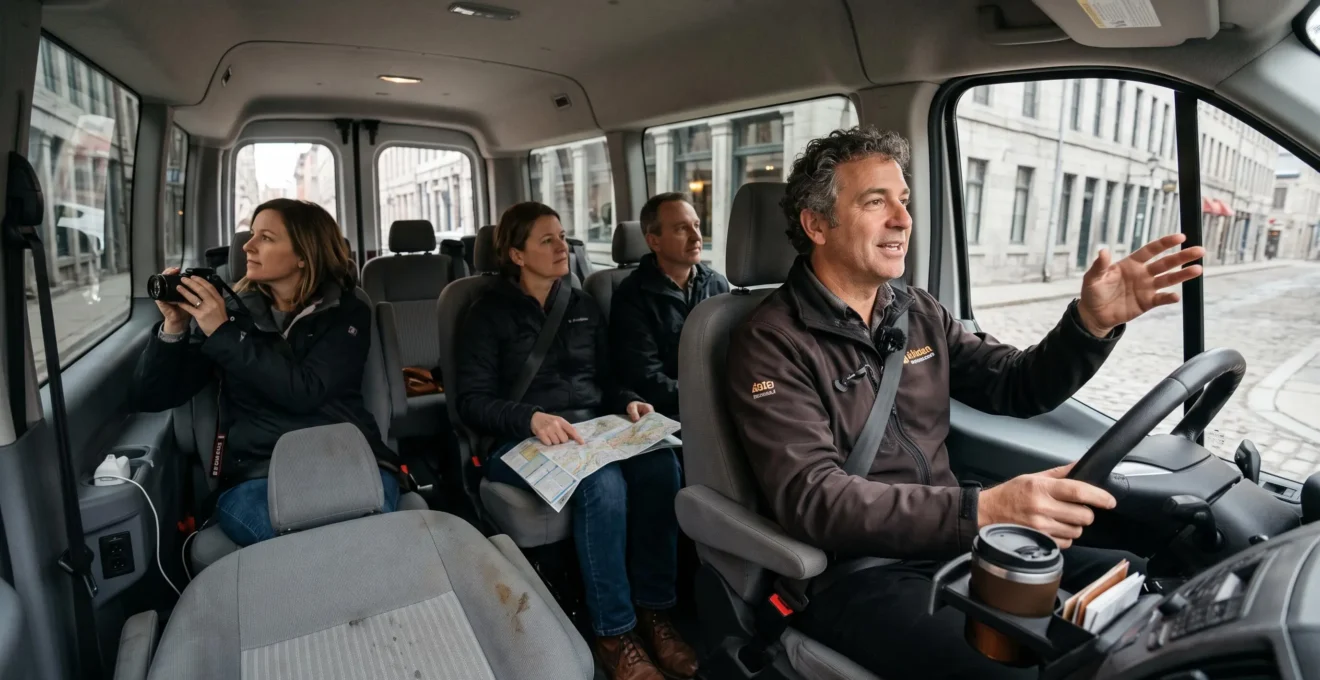
Montréal’s landmarks reveal more than their architecture. Behind the stone façades of Old Montréal, the outdoor staircases of the Plateau, and the neighbourhood streets of Mile End are stories about settlement, cultural identity, urban transformation, and everyday life. Yet travellers moving independently between attractions can encounter these places without discovering what makes them significant.
Narrated transportation tours connect the journey with the interpretation. Instead of treating movement between landmarks as wasted time, a knowledgeable driver-guide or dedicated narrator uses the route to explain the city’s development, neighbourhood contrasts, and local traditions. A well-designed tour can introduce a dozen meaningful historical and cultural stories without requiring twelve separate stops.
The experience depends on more than the vehicle. Route design, narration quality, photo-stop timing, and access to pedestrian-priority streets all influence whether visitors leave with an understanding of Montréal or simply a collection of photographs.
Montréal Narrated Sightseeing: The Essentials
- Combining transport and sightseeing can reduce unnecessary transfers while turning travel time into meaningful cultural exploration; the actual savings depend on the itinerary.
- Old Montréal provides architectural and historical context, while Plateau-Mont-Royal and Mile End reveal residential character and contemporary cultural life.
- The strongest tours balance knowledgeable narration, practical routing, carefully chosen photo stops, and confirmed pickup arrangements.
- Why Combining Transportation and Sightseeing Saves Time Compared to Separate Tour Bookings
- How to Choose Between a 4-Hour Highlights Tour and an 8-Hour Deep-Dive Montréal Experience
- Old Montréal vs. Plateau Mont-Royal: Which District Delivers the Most “Montréal Character” in 2 Hours?
- The Photo Stop Mistake That Left Tourists With 47 Blurry Pictures and Zero Understanding
- When to Schedule Your Montréal Photo Tour: The Golden Hour and Crowd-Avoidance Strategy
- Local Driver Stories vs. Pre-Recorded Audio Tours: Which Creates More Memorable Montréal Experiences?
- How to Route Your Historical Tour: Chronological Story vs. Geographic Efficiency for Landmarks
- How Attraction-Focused Transportation Eliminates the 3 Logistics Headaches at Montréal’s Top Sites
Why Combining Transportation and Sightseeing Saves Time Compared to Separate Tour Bookings
Combining sightseeing and transportation can save time by removing unnecessary transfers between separately booked experiences. A continuous guided route also reduces repeated meeting-point arrangements and allows narration to continue between attractions. However, the savings depend on the number of destinations, their locations, traffic conditions, and the time each individual visit requires.
Consider a visitor arranging separate tours of Old Montréal and Plateau-Mont-Royal. The first experience might end near the Old Port, while the second begins at a different meeting point farther north. That creates a transfer, a possible waiting period, and another departure procedure.
A combined narrated tour can connect both neighbourhoods directly, using the journey to introduce their contrasting identities.
The advantage is not simply faster driving. It comes from eliminating movements that exist only because two experiences were booked independently.
Three potential sources of savings deserve attention:
- Fewer connecting journeys: a continuous itinerary can avoid unnecessary returns to separate starting locations.
- Less scheduling friction: travellers do not need to coordinate multiple departure times and meeting points.
- Productive transfer time: narration gives cultural meaning to the journeys between landmarks.
These advantages are not automatic. A guided vehicle may encounter congestion, take a less direct route to accommodate sightseeing, or require a longer walk to reach pedestrianized attractions.
To estimate the difference, list the attractions and compare the full duration of the independently booked itinerary with that of the continuous tour. Include walking to meeting points, expected waiting periods, transfers, and the actual time spent visiting attractions.
The ARTM‘s Chrono transportation planning application can help travellers assess public transportation connections, service information, and journey options across Greater Montréal. It does not predict private sightseeing vehicle travel times.
Hypothetical comparison: two Montréal sightseeing plans
Imagine two visitors planning the same historical and neighbourhood experiences. One books separate guided visits requiring independent transfers. The other books a continuous narrated route covering the same locations.
To compare them fairly, both visitors should add departure logistics, transport connections, waiting periods, sightseeing duration, and return arrangements. The difference between those totals represents the estimated logistical time saving, rather than an assumed three-hour advantage.
There is also an important distinction between saving time and making better use of it. A narrated journey might not be dramatically shorter, but the visitor continues learning while travelling rather than treating each transfer as an interruption.
Once the transfer benefits are understood, the more important decision becomes how much time to devote to the city’s stories.
How to Choose Between a 4-Hour Highlights Tour and an 8-Hour Deep-Dive Montréal Experience
A four-hour Montréal tour generally suits visitors seeking an introduction to recognizable attractions, while an eight-hour experience allows more neighbourhood exploration and time for cultural interpretation. Neither format is automatically superior. The better choice depends on the traveller’s historical interests, walking tolerance, available vacation time, and the actual itinerary offered by the operator.
A short highlights-focused route might feature Notre-Dame Basilica, Place d’Armes, Place Jacques-Cartier, and the Old Port. The narrator can introduce the historical significance of each landmark while connecting the district’s architecture to the city’s development.
An extended experience creates room for different aspects of Montréal, including Plateau-Mont-Royal’s residential streets, artistic culture, and the distinctive food and commercial environments associated with Mile End.
The practical differences become clearer when comparing typical itinerary priorities rather than assuming that every operator offers identical coverage.
| Decision factor | 4-hour highlights format | 8-hour deep-dive format |
|---|---|---|
| Primary objective | Recognize major landmarks and understand their basic context | Connect historical attractions with broader neighbourhood culture |
| Typical emphasis | Old Montréal and central landmarks | Historic sites plus areas such as the Plateau and Mile End |
| Walking and standing | Potentially easier to manage with fewer stops | More demanding if the itinerary includes extended walking |
| Historical interpretation | Concentrated overview | More opportunities for questions and thematic connections |
| Best fit | Short stays and first-time orientation | Travellers seeking deeper cultural context |
An often-overlooked concern is information fatigue. Longer narration does not necessarily produce stronger memories. After several hours of listening, even enthusiastic visitors can struggle to distinguish one historical episode from another.
A thoughtful longer tour therefore alternates narration with independent observation, quieter journeys, food breaks, and photo stops. Ask whether the itinerary contains genuine breaks rather than uninterrupted commentary.
Winter changes the calculation. Heated transportation can make movement between attractions more comfortable, especially when outdoor walking and photography periods are deliberately managed. However, shorter daylight hours also constrain the schedule.
Travellers with limited mobility should request the precise walking requirements for either format, including steps, uneven pavement, and the distance between permitted vehicle stops and attraction entrances.
Duration determines how widely a tour can explore, but the character of the neighbourhoods selected ultimately determines what the visitor discovers.
Old Montréal vs. Plateau Mont-Royal: Which District Delivers the Most “Montréal Character” in 2 Hours?
Old Montréal delivers a concentrated introduction to the city’s historic architecture and recognizable landmarks, while Plateau-Mont-Royal reveals residential design, contemporary cultural identity, and everyday neighbourhood life. For a two-hour experience, choose Old Montréal for heritage-focused sightseeing or the Plateau for urban culture. A combined route works best when the contrast itself becomes the central story.
These neighbourhoods express different dimensions of Montréal rather than competing definitions of what makes the city authentic.
Old Montréal tells the story of the historic city. Its stone buildings, cobblestoned streets, religious landmarks, and waterfront setting provide opportunities to explore the development of the settlement established as Ville-Marie in the seventeenth century.
A visitor standing near Place d’Armes can consider the relationship between public spaces, religious institutions, commercial activity, and Montréal’s changing urban identity.
The Tourisme Montréal overview of Old Montréal describes the area’s historic architecture, cobblestoned streets, waterfront setting, and contemporary cultural attractions.
The Plateau offers a different set of narratives. Outdoor spiral staircases, residential streets, parks, cafés, murals, and independent businesses reveal how Montréal’s urban culture is expressed beyond its monumental architecture.
A narrator can use those everyday details to discuss housing forms, local artistic expression, neighbourhood identity, and the relationship between residential and commercial streets.
For visitors fascinated by ordinary urban life, the Plateau may communicate more through its streets than a succession of famous monuments.
Logistics also affect the experience. In Old Montréal, narrow streets and pedestrian-priority areas can limit where vehicles approach attractions. In the Plateau, residential street patterns and seasonal pedestrianization can make carefully selected stops preferable to repeated short vehicle movements.
A hybrid itinerary introduces a particularly effective narrative: begin with the historic settlement and its surviving urban fabric, then travel toward neighbourhoods illustrating different periods and expressions of Montréal life.
That contrast creates a coherent journey from the city’s historical foundations toward its contemporary cultural landscape.
For a strict two-hour schedule, however, combining both districts reduces the time available for walking, photography, and local observations. Visitors should decide whether they prefer depth within one neighbourhood or a broader introduction with fewer stops.
Whichever district takes priority, the strongest experience gives visitors more than photogenic streets: it explains what they are looking at and why it matters.
The Photo Stop Mistake That Left Tourists With 47 Blurry Pictures and Zero Understanding
The biggest sightseeing photo mistake is stopping at a famous location without understanding its significance. A visitor may collect dozens of images yet remember little about the buildings, people, or events represented. A meaningful photo stop combines an intentional viewpoint, suitable lighting, and a short explanation that connects the visible landmark to Montréal’s history or culture.
Imagine a hypothetical visitor returning from a tour with 47 photographs of unfamiliar façades. Some are blurred, others show crowded squares, and several could have been taken in any historic North American city.
The technical quality of those pictures matters less than their missing context.
A photograph of Notre-Dame Basilica becomes more memorable when the visitor understands why the building occupies such a prominent place within the historic city. A Plateau staircase becomes more interesting when its architectural form is connected to local residential streets and urban life.
A narrative photo stop has three essential components:
- A viewpoint that reveals a distinctive visual feature of the landmark.
- An explanation identifying what makes that feature historically or culturally meaningful.
- Enough time to observe and photograph without rushing back into the vehicle.
Timing is equally important. At Place Jacques-Cartier, visitor activity may compete with architectural photography during busy periods. Around Notre-Dame Basilica, entrance activity and local events can change the atmosphere throughout the day.
A knowledgeable narrator should therefore offer alternative viewpoints when a familiar photo location becomes crowded or visually obstructed.
The opposite mistake is arranging too many photo stops. Repeatedly interrupting the journey can fragment the narrative, increase the time spent boarding and exiting the vehicle, and leave little opportunity to connect successive stories.
A practical approach is to select a small number of narrative anchor stops. Each should represent a different aspect of the city: historical foundations, architectural change, cultural expression, or neighbourhood life.
Between those anchors, the narrator can explain landmarks visible through the windows without requiring another stop.
Even the best-chosen locations benefit from careful scheduling, because Montréal’s light and visitor activity change considerably throughout the year.
When to Schedule Your Montréal Photo Tour: The Golden Hour and Crowd-Avoidance Strategy
The best time for a Montréal photo tour depends on the season, the orientation of the buildings, and the expected activity around each attraction. Golden-hour light can enhance historic stone architecture, but favourable lighting does not guarantee quiet streets. Effective scheduling balances sunlight, visitor concentrations, attraction access, and the travel time between planned photographic locations.
Golden hour refers to the period of low-angle sunlight around sunrise or sunset. Its exact timing varies by date, and surrounding buildings can block the sun before the official sunset.
Montréal’s historic streets present an additional challenge: adjacent façades may face different directions or sit in the shadow of taller structures. A route designed for photography should therefore consider the orientation of individual streets rather than treating the entire district as equally illuminated.
Morning may favour one façade while late-afternoon light produces stronger texture on another.
The seasonal differences are particularly important:
- Summer: longer daylight hours provide flexibility, but popular visitor areas may become busier during peak sightseeing periods.
- Autumn: changing foliage and lower sun angles create opportunities for combining neighbourhood scenery with architectural photography.
- Winter: shorter days compress the available daylight, while snow and low-angle sunlight can create distinctive contrasts against stone buildings.
- Spring: changing weather and variable daylight make flexible routes and sheltered alternatives useful.
The ideal schedule also depends on the visitor’s photographic priorities. Someone hoping to photograph recognizable landmarks with fewer people may favour quieter periods even when the lighting is less dramatic.
A traveller seeking warm light across cobblestoned streets may accept a busier location in exchange for stronger visual atmosphere.
Before selecting a departure time, check the opening hours of attractions requiring interior visits. A perfectly timed outdoor photo route loses value if it reaches a scheduled interior attraction after admission has ended.
Also ask the operator whether large group arrivals, special events, or temporary street restrictions are expected to affect the proposed route.
A useful itinerary alternates between locations selected for light and locations selected for their narrative importance. This avoids making the entire tour dependent on a single weather condition.
Photography becomes even more meaningful when the person leading the tour can explain what a landmark represents rather than merely announcing its name.
Local Driver Stories vs. Pre-Recorded Audio Tours: Which Creates More Memorable Montréal Experiences?
Local driver narration offers personal anecdotes, spontaneous explanations, and responses to travellers’ questions, while pre-recorded audio delivers more consistent content and potentially broader language availability. Neither format guarantees a memorable experience. The best choice depends on whether visitors value interaction and local perspectives or prefer structured, predictable interpretation in a language they understand comfortably.
Imagine a tour passing through Plateau-Mont-Royal during a neighbourhood event. A knowledgeable local narrator may explain how that event relates to the community, describe changes to the street, or answer a passenger’s question about nearby buildings.
A pre-recorded recording cannot necessarily respond to the same circumstances. Its strength lies elsewhere: the information can be prepared, standardized, and delivered consistently when the playback system is functioning as intended.
For an international visitor, audio available in a familiar language may be more useful than live commentary delivered too quickly to follow.
The strengths of each format are therefore complementary.
| Experience factor | Local driver or guide | Pre-recorded audio |
|---|---|---|
| Questions | Can respond to passengers directly | Typically follows fixed content |
| Unexpected events | Can adapt explanations to current circumstances | May not reflect recent changes |
| Language options | Depends on the narrator’s abilities | May support multiple recorded languages |
| Local perspective | Can include personal observations and lived experiences | Usually relies on prepared interpretation |
| Consistency | Varies with experience and communication skills | More consistent across departures |
What distinguishes a strong local guide is the ability to connect factual history with ordinary urban experiences.
A narrator might explain the pronunciation of a French street name, describe the neighbourhood’s cultural significance, or relate how an architectural feature shapes everyday Montréal life.
Personal recollections can enrich that explanation, but they should be distinguished from established historical facts.
Not every driver is a trained narrator. A transportation service offering occasional commentary may provide a different experience from a dedicated guided sightseeing tour.
Before booking, ask whether the operator supplies a qualified guide, a driver-guide, or pre-recorded audio. Confirm the available narration languages and whether passengers can ask questions during the journey.
For visitors choosing live narration, it is also worth establishing whether commentary takes place during safe driving conditions or is delivered by a separate guide.
Once the narration format is chosen, the order in which the city’s stories unfold becomes the next important design decision.
How to Route Your Historical Tour: Chronological Story vs. Geographic Efficiency for Landmarks
A chronological Montréal tour organizes landmarks around historical developments, while a geographically efficient tour minimizes unnecessary movement between destinations. These priorities can conflict because locations associated with different eras are not arranged in a perfect historical sequence. A hybrid approach usually works best: optimize the physical route while allowing the narrator to present a coherent chronological storyline.
Montréal provides a useful example because many sites associated with its early urban development are concentrated in Old Montréal, while other neighbourhoods reveal subsequent transformations and contemporary cultural life.
The historic district offers opportunities to discuss the founding of Ville-Marie, colonial-era urban development, religious institutions, trade, and the evolving relationship between the city and its waterfront.
Pointe-à-Callière, Place Royale, and the surrounding historic streets can be connected through a narrative about the origins of the settlement and the city’s later development.
Travelling onward toward Plateau-Mont-Royal or Mile End introduces different architectural forms, cultural environments, and neighbourhood identities.
However, the physical route does not necessarily mirror the dates of the events being described.
The solution is to separate narrative sequence from vehicle sequence. A guide can introduce an earlier historical episode while travelling toward a later landmark, then return to the appropriate period when explaining the next destination.
Good signposting helps visitors follow those transitions. Phrases such as “Earlier in the city’s development” or “Several generations later” can establish the historical relationship without requiring vehicles to retrace streets unnecessarily.
The most useful route is therefore not always the one with the shortest driving distance. It is the route that balances accessible landmarks, interpretive coherence, reasonable travel time, and sufficient opportunities for observation.
A visitor should request the proposed stop sequence before booking and check whether the operator can explain why those destinations appear in that order.
Five Steps to Evaluate a Montréal Narrated Tour Before Booking
- Identify your priorities: write down three to five landmarks or neighbourhood themes you want to explore. Deliverable: a personal sightseeing shortlist.
- Request the complete stop sequence: ask the operator for planned attractions, approximate walking requirements, and anticipated pickup locations. Deliverable: an itinerary with identifiable stops.
- Check the narrative structure: determine whether the tour follows historical chronology, geographical efficiency, or a hybrid approach. Deliverable: a brief explanation of the route’s organizing logic.
- Confirm narration and photo arrangements: establish who provides commentary, in which language, and where dedicated photography stops occur. Deliverable: a confirmed list of interpretation and photo opportunities.
- Verify operational details: check departure arrangements, attraction admission requirements, expected breaks, and the operator’s plan for access restrictions. Deliverable: a practical booking checklist with no unresolved essential questions.
These checks also help distinguish a carefully curated cultural experience from ordinary transportation marketed as a sightseeing tour.
Even an expertly designed historical itinerary needs reliable access arrangements so that logistics do not interrupt the stories visitors came to discover.
Key Takeaways Before Booking
- Ask for specific pickup and drop-off locations, especially where historic streets have pedestrian-priority measures.
- Confirm whether attraction admissions, walking transfers, breaks, and vehicle waiting arrangements are included in the experience.
- Check the operator’s contingency plan for festivals, temporary street closures, and changes to the intended route.
How Attraction-Focused Transportation Eliminates the 3 Logistics Headaches at Montréal’s Top Sites
Attraction-focused transportation can reduce three recurring sightseeing problems: finding parking near busy landmarks, coordinating transfers with scheduled attraction visits, and carrying personal belongings between stops. A dedicated vehicle simplifies these tasks when the operator manages access and timing effectively. However, pedestrian-priority streets, special events, and vehicle security policies can limit these advantages.
In Old Montréal, transportation logistics require particular attention because the historic district combines narrow streets, popular attractions, and changing arrangements for pedestrian and vehicle access.
The City of Montréal‘s Old Montréal pedestrian-priority project describes changes being introduced progressively between 2024 and 2030.
The municipality identifies the pedestrianization of Notre-Dame Basilica’s esplanade in September 2024 and changes affecting streets and parking arrangements within the project area. The programme does not mean every street in Old Montréal is permanently closed to vehicles.
For tour passengers, this distinction matters. An operator may be able to approach the district while still needing to arrange a permitted drop-off away from the attraction entrance.
The first logistical headache is parking and vehicle access. Visitors using their own cars must independently identify suitable parking arrangements, while passengers on a dedicated tour can generally leave the route-planning responsibility to the operator.
The second is coordinating arrival times with attraction visits. A guided transportation provider may organize the travel sequence around planned admission windows, although visitors should confirm whether admission tickets and reservations are included.
The third is managing belongings. A dedicated vehicle can potentially serve as a temporary base for coats, shopping bags, and items that are not needed during short sightseeing stops.
This convenience should never be interpreted as a guarantee of secure storage. Passengers need to confirm whether belongings may remain onboard, whether the vehicle stays attended or locked, and what responsibility the operator accepts for stored items. Valuables should generally remain with the traveller.
Festivals and temporary street closures introduce another limitation. Major events can change access arrangements, and an operator may need to substitute a stopping location or adjust the route.
A vehicle that simplifies one part of the journey can become less convenient if its passengers must walk farther than expected to a historic attraction.
Before booking, ask one particularly useful question: “Where exactly will the vehicle drop us off and pick us up at each attraction, and what happens if that location becomes unavailable?”
A clear answer demonstrates that the transportation provider has considered practical access rather than assuming that driving directly to every landmark will always be possible.
Ultimately, efficient attraction logistics contribute to the cultural experience itself. Time and attention no longer consumed by repeated navigation decisions can instead be devoted to the explanations, questions, and observations that make the journey meaningful.
Before reserving, request a written itinerary identifying the narration format, confirmed pickup arrangements, expected walking distances, and planned landmark stops. The right Montréal tour should make both the journey and the city’s stories easier to understand.
Do narrated transportation tours include admission to Montréal attractions?
Not necessarily. A narrated tour may include exterior sightseeing, photo stops, guided walks, or interior attraction visits depending on its itinerary. Travellers should ask whether admission fees, timed reservations, and guided interior access are included before booking.
Are narrated Montréal tours suitable for visitors with limited mobility?
Some vehicle-based tours can reduce walking between attractions, but accessibility depends on the vehicle, boarding arrangements, walking requirements, and permitted stopping points. Historic streets may have uneven surfaces. Ask the operator about wheelchair accommodation, steps, walking distances, and accessible pickup locations.
Can visitors experience both Old Montréal and Plateau-Mont-Royal in one narrated tour?
Yes, a combined itinerary can introduce both districts when sufficient time is allocated for travel and observation. Old Montréal emphasizes historic architecture and major landmarks, while the Plateau provides insight into residential streets and contemporary cultural life. The depth of the experience depends on its duration and number of stops.
Are narrated sightseeing tours available in both English and French?
Language availability varies by operator and departure. Some experiences may offer live English or French narration, bilingual commentary, or recorded audio in multiple languages. Confirm the specific language of the booked departure rather than assuming every tour provides both.
What should visitors do if weather or street closures affect their planned tour?
Contact the operator to confirm whether the route, stops, or departure arrangements have changed. Ask about sheltered alternatives, adjustments to outdoor photo stops, and the provider’s rescheduling or cancellation conditions. Special events and pedestrian-access changes may require a different meeting point or landmark sequence.