
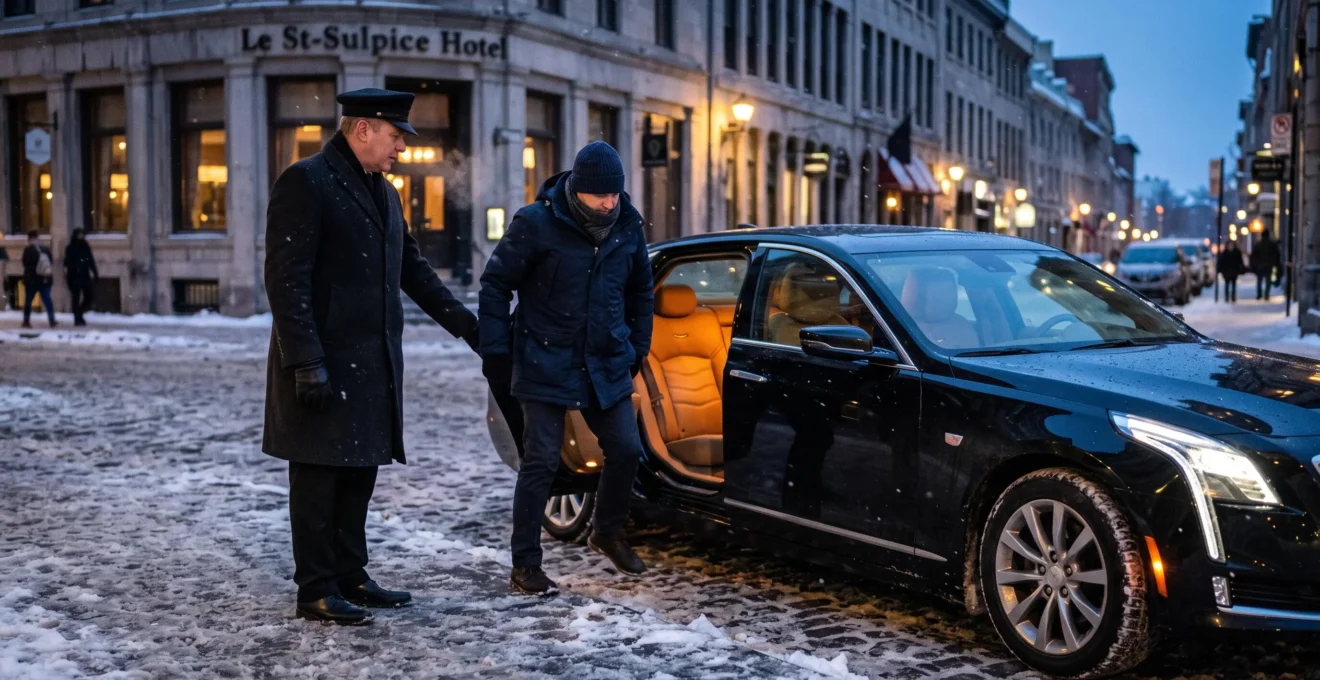
The difference between arriving somewhere and experiencing the journey begins before the vehicle moves. A chauffeur opens the door, the noise of the street fades, and the cabin welcomes passengers with carefully chosen materials, comfortable seating, and lighting that changes the atmosphere of the evening. Transportation becomes more than the distance between two addresses.
For an anniversary in Old Montreal, a milestone birthday, or a formal gala, these details influence how the occasion feels. A quiet sedan encourages conversation and intimacy. A limousine creates room for shared celebration. Neither produces a memorable experience automatically; the vehicle, chauffeur, itinerary, and occasion need to complement one another.
Montreal adds its own considerations. Winter weather, historic streets, seasonal events, and busy downtown pickup areas make practical preparation as important as appearance. Understanding which comforts genuinely improve the ride helps distinguish worthwhile luxury from expensive decoration—and turns a transportation booking into an intentional part of the celebration.
What Makes Luxury Transportation Worth Remembering?
- Genuine luxury is experienced through acoustic comfort, seating, climate control, tactile materials, and attentive chauffeur service—not appearance alone.
- The right vehicle depends on the atmosphere: a sedan provides discreet intimacy, while a stretch limousine creates a shared social occasion.
- Vehicle condition, booking details, winter readiness, and event coordination matter more than choosing the highest advertised price.
- Why Luxury Vehicle Interiors Feel Different: The 7 Sensory Elements You’re Actually Experiencing
- How to Choose Luxury Vehicles for Anniversaries, Proposals, and Once-in-a-Lifetime Events
- Luxury Sedan vs. Stretch Limousine: Which Creates the Experience You Actually Want?
- The Luxury Mistake Where “More Expensive” Felt Tacky Instead of Tasteful
- When to Book Luxury Vehicles for New Year’s Eve, Grand Prix, and Major Galas: The 4-Week Rule
- Why “Leather Seats” in a $60 Sedan Feel Nothing Like $120 Luxury Vehicle Leather
- Why a Mercedes S-Class Costs $95 While a Lincoln Navigator Costs $145: Vehicle Class Value Breakdown
- What Justifies Luxury Vehicle Rates: The 12 Comfort and Prestige Features You’re Actually Paying For
Why Luxury Vehicle Interiors Feel Different: The 7 Sensory Elements You’re Actually Experiencing
Luxury vehicle interiors feel different because several sensory details work together: seat materials, ambient lighting, acoustic insulation, scent and air quality, suspension comfort, climate control, and tactile finishes. These elements influence how passengers experience the journey. Their combined effect matters more than decorative extravagance, although the quality and availability of each feature depend on the specific vehicle.
The first layer is seating material and craftsmanship. Leather texture, stitching consistency, cushioning, and seat shape determine what passengers feel throughout the ride. Decorative stitching may look appealing, but supportive seat architecture matters more after an extended journey.
The second is ambient lighting. Warm, restrained illumination can create a welcoming atmosphere, while overly bright or constantly changing colours may become distracting. Lighting should support the evening rather than compete with it.
Third comes acoustic comfort. Laminated glazing, additional sound insulation, door sealing, and powertrain refinement can reduce unwanted cabin noise. A quieter interior allows conversation without passengers raising their voices. Road surface, tires, and driving speed still influence the result.
Fourth is scent and air quality. A clean cabin with effective ventilation is often preferable to a heavily perfumed one, particularly when passengers are sensitive to fragrances. Fifth is ride smoothness: suspension design, tire condition, driving style, and seating position all affect how bumps and vibrations are experienced.
Sixth is climate zoning, which allows occupants to adjust temperature according to their preferences when the vehicle is appropriately equipped. Seventh is tactile detailing: well-finished switches, handles, armrests, and door controls reinforce the impression of considered craftsmanship.
These distinctions are technological as well as aesthetic. Mercedes-Benz’s 2027 S-Class equipment guide lists noise-insulating laminated glass, heated and ventilated front seats, climate controls, and rear sunshades. These are documented examples of comfort equipment, not a guarantee that every chauffeur-operated S-Class in Montreal has the same configuration.
Montreal’s winter conditions make the distinction particularly meaningful. On an exceptionally cold February evening, preheated seating, effective cabin heating, clear mirrors, and a smooth, carefully driven departure can transform the transition from snowy pavement to warm interior comfort. Heated steering wheels primarily benefit the chauffeur, while heated rear seats directly benefit passengers.
Winter comfort must also rest on proper vehicle preparation. Under the Québec government’s winter tire requirements, winter tires are generally mandatory from December 1 through March 15 for motor vehicles registered in Québec, subject to stated exceptions. Luxury amenities cannot substitute for suitable tires and driving adapted to road conditions.
A useful test is to imagine closing your eyes. Would you still notice the seating, quietness, temperature, smoothness, and cleanliness? Features that pass this test contribute directly to the experience. Features that disappear may be primarily visual.
The strongest interiors balance comfort rather than maximizing every effect. Once those sensory priorities are clear, choosing a vehicle for a particular celebration becomes far easier.
How to Choose Luxury Vehicles for Anniversaries, Proposals, and Once-in-a-Lifetime Events
Choosing a luxury vehicle for a special occasion starts with the emotional experience you want to create, followed by privacy, passenger count, itinerary, and service flexibility. A proposal generally benefits from discretion and predictable timing, an anniversary from relaxed intimacy, and a milestone birthday from shared space. Confirm the actual vehicle’s features before assuming its category provides them.
For a proposal, privacy deserves particular attention. A quiet executive sedan may provide a more intimate atmosphere than a large limousine, although certain limousines can offer a physical partition between the chauffeur and passengers. That partition must be verified rather than presumed.
An anniversary may call for a scenic drive through Old Montreal, followed by dinner and a carefully timed return. A route near the Lachine Canal could also contribute to the evening, provided the operator confirms appropriate access and stopping arrangements.
A milestone birthday prioritizes a different form of enjoyment: conversation, group seating, and a celebratory atmosphere. The important question is whether everyone can participate comfortably without being crowded.
| Occasion | Recommended priority | Confirm with the operator |
|---|---|---|
| Marriage proposal | Privacy, quietness, precise timing | Partition availability, discreet chauffeur conduct, photo-stop flexibility |
| Anniversary | Comfort, intimacy, scenic itinerary | Route options, restaurant waiting time, return pickup |
| Milestone birthday | Group interaction and atmosphere | Comfortable seating capacity, entertainment controls, luggage space |
| Gala or formal celebration | Arrival presentation and coordination | Entrance access, passenger unloading, event traffic arrangements |
Surprises introduce operational details that standard point-to-point transportation may not cover. Ask whether the chauffeur can wait during dinner, coordinate a planned reveal, stop for photographs where permitted, and accommodate an itinerary adjustment. Each capability may depend on the reservation terms and location.
Discretion should be specified, not assumed. A chauffeur remaining in the cabin, unexpected conversation, an unwanted fragrance, or an absent privacy partition could interrupt a proposal even when the vehicle looks impressive. Confirm the non-smoking policy, expected chauffeur interaction, privacy equipment, and any music or lighting preferences.
The most common sizing mistake is selecting a vehicle to symbolize the occasion rather than accommodate the people involved. An oversized stretch limousine may feel theatrical for a quiet evening for two. Conversely, a sedan may leave a group of friends separated into multiple vehicles.
Five Booking Checks for a Memorable Occasion
- Define the atmosphere. Write a one-sentence brief describing whether the occasion should feel intimate, celebratory, discreet, or dramatic.
- Confirm the vehicle. Obtain written confirmation of the assigned vehicle class, passenger capacity, relevant amenities, and recent interior photographs.
- Map the occasion. Share an itinerary identifying pickup addresses, scheduled stops, photo locations, and the final destination.
- Specify chauffeur coordination. Receive written confirmation of privacy requirements, waiting arrangements, surprise timing, and permitted route adjustments.
- Approve the total reservation. Keep a written quotation detailing included hours, additional charges, cancellation conditions, and the operator’s contact information.
A thoughtfully matched vehicle should enhance the event without becoming its centre of attention. That principle is especially useful when deciding between a discreet sedan and a more theatrical limousine.
Luxury Sedan vs. Stretch Limousine: Which Creates the Experience You Actually Want?
A luxury sedan is generally better for discreet, chauffeur-driven intimacy, while a stretch limousine is designed around shared celebration and a more conspicuous arrival. Neither is inherently superior. Choose the sedan when privacy and refinement matter most, and consider the limousine when group interaction and visual impact are central. Practical access, seating configuration, and ride duration can change that decision.
A premium sedan works particularly well for couples, executives, and guests who appreciate understated elegance. Passengers typically sit facing forward, with a conventional automotive seating position that can be more comfortable for longer journeys.
A stretch limousine offers a different environment. Extended seating layouts, entertainment equipment, and interior lighting can turn travel into a group activity. However, seating arrangements vary by vehicle, and some configurations prioritize social interaction over the individual comfort of a traditional rear seat.
Advertised passenger capacity should not be confused with ideal comfort. A vehicle that legally accommodates a particular number of passengers may feel crowded during an extended journey, especially when winter coats, formal clothing, or personal belongings are involved.
| Experience factor | Luxury sedan | Stretch limousine |
|---|---|---|
| Atmosphere | Quiet, discreet, personal | Celebratory, social, expressive |
| Typical ideal occasion | Anniversary, executive transfer, intimate dinner | Birthday group, wedding celebration, gala entrance |
| Passenger interaction | Focused conversation among a small party | Shared conversation across a larger seating area |
| Urban manoeuvrability | Generally easier in restricted pickup areas | Requires more space and route planning |
| Extended-ride comfort | Conventional seating may be preferable | Depends strongly on layout and occupancy |
| Arrival impact | Understated prestige | More visible and theatrical |
Montreal makes physical dimensions especially relevant. Some Old Montreal streets, historic-building entrances, and downtown hotel approaches offer limited room for longer vehicles. Snowbanks and winter parking restrictions can further complicate stopping arrangements.
A sedan’s shorter footprint generally makes positioning easier, but access still depends on traffic rules, loading zones, and the specific street. A limousine operator should confirm the actual stopping location rather than simply accepting an address without considering vehicle length.
Use a practical self-assessment before choosing. Identify your three non-negotiables from privacy, group interaction, and arrival impact. Then determine which vehicle satisfies at least two without creating a serious problem with the third.
For example, in a hypothetical anniversary booking, privacy and conversation might outweigh an impressive entrance. A sedan would probably fit better. For a birthday group attending a formal celebration, shared atmosphere and arrival impact could justify a limousine, provided pickup access and seating comfort are confirmed.
The most memorable choice is the one that feels appropriate after the novelty of arrival fades. This distinction also explains why spending more does not always produce a more tasteful experience.
The Luxury Mistake Where “More Expensive” Felt Tacky Instead of Tasteful
Luxury can feel tacky when visual extravagance overwhelms comfort, discretion, and service quality. Excessive lighting, conspicuous branding, oversized vehicles, and poorly matched chauffeur presentation may make an expensive booking feel theatrical rather than refined. Tasteful luxury comes from proportion: the vehicle’s design, condition, and service style should suit the occasion instead of competing with it.
Imagine a hypothetical couple booking a romantic anniversary dinner. They select the longest limousine available, expecting the higher price and dramatic proportions to create an extraordinary evening.
Instead, the couple finds the cabin unnecessarily spacious, the lighting distracting, and the arrival more public than anticipated. The problem is not that a stretch limousine lacks luxury. It is that the vehicle creates a different emotional experience from the one the couple wanted.
Illustrative Scenario: Choosing Presence Over Intimacy
A couple planning a quiet dinner hypothetically chooses a large limousine solely for its prominent appearance. Its party-oriented interior conflicts with their preference for a relaxed, private journey.
A well-maintained executive sedan with comfortable rear seating and a discreet chauffeur could better match their priorities, regardless of which reservation costs more. This scenario illustrates a selection mistake; it is not a documented customer experience.
The same limousine could be entirely appropriate for a gala arrival or a group birthday. Context changes how extravagance is perceived.
Several warning signs deserve attention before booking: lighting controls that cannot be adjusted, noticeable exterior branding, tired upholstery, excessive decorative chrome, intrusive cabin fragrances, or a chauffeur’s dress and conduct that clash with the formality of the event.
Money devoted to maximum vehicle size may be poorly allocated if it leaves insufficient attention to fleet condition, chauffeur professionalism, and discretion. These attributes influence the experience throughout the ride, not only during the first impression.
Ask the operator for recent photographs of the actual vehicle assigned to the reservation. Generic promotional photographs may show a different model year, interior arrangement, or level of upkeep. Confirm the condition of the seating, passenger controls, lighting, and privacy features.
The chauffeur deserves similar attention. Ask whether the assigned professional has experience with proposals, formal galas, or wedding transportation, depending on the occasion. Familiarity with the type of event can make coordination easier, although experience alone does not guarantee a flawless service.
Refinement is ultimately an exercise in restraint. A clean, well-kept vehicle and a chauffeur who understands when to assist and when to remain unobtrusive may create a stronger impression than decorative features that demand constant attention.
Once the desired style is established, the next consideration is availability. Even a perfectly chosen vehicle cannot deliver the intended experience if booking and event logistics are poorly coordinated.
When to Book Luxury Vehicles for New Year’s Eve, Grand Prix, and Major Galas: The 4-Week Rule
Booking a luxury vehicle approximately four weeks before a major event is a useful planning guideline, not a guarantee of availability or the best price. For high-demand dates in Montreal, reserving earlier can provide more vehicle choice. New Year’s Eve, major galas, and Canadian Grand Prix activities deserve advance planning, with the precise lead time determined by the event and reservation requirements.
Demand often becomes more complicated when different occasions compete for similar vehicles. A major sporting weekend, for example, may attract visitors, corporate gatherings, private celebrations, and formal dinners within the same period.
The result is a practical challenge for customers: a desired vehicle category may be unavailable even when other cars remain bookable. Early planning preserves more flexibility around size, amenities, chauffeur coordination, and pickup arrangements.
One calendar detail matters particularly for future reservations. Although Montreal’s Grand Prix is often associated with June, the official 2027 Canadian Grand Prix schedule places the event on May 21–23 at Circuit Gilles-Villeneuve. Travellers arranging transportation for 2027 should use these published dates and reconfirm the schedule before finalizing their plans.
May 21–23, 2027
Scheduled Canadian Grand Prix weekend in Montreal, according to Formula 1. These dates establish the event period, not a recommended transportation booking deadline.
Formula 1, official 2027 Canadian Grand Prix event schedule.
Busy periods also introduce operational complications. Street access, temporary restrictions, congested hotel entrances, and event traffic can affect where a chauffeur can stop and how reliably a proposed itinerary can be followed. Specific restrictions should be checked closer to the event; a Grand Prix date alone does not establish which streets will close.
Booking early buys planning options, not immunity from disruption. Before paying, request written confirmation of event-night pricing, minimum reservation hours, waiting charges, cancellation conditions, and pickup procedures.
A sensible planning timeline separates reservation lead time from final preparation:
- Before the event, ideally earlier than four weeks when choice matters: compare suitable vehicles, request itemized quotations, and confirm availability.
- At reservation: agree on the date, time, passenger count, planned stops, applicable event charges, and cancellation terms.
- During the final week: review the itinerary and any published access restrictions that could affect pickup or drop-off.
- Within the final 48 hours: reconfirm addresses, contact details, timing, waiting arrangements, and an alternative meeting point if required.
- On event day: keep the designated contact reachable and allow for reasonable adjustments if traffic or access conditions change.
New Year’s Eve may require particularly careful return-trip scheduling, while corporate holiday celebrations can involve several groups leaving at similar times. Major galas may impose designated loading areas. None of these considerations should be left to an assumption that the chauffeur will improvise successfully.
Good planning protects the overall atmosphere. With timing under control, attention can return to the physical comforts that make the vehicle itself feel worthy of the occasion.
Why “Leather Seats” in a $60 Sedan Feel Nothing Like $120 Luxury Vehicle Leather
Leather seats can feel very different across vehicle categories because the word “leather” does not describe a single material or construction standard. Surface finish, leather grade, cushion structure, stitching, perforation, temperature control, and upholstery condition all influence comfort. The illustrative $60 and $120 rates cannot establish upholstery quality by themselves; the actual vehicle must be inspected.
Full-grain leather preserves the natural grain surface and can retain distinctive texture. Corrected-grain leather has undergone surface treatment to achieve a more uniform appearance. Leatherette is a synthetic upholstery material that imitates leather visually but differs in its composition and surface behaviour.
These categories are useful starting points, not an automatic quality ranking for every seat. Leather thickness, finishing treatments, perforation, ventilation, and underlying cushioning can influence the passenger experience as much as the material label.
Perforation can help support airflow when a seat has an appropriate ventilation system. Without active ventilation, perforations alone should not be mistaken for a cooled seat. Likewise, a soft leather surface does not guarantee comfortable support during a long journey.
Montreal’s seasonal temperature extremes add another dimension. Upholstery left in a cold vehicle can initially feel chilly regardless of material, while summer heat can make some non-breathable surfaces uncomfortable. Effective cabin conditioning, heated seating, ventilation, and proper preconditioning can matter more than whether the upholstery is marketed as premium leather.
The premium associated with a higher vehicle class may also reflect stitching quality, seat architecture, adjustable lumbar support, heating functions, and upholstery maintenance. These features need to be distinguished from the price of the surface material itself.
A higher rental rate does not prove that the operator follows superior replacement or maintenance standards. Ask about the actual seat functions and review recent photographs rather than assuming that a premium category guarantees pristine upholstery.
A brief inspection at pickup can reveal useful clues. Look for consistent stitching, excessive creasing, damaged perforations, or worn cushions. Gently assess the seat-back and cushion flexibility, note any strong chemical or stale odour, and check whether the booked heating or ventilation controls are present and functional.
This 30-second assessment cannot scientifically establish leather grade or authenticity, but it can identify visible condition problems and missing amenities before the trip begins.
Leather becomes a meaningful luxury feature when it is part of an intelligently designed, well-maintained seat. The same principle applies to comparing entire vehicle classes and their advertised rates.
Why a Mercedes S-Class Costs $95 While a Lincoln Navigator Costs $145: Vehicle Class Value Breakdown
A Mercedes-Benz S-Class might be quoted at $95 while a Lincoln Navigator is quoted at $145 in an illustrative pricing scenario because vehicle rates reflect more than brand prestige. Passenger capacity, vehicle positioning, operating costs, demand, chauffeur time, and booking conditions all affect quotations. These figures are not verified current Montreal market rates, and an accurate comparison requires complete, equivalent quotes.
The Mercedes-Benz S-Class represents the executive luxury sedan experience. Its appeal centres on refined seating, cabin quietness, comfort technologies, and a discreet appearance that suits professional travel or intimate celebrations.
A Lincoln Navigator represents a different proposition. As a large luxury SUV, it emphasizes cabin space, substantial exterior presence, and the practical possibility of accommodating more passengers or luggage, depending on its seating configuration.
The price difference therefore cannot be interpreted simply as one vehicle being more luxurious than the other. Each vehicle class may serve a distinct combination of comfort, capacity, and presentation requirements.
| Comparison factor | Mercedes-Benz S-Class | Lincoln Navigator |
|---|---|---|
| Illustrative advertised rate | $95 | $145 |
| Principal appeal | Executive refinement and discretion | Space, presence, and versatility |
| Potentially suitable occasion | Executive pickup at YUL, anniversary dinner | Small-group celebration, formal event arrival |
| Passenger comfort priority | Individual seat quality and quietness | Space and seating configuration |
| Key booking question | Which rear-seat features are included? | How many passengers and bags fit comfortably? |
The figures above illustrate a possible class-based comparison only. They do not specify a verified operator, rate period, hourly minimum, taxes, gratuity, or inclusions, and should not be treated as directly comparable final prices.
Consider a hypothetical transfer from Montréal–Trudeau International Airport (YUL). A couple travelling with modest luggage may appreciate the S-Class’s discreet character. A larger party with several suitcases may benefit more from a properly configured luxury SUV, provided luggage space and passenger capacity are confirmed.
The opposite situation illustrates the fit-over-price principle. Paying a higher rate for a larger SUV adds little value when the occasion calls for a quiet, intimate journey and the extra space remains unused.
The more important comparison concerns total booking cost. One operator might advertise a lower hourly rate but require a longer minimum reservation or add separate waiting and pickup charges. Another might quote a higher figure that includes the needed services.
Request two written quotations for the same itinerary and ask each operator to identify:
- Total reservation price in CAD and the applicable taxes.
- Minimum booking duration and included distance, where applicable.
- Chauffeur waiting time, additional stops, and overtime charges.
- Airport, event, parking, or other relevant fees.
- Gratuity treatment, cancellation deadlines, and refund conditions.
Only then can the two options be compared on equivalent terms. A lower advertised figure is not necessarily the lower total cost, and the higher figure is not automatically the more suitable experience.
Vehicle class explains only part of premium pricing. The remaining value comes from specific comfort features and the professional service supporting the journey.
Key Takeaways Before Paying for Luxury Transportation
- Judge each vehicle by the amenities, passenger space, and atmosphere that matter to your occasion—not its advertised prestige.
- Compare complete written quotations, including chauffeur time, waiting arrangements, and applicable conditions.
- Remember that reliable coordination, discretion, and vehicle upkeep can be more valuable than additional decorative equipment.
What Justifies Luxury Vehicle Rates: The 12 Comfort and Prestige Features You’re Actually Paying For
Luxury vehicle rates are justified when they reflect tangible comfort, professional service, dependable coordination, and an experience suited to the occasion. The strongest value comes from features passengers can actually use and service standards the operator can explain. Twelve useful evaluation criteria—five focused on physical comfort and seven on prestige and service—help distinguish a meaningful premium from decorative marketing.
Comfort begins with the cabin’s design and equipment. Prestige extends beyond the vehicle to how guests are received, transported, and delivered to their destination.
The following twelve features provide a practical framework rather than a scientifically validated ranking or a guarantee that every premium operator provides them.
Five physical comfort features:
- Acoustic insulation: glazing, seals, and sound-dampening materials that reduce unwanted noise and support comfortable conversation.
- Adaptive or refined suspension: suspension systems designed to manage road irregularities and body movement, with actual comfort affected by tires and driving conditions.
- Heated and ventilated seating: individually useful temperature features that can improve comfort during Montreal’s cold winters and warm summers.
- Climate zoning: controls that help passengers maintain a comfortable cabin temperature, subject to the installed equipment.
- Legroom and seat architecture: sufficient personal space, supportive cushioning, appropriate seating angles, and convenient entry and exit.
Seven prestige and service features:
- Vehicle image: an appearance and class that complement the event, from executive restraint to formal-arrival presence.
- Chauffeur professionalism: courteous interaction, competent driving, appropriate presentation, and familiarity with reservation requirements.
- Discretion: respectful handling of conversations, personal occasions, passenger preferences, and privacy requests.
- Arrival impact: a well-coordinated entrance that suits the venue and the tone of the celebration.
- Operational reliability: clear pickup planning, maintained vehicles, communication arrangements, and documented responses to disruptions.
- Personalized service: agreed adjustments to routes, stops, seating preferences, and occasion-specific coordination.
- Consistent vehicle presentation: cleanliness, functioning passenger amenities, and condition standards appropriate to the advertised tier.
These features carry operating costs. Chauffeur compensation and training, maintenance, cleaning, commercial insurance, dispatch coordination, vehicle acquisition, and scheduling all contribute to the expense of providing a managed transportation service.
Québec’s occupational description of limousine and company drivers identifies tasks including scheduled passenger pickups, luggage assistance, vehicle upkeep, and dispatch-related coordination. This establishes the range of work involved, though it does not certify the quality or reliability of any individual luxury transportation provider.
A high rate should not be interpreted as a reliability guarantee unless the operator explicitly offers defined commitments and explains the conditions. Ask how pickup times are confirmed, what happens if a vehicle becomes unavailable, and who handles itinerary changes.
It also helps to separate measurable benefits from presentation claims. Working heated seats can be checked. Passenger legroom can be assessed. Privacy equipment can be identified. Recent interior photographs can provide evidence of apparent condition. Phrases such as “ultimate VIP treatment” offer little practical information without specific inclusions.
The final decision should focus on the two or three features that matter most. For a winter anniversary, that might mean a quiet cabin, heated rear seating, and a discreet chauffeur. For a gala with friends, passenger space, coordinated arrival timing, and group comfort may take priority.
When these priorities align with the operator’s actual offering, the premium becomes easier to justify as a deliberate part of the occasion rather than an unexplained transportation surcharge.
Before reserving, choose your three essential features, request confirmation that the assigned vehicle and chauffeur service can provide them, and compare the complete written cost. The result should be more than an impressive arrival: it should be a journey that genuinely contributes to the memory of the day.
Is luxury transportation worthwhile for a relatively short journey?
It can be worthwhile when the journey is part of a meaningful occasion, such as a proposal, anniversary, or formal arrival. For shorter trips, chauffeur presentation, convenient pickup, cabin ambience, and arrival coordination may matter more than advanced seating features. Compare the total reservation cost against the specific experience you want.
Can passengers request a fragrance-free luxury vehicle?
Passengers can request an unscented or fragrance-free cabin, but availability and implementation depend on the operator. Ask whether air fresheners can be removed and whether the vehicle is routinely treated with fragrances. A fragrance-free request cannot guarantee the absence of all residual scents.
What should passengers check when booking luxury transportation during Montreal’s winter?
Confirm appropriate winter tires, weather-related pickup arrangements, heating performance, and any requested heated passenger seats. Québec generally requires winter tires from December 1 to March 15 on locally registered motor vehicles, with specified exceptions. Ask the operator how road conditions may affect timing and pickup locations.
Should a luxury vehicle reservation specify the exact model and model year?
Yes, particularly when specific amenities matter. The same vehicle name can cover different generations, seating configurations, and equipment packages. Request confirmation of the assigned model, model year, passenger capacity, and essential comfort features, along with the operator’s vehicle-substitution policy.
How can a special-occasion passenger preserve privacy without booking a limousine?
A discreet executive sedan may provide suitable privacy for many occasions without a physical partition. Ask for a chauffeur who understands the nature of the event, minimal unnecessary interaction, appropriate music settings, and a carefully arranged pickup and drop-off. If a physical partition is essential, confirm a vehicle specifically equipped with one.