
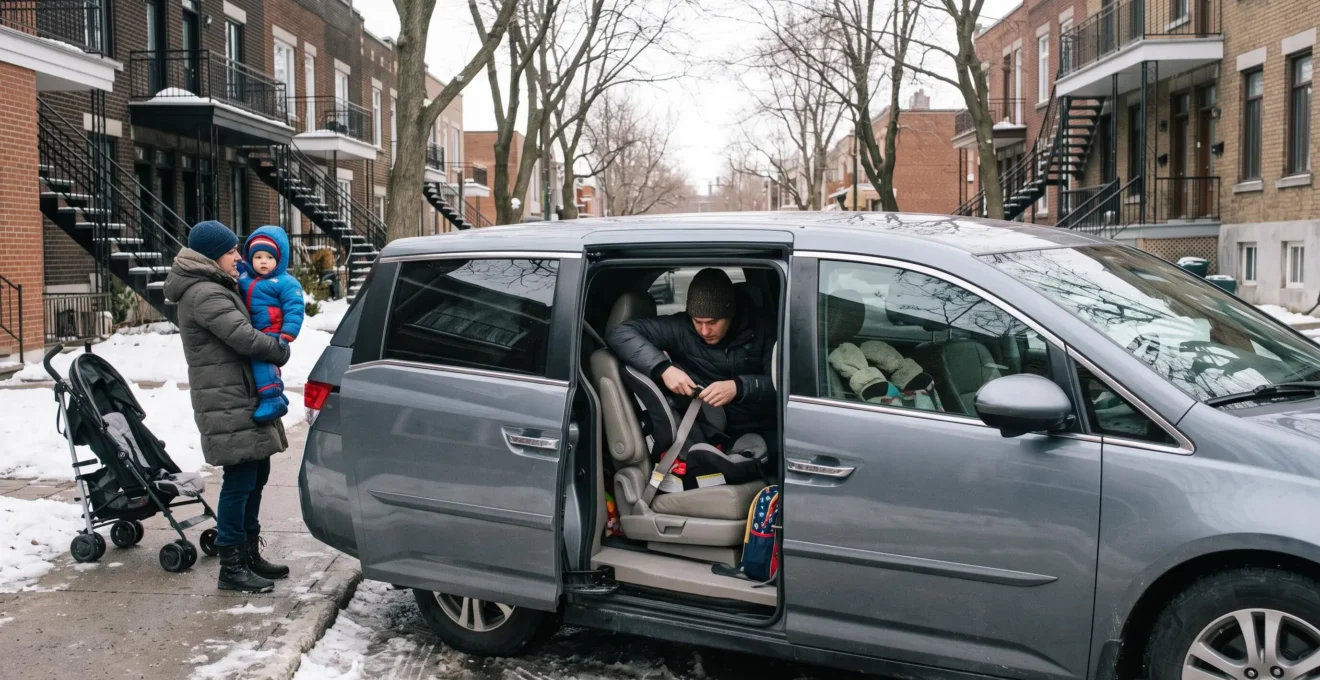
A family outing in Montréal can unravel before the vehicle leaves the curb. The car seat is missing, the stroller does not fit, an airport pickup becomes complicated, or a return journey runs directly into a toddler’s usual nap. None of these problems necessarily involves a long drive. They arise because transporting children requires more planning than moving passengers between two addresses.
Family-focused transportation reduces five recurring stressors: child-restraint uncertainty, insufficient vehicle space, rushed transitions, disrupted rest schedules and difficult pickup logistics. The solution is not simply booking the largest available vehicle. It is matching the transportation arrangement to the children, their equipment and the family’s actual schedule.
For parents of children under 10, a practical booking request should describe each child’s restraint needs, the number of adults, the stroller and luggage load, accessibility requirements and realistic pickup windows. Montréal’s winter conditions and airport arrangements make these details particularly important.
Family transportation in Montréal: the essentials
- Confirm each child’s appropriate restraint and the provider’s ability to supply or accommodate it. Québec has specific child-seat rules, including exceptions for taxis and taxi-equivalent vehicles.
- Choose a vehicle based on installed car seats, usable passenger positions, third-row access and actual cargo dimensions rather than advertised seating capacity.
- Build transition and nap buffers into the itinerary, and confirm pickup locations, waiting policies and equipment in writing before departure.
- Why You Can’t Skip Car Seats in Private Transportation: Québec’s Law and the Real Cost of Non-Compliance
- How to Specify Exactly Which Car Seats You Need: The Age-Weight-Height Booking Formula
- Minivan vs. 3-Row SUV for Families: Which Fits 2 Car Seats, a Stroller, and Weekend Bags?
- The Family Outing Mistake That Turned Fun Into Tears: Scheduling Without Kid-Time Buffers
- When to Schedule Family Outings: Aligning Transportation With Your Toddler’s Nap Windows
- The Car Seat Mistake That Delays Most Family Airport Pickups in Montréal
- How Private Transfers Eliminate the 4 Pain Points of Public Transit for Families With Toddlers
- How to Select Passenger Transportation That Accommodates Mobility, Luggage, and Group Needs
Why You Can’t Skip Car Seats in Private Transportation: Québec’s Law and the Real Cost of Non-Compliance
In Québec, young children generally need an appropriate child restraint until they reach age nine or a height of 145 cm. However, taxis and taxi-equivalent vehicles have a specific legal exception. That exception does not make an adult seat belt as protective as a properly fitted child seat. Families should confirm the applicable rules and arrange appropriate restraints before booking.
The distinction matters because a private transfer, taxi and rideshare may not all operate under the same classification. Québec’s Highway Safety Code establishes general child-restraint requirements, while the SAAQ guidance on transporting children in taxis and other vehicles describes exceptions for taxis and taxi-equivalent vehicles.
According to the SAAQ, where the taxi exception applies and no child seat is available, a child who can maintain an upright seated position must wear the seat belt. Specific provisions also address children unable to sit upright independently. These exceptions are legal accommodations, not evidence that travelling without an appropriate child restraint offers equivalent protection.
Parents should prioritize a suitable child restraint even where an exception permits a different arrangement. They should also avoid assuming that a service advertised as family-friendly automatically includes the required equipment.
A practical distinction separates two transportation arrangements:
- Provider-supplied seat: The company confirms the restraint model, suitability, condition, Canadian compliance markings and installation arrangements before pickup.
- Parent-supplied seat: The family brings a known restraint and confirms that the vehicle has compatible seating positions and adequate installation time.
Transport Canada’s National Safety Mark helps identify child restraints meeting applicable Canadian safety standards. A compliant product still needs to match the child and be installed according to the seat and vehicle manufacturers’ instructions.
A company may also decline a booking or be unable to complete an agreed seat-equipped service if appropriate equipment is unavailable. This operational risk is particularly disruptive when a family is already waiting outside with children and luggage. The precise legal responsibilities of the driver, operator and accompanying adult depend on the applicable transportation rules and circumstances; they should not be reduced to a universal claim that only the parent is responsible.
Before confirming a reservation, ask three questions:
- Does the supplied seat have the Canadian National Safety Mark, and is it suitable for the child’s measurements?
- Who installs the restraint, and how will correct installation be checked?
- What replacement or cancellation arrangement applies if the agreed seat is unavailable?
A written response makes it easier to identify vague promises before they become pickup-day problems. The practical cost of an unsuitable arrangement can include lost time, replacement transportation and an interrupted outing; any specific financial penalty depends on the offence and current applicable law.
Once the legal framework is understood, the next challenge is communicating exactly which restraint each child needs so that the correct equipment arrives.
How to Specify Exactly Which Car Seats You Need: The Age-Weight-Height Booking Formula
The most reliable way to request a child seat is to provide the child’s age, current weight, height and appropriate restraint stage, together with any relevant manufacturer limits. Age alone cannot determine the correct seat. A dispatcher also needs to know how many restraints are required and whether the company or parent will install them.
Québec recognizes rear-facing, forward-facing and booster-seat stages. The transition between them depends on the child’s development and the specific restraint’s approved limits. The SAAQ instructions for choosing and using child car seats distinguish minimum requirements from recommended safety practices.
The following grid provides a practical starting point for a booking request. It does not replace the seat manufacturer’s instructions.
| Restraint stage | Selection considerations | Information to provide |
|---|---|---|
| Rear-facing | Use within the restraint’s approved height and weight limits. Remaining rear-facing as long as permitted is recommended. | Child’s age, weight, height, seat model and rear-facing installation requirement. |
| Forward-facing harness | Consider only when the child is ready under the manufacturer’s instructions; the SAAQ recommends not transitioning before age two. | Current measurements, harnessed-seat requirements and installation compatibility. |
| Booster seat | The child must weigh at least 18 kg (40 lb), meet the booster manufacturer’s requirements and use an appropriate lap-and-shoulder belt. | Weight, height, booster type and availability of a three-point seat belt. |
| Vehicle seat belt | Consider legal criteria and whether the belt fits correctly across the shoulder and hips. | Child’s measurements and confirmation that the vehicle belt fits properly without compromising positioning. |
Reaching the minimum weight for a booster does not automatically mean a child should leave a harnessed seat. A child may continue using the current restraint while remaining within its approved limits.
To avoid a mismatched seat, parents should check the labels on the child’s current restraint before contacting a provider. Record its make, model, installation mode and applicable height and weight range. For a supplied seat, request equivalent suitability rather than assuming that any seat in the same broad category will fit.
The Canadian National Safety Mark, manufacturer instructions and product condition all matter. A seat must also be compatible with the vehicle. These considerations are explained in Transport Canada‘s child car seat selection guidance.
Hypothetical booking example: two children, two different restraints
A Montréal parent is travelling with a younger child who still uses a rear-facing seat and an older child using a forward-facing harness. Requesting “two car seats” leaves the dispatcher uncertain about both restraint types.
A more useful note is: “Two child restraints required: one rear-facing seat for a child aged [age], weighing [weight] and measuring [height]; one forward-facing harnessed seat for a child aged [age], weighing [weight] and measuring [height]. Please confirm each seat’s model, approved limits, installation responsibility and vehicle compatibility in writing.”
The parent should replace every bracketed field with verified measurements and specify whether the company will provide both seats. If the children already use particular restraint models, including those details can help the dispatcher identify possible compatibility issues.
Accurate restraint specifications prevent one category of mismatch, but a vehicle must also have enough usable seating positions and cargo space once those seats are installed.
Minivan vs. 3-Row SUV for Families: Which Fits 2 Car Seats, a Stroller, and Weekend Bags?
A minivan is often more practical than a three-row SUV for two child seats, a stroller and weekend luggage, particularly when adults need access to the third row. However, neither category guarantees enough space. The best vehicle is the specific model that accommodates the installed restraints, remaining passengers and folded equipment without blocking safe access or overloading the cargo area.
Advertised passenger capacity can be misleading. A seven-passenger vehicle may technically have seven seating positions, but child-restraint installation can make some positions difficult to reach or use. Whether the vehicle effectively accommodates four, five or more passengers depends on its seating layout, restraints and access arrangements.
Usable seating capacity matters more than the advertised passenger count. Two child seats mounted across a second-row bench may obstruct access to the third row. Captain’s chairs can create a different access pattern, although the exact configuration varies by model.
The comparison becomes clearer when considering the equipment families actually carry.
| Practical consideration | Minivan | Three-row SUV |
|---|---|---|
| Two installed child seats | Often offers flexible second-row configurations; compatibility must be verified. | May accommodate both, but access and installation positions vary considerably. |
| Third-row access | Sliding doors and cabin layouts may make access easier. | May require moving a second-row seat, which can be impractical with an installed restraint. |
| Full-size stroller | Often provides useful cargo height and a practical loading opening. | Cargo space can become limited when all three rows are occupied. |
| Weekend bags | Frequently easier to organize around a stroller, subject to available dimensions. | May require tighter packing or reducing occupied seating positions. |
| Grandparent or additional caregiver | Potentially easier entry through sliding side doors. | Entry height and third-row accessibility require model-specific checks. |
Child restraints can use a vehicle’s compatible Universal Anchorage System (UAS) positions or an approved seat-belt installation, depending on the seat and vehicle instructions. Anchorage locations are not interchangeable, and their availability cannot be assumed for every passenger position.
The cargo test should begin with the stroller rather than the suitcases. A compact travel stroller may fit easily, while a full-size stroller or double stroller can occupy much of the available loading area. Families should measure the stroller when folded, including protruding wheels and handles, then compare those dimensions with the vehicle’s usable cargo opening and space behind the occupied seats.
For a hypothetical weekend trip, two children in car seats, three adults, a double stroller and several bags create a very different space requirement from two adults travelling with one child and a compact stroller. The transportation company should assess the complete load, not merely the total passenger count.
Request the actual vehicle make and model when possible, and check the manufacturer’s seating and child-restraint instructions. If the provider cannot guarantee a particular model, ask which replacement models can accommodate the same arrangement.
A properly equipped vehicle solves the space problem, but it will not protect the outing from a schedule that leaves no room for children’s transitions and changing energy levels.
The Family Outing Mistake That Turned Fun Into Tears: Scheduling Without Kid-Time Buffers
A family outing can become stressful when the schedule includes driving and activity time but excludes the transitions around them. Children need time to get ready, use the bathroom, settle into their restraints and recover after stimulation. Without these margins, even an otherwise punctual transfer can lead to a rushed departure or an exhausted return journey.
Adults often estimate a trip by adding travel time to the planned activity. Young children experience the entire sequence: dressing, leaving home, entering the vehicle, travelling, participating, returning and settling afterward.
That difference explains why the return trip can be particularly difficult. A child who coped well with the morning departure may be hungry, overstimulated or tired after several hours outside. A minor delay then feels much larger because the family has no remaining flexibility.
The practical response is to add two distinct margins:
- Pre-departure buffer: Time for clothing, toilet visits, feeding, forgotten belongings, stroller folding and safe restraint fastening.
- Post-activity buffer: Time for snacks, bathroom visits, putting on winter clothing, collecting equipment and moving calmly toward the pickup location.
Neither buffer has a universal duration. Families should estimate them from their children’s usual routines rather than treating a suggested number of minutes as a guarantee.
Hypothetical outing: the rushed return
A family plans an afternoon at an indoor attraction in Montréal. The return vehicle is booked for the exact minute the activity ends. One child needs the bathroom, another refuses to put on winter boots, and the stroller is still unfolded when the driver arrives.
In a revised plan, the family ends the activity earlier, uses a transition window for clothing and snacks, and moves toward a pre-agreed pickup point. The vehicle arrives with confirmed child restraints, avoiding additional installation work at the curb.
This example illustrates a planning mechanism rather than a measured outcome. The benefit comes from removing avoidable points of uncertainty. Transportation arrangements that include reliable pickup communication, suitable restraints and clear waiting policies make the family’s schedule easier to manage.
Pre-installed restraints can preserve the pickup buffer when the provider has explicitly confirmed that arrangement. However, parents or caregivers should still check correct harness use before departure.
For outings involving timed tickets or fixed appointments, plan the flexible activities around the fixed commitment rather than scheduling every transition to the minute.
Timing becomes even more important when a toddler’s nap falls during the outing, because the choice of return journey can either support or disrupt the child’s normal routine.
When to Schedule Family Outings: Aligning Transportation With Your Toddler’s Nap Windows
Family transportation should be scheduled around a toddler’s established sleep routine where practical, rather than assuming the child will nap whenever the vehicle moves. A return journey that overlaps with a familiar nap window may be convenient, but car-seat sleep and transfers require appropriate supervision and safe-restraint use. The plan also needs flexibility when sleep does not happen as expected.
The starting point is the child’s actual routine. Parents can record the usual nap window, likely activity duration and realistic travel times, then compare possible outbound and return bookings.
For example, if a toddler generally becomes sleepy in the early afternoon, a morning outing with a return transfer near that period may be easier than extending the activity into a time when the child is already overtired. This is a planning illustration, not a recommendation for a fixed nap schedule.
Three variables determine whether transportation supports the routine:
- Pickup timing: The return booking should reflect when the child is likely to become tired, allowing for ordinary variation.
- Door-to-door practicality: A nearby pickup point can reduce unnecessary walking and equipment handling, especially in winter.
- Waiting flexibility: The provider’s policy should allow the parent to understand what happens if the activity ends earlier or later than expected.
A child who falls asleep while properly restrained during a journey should remain correctly secured while the vehicle is moving. Once travel ends, parents should follow age-appropriate safe-sleep guidance; a car seat is not a substitute for an appropriate sleep surface outside its transportation purpose.
Families should not assume that a sleeping child can remain undisturbed through every transfer. Vehicle changes, arrival procedures and necessary unbuckling can interrupt sleep, so the schedule needs a realistic contingency.
Montréal adds seasonal constraints. Snow, ice, heavy winter clothing and reduced daylight can increase preparation demands and make a tightly timed itinerary harder to manage. Travel estimates should therefore account for conditions on the actual day, without relying on a single fixed seasonal adjustment.
The contingency plan should be simple: establish the earliest acceptable return, the preferred pickup period and the latest practical departure. Ask whether the provider permits changes, how much notice is required and what waiting charges may apply.
These same scheduling principles become especially valuable at airports, where flight timing, luggage collection and child-restraint arrangements create additional uncertainty.
The Car Seat Mistake That Delays Most Family Airport Pickups in Montréal
One preventable source of family airport pickup delays is booking a vehicle without clearly specifying the required child restraints. The wrong seat, an unconfirmed installation arrangement or a vehicle that cannot accommodate the family’s equipment can complicate collection. No verified evidence establishes that this causes most Montréal airport delays, but confirming restraint details in advance removes an avoidable source of disruption.
At Montréal-Trudeau International Airport (YUL), the pickup process involves more than finding a driver. Families must account for baggage collection, stroller access, their assigned meeting location and the vehicle’s authorized pickup arrangements.
According to YUL’s official passenger pickup instructions, designated options include the P4 and P10 Express areas. These are connected to arrivals by shuttle, with access arrangements and conditions specific to each location.
The airport identifies connections near arrivals Door 28 for P4 and Door 20 for P10. The shuttle journey is described as approximately five minutes, excluding possible waiting, walking and boarding time. P10 has published free-access conditions, while P4 functions as a pickup and drop-off area rather than a conventional parking lot.
Commercial pickup permissions should be confirmed directly with the transportation provider. Not every vehicle service is necessarily authorized to use every passenger pickup area. Families should also check whether a shuttle-based meeting point is practical with their stroller and luggage.
For a more predictable airport collection, the booking message should include the flight number, expected arrival, passenger count, child-restraint specifications, stroller dimensions and number of bags.
Before departure, a useful confirmation message is: “Please confirm the exact meeting point, your authorized pickup arrangement at YUL, the supplied child-seat types and installation responsibility. The booking includes [number] children, [number] adults, [stroller details] and [bag count]. Please advise how flight delays affect the pickup.”
Sending this request approximately 48 hours before travel can be a sensible personal planning practice, although it is not an airport-imposed child-seat confirmation rule.
Families should also decide whether bringing their own child restraints is worthwhile. Personal seats provide familiarity with the model and its history but require transport, handling and installation at each applicable stage of the journey. Provider-supplied seats reduce baggage needs but require reliable confirmation of suitability and condition. Destination rentals introduce a separate availability and compatibility check.
On the return trip, confirm whether the same equipment arrangements apply. A seat supplied at airport arrival should not be assumed available for the departure transfer unless both journeys have been explicitly agreed.
Arrangements at Montréal Metropolitan Airport (YHU) require separate verification; YUL’s published pickup instructions must not be generalized to another airport.
Airport transfers highlight the value of door-to-door planning, but similar trade-offs arise during everyday outings when families choose between public transit and private transportation.
How Private Transfers Eliminate the 4 Pain Points of Public Transit for Families With Toddlers
A suitable door-to-door private transfer can reduce four practical difficulties families encounter on public transit: carrying children and equipment, navigating stroller transfers, waiting outdoors in winter and managing the transition into a vehicle requiring child restraints. It does not automatically eliminate every inconvenience, and Montréal public transit remains a practical choice for many simpler family journeys.
The strongest case for private transportation arises when the family is managing several small children, a large stroller, substantial luggage or mobility limitations. A short, direct métro journey with one school-age child may be easier and less expensive than a booked vehicle.
Consider the four friction points separately.
- Equipment handling: A parent may need to manage a toddler, stroller, bags and possibly a personal child seat. Door-to-door pickup reduces the need to move all these items between transportation modes.
- Stroller transfers: Changing lines or moving between platforms adds folding, lifting or route-planning work. A suitable private vehicle can keep the journey continuous once everybody is safely secured.
- Winter waiting: Outdoor connections can become uncomfortable when children are cold or tired. A confirmed pickup can reduce exposure, although road delays remain possible.
- Child-restraint logistics: A private transfer with agreed child seats can simplify a journey that would otherwise require securing children and equipment across different vehicles. Public transit vehicles and taxi services have different applicable restraint arrangements, so requirements should not be generalized.
These are situational advantages rather than proof that every family should avoid Montréal’s transit network. Accessible stations, direct routes, light luggage and older children can all make public transportation a sensible option.
Cost should be compared across the complete trip, not just the displayed fare. For transit, consider the fares actually payable by eligible family members, the number of transfers and any additional paid ride that could become necessary. For private transportation, request the complete quoted amount and check whether child seats, waiting, parking or changes are included.
A useful comparison divides the quoted private-transfer cost by the number of passengers to understand the family-level expense, while keeping in mind that a lower per-person figure does not make the total bill affordable or justified.
For a single adult with one child on a straightforward route, public transit may remain the better fit. For two adults with several young children, bulky equipment and a journey involving multiple connections, the convenience of an equipped private transfer may justify its additional expense.
One important limitation is the spontaneous taxi option. Québec’s exception for taxis and taxi-equivalent vehicles should not be confused with a promise that an appropriate child seat will be supplied on demand. A family that wants its child to travel in a suitable restraint should establish availability before relying on that option.
The choice becomes easier when all requirements are consolidated into one specification that transportation providers can confirm rather than interpret.
Key takeaways before booking
- Match every child to an appropriate restraint and confirm the supplier, installation arrangements and vehicle compatibility.
- Check the usable seats, luggage space and passenger access with all child restraints installed.
- Agree on realistic pickup windows, equipment handling, accessibility arrangements and the total quoted cost before committing.
How to Select Passenger Transportation That Accommodates Mobility, Luggage, and Group Needs
Selecting suitable family transportation means specifying the entire journey, not simply asking for a large vehicle. The provider needs the number of adults and children, exact restraint requirements, stroller and luggage dimensions, mobility accommodations and pickup constraints. A written confirmation of the vehicle’s suitability and service conditions gives parents a practical basis for comparing alternatives.
The most effective approach is to create one consolidated booking specification and use it consistently across providers. This reduces the chance that a dispatcher confirms the number of passengers while overlooking an essential child seat or mobility requirement.
Start with the people travelling. Include each child’s age and relevant measurements, the number of adults, and any passenger who needs assistance entering or leaving the vehicle.
Next, document the equipment. A folded wheelchair, large stroller, stroller-wheelchair hybrid or mobility aid may affect both cargo capacity and the type of vehicle required. A large SUV is not necessarily wheelchair accessible. Ramp access, accessible seating, door opening dimensions and appropriate mobility-device securement must be confirmed for anyone who needs them.
Accessibility must be specified independently of passenger capacity. A provider offering a seven-passenger vehicle may still be unable to accommodate a passenger who needs wheelchair-accessible transportation.
The same principle applies to older relatives. A grandparent with limited mobility may find a high entry step or difficult third-row access impractical, even when sufficient seats technically exist.
When comparing providers, request details on child-seat availability and installation, the actual or guaranteed-equivalent vehicle model, flight monitoring where relevant, pickup instructions, waiting policies and complete pricing. Fixed pricing can improve predictability, but its inclusions and adjustment conditions still need to be checked.
Five-step family transportation booking checklist
- Prepare the passenger manifest: Record every adult and child, each child’s age, height and weight, and any mobility needs. Deliverable: one complete passenger specification.
- Document restraint requirements: Identify the number, type and approved size range of every child seat, along with who provides and installs each one. Deliverable: written seat confirmation.
- Verify physical capacity: Provide folded stroller dimensions, luggage quantities and mobility-device details, then request confirmation of usable seating and cargo space. Deliverable: approved vehicle model or equivalent specification.
- Confirm the journey schedule: State flight details where applicable, pickup location, preferred timing window, planned stops and potential child-related delays. Deliverable: agreed pickup instructions and waiting policy.
- Review the final booking: Check the total quoted price, included equipment, cancellation conditions and alternative arrangements if the promised vehicle or seat becomes unavailable. Deliverable: a complete written reservation record.
A good confirmation should resolve the family’s most important uncertainties before the day of travel. It should identify what equipment will be present, where passengers will meet the driver, which timing changes are permitted and what happens if an essential requirement cannot be fulfilled.
Keep that information accessible during the outing, together with the provider’s contact method. Reusing the same specification for later trips makes it easier to update only the variables that change, such as a child’s size, the stroller or the number of passengers.
The next practical step is to send the complete specification to prospective transportation providers, compare their written answers and book only an arrangement that meets the family’s confirmed safety, space, accessibility and scheduling needs.
Can a family bring its own child seats in a booked private vehicle?
Yes, if the provider permits the arrangement and the seats can be installed correctly in the assigned vehicle. Confirm the vehicle’s compatible seating positions, the installation procedure and the time available before pickup. Follow both the child-restraint and vehicle manufacturers’ instructions.
Does a child over nine still need a booster seat in Québec?
A child who has reached age nine or a height of 145 cm may no longer fall under Québec’s general mandatory child-seat threshold. However, proper seat-belt fit remains essential. The SAAQ recommends continued booster use when necessary to position the shoulder belt across the middle of the shoulder and the lap belt across the hips.
Should a family choose one larger vehicle or two smaller vehicles?
Compare the actual restraint positions, remaining passenger seats, accessible entry and cargo capacity. One suitable larger vehicle can simplify coordination, but two vehicles may be necessary when no available model accommodates the full group. Each vehicle must meet the applicable safety and passenger requirements.
What if the booked child seat is missing at pickup?
Ask the provider to arrange the agreed suitable restraint or another appropriate transportation solution. Do not improvise an unsafe child-restraint installation. Applicable legal exceptions for certain vehicle categories should not be treated as equivalent protection. Keep the written equipment confirmation available when discussing replacement arrangements.
Can a private family transfer accommodate a wheelchair and stroller together?
Some appropriately equipped vehicles may accommodate both, but available capacity depends on the wheelchair’s use and dimensions, securement arrangements, the stroller’s folded size and the passenger layout. Request explicit confirmation of accessibility equipment, safe passenger positions and luggage space rather than assuming any minivan or SUV is suitable.