
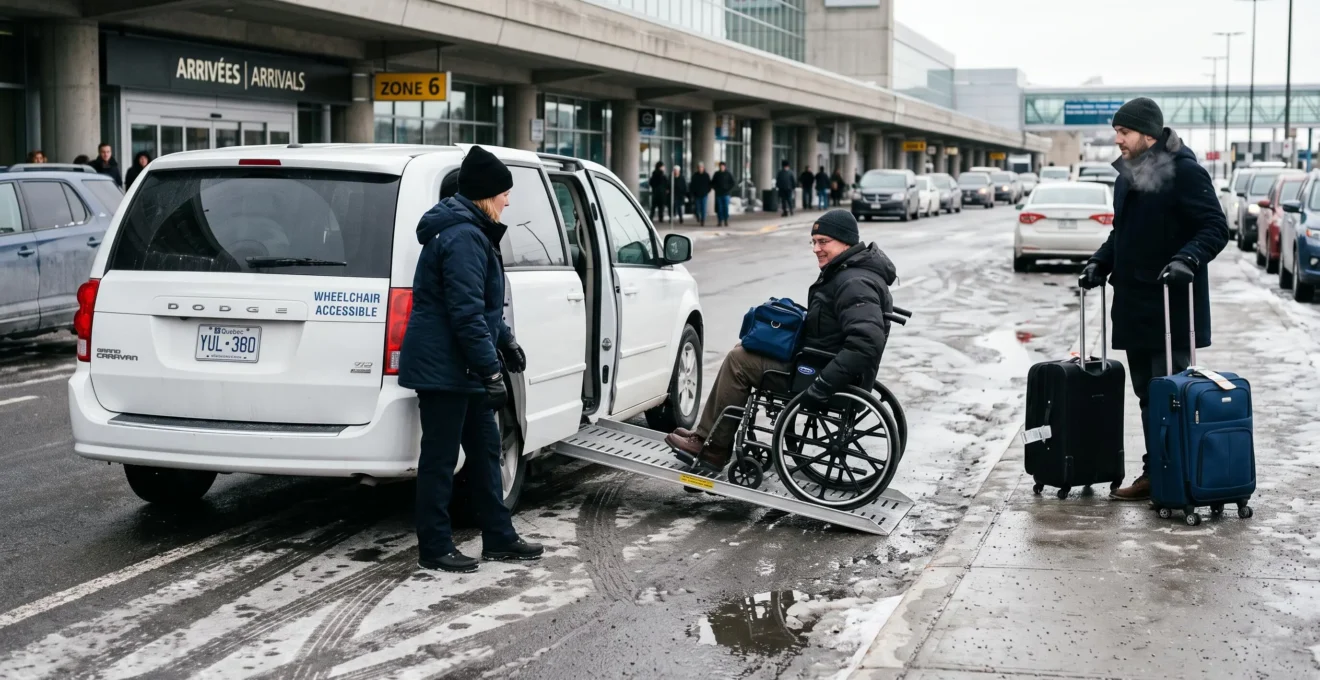
Choosing passenger transportation in Montréal requires more than counting available seats. A vehicle may accommodate everyone on paper yet lack room for wheelchairs, checked luggage, child restraints or comfortable boarding. These differences become particularly important when coordinating airport transfers, family journeys, accessible travel and corporate events.
The most reliable approach is to match each passenger’s needs to a specific vehicle configuration before confirming the reservation. That means identifying mobility equipment, measuring unusual luggage, checking accessible boarding arrangements and understanding the operator’s actual passenger and cargo limits.
Montréal adds practical considerations: winter clothing and snow-covered equipment, busy airport access routes, constrained downtown loading areas and journeys extending into the Laurentians or Eastern Townships. A carefully specified booking can reduce last-minute vehicle changes while making travel safer and more comfortable for everyone.
Passenger transportation essentials for Montréal
- Choose vehicles according to mobility requirements, boarding arrangements and luggage space, not advertised passenger capacity alone.
- Confirm child restraints, wheelchair securement, accessible entry and authorized pickup locations before travel.
- For larger groups, compare complete transportation costs and coordinate arrivals using shared manifests and realistic loading buffers.
- Why a Standard Sedan Often Fails Passengers With Mobility Aids — and What to Request Instead
- How to Calculate the Right Vehicle Size for 6 Passengers With Airport-Sized Luggage
- Sedan vs. Minivan vs. Sprinter Van: Which Fits Your Group’s Comfort and Budget?
- The Car Seat Mistake That Delays Family Airport Pickups in Montréal
- When to Schedule Passenger Pickup for a 200-Person Conference: The 3-Wave Strategy
- Why ‘Accessible Vehicle’ Isn’t Specific Enough: The 5 Accessibility Levels Explained
- Minivan vs. 3-Row SUV for Families: Which Fits 2 Car Seats, a Stroller, and Weekend Bags?
- How to Transport 12 Passengers Across Montréal Without Splitting Groups or Overpaying for Capacity
Why a Standard Sedan Often Fails Passengers With Mobility Aids — and What to Request Instead
A standard sedan is suitable for some passengers who use mobility aids, but only when they can transfer safely into the seat and their equipment fits inside the vehicle. Passengers who must remain in their wheelchairs need a properly configured wheelchair-accessible vehicle, with compatible entry equipment and an appropriate occupant-restraint and wheelchair-securement system.
The difficulty is often physical rather than simply a question of vehicle size. A narrow trunk opening may prevent a folded wheelchair from fitting even when the trunk appears spacious. Low door openings, restricted legroom and awkward rear-seat angles can also make transfers uncomfortable or unsafe.
Walkers, knee scooters and folding wheelchairs have different storage requirements. Confirm whether equipment folds, its dimensions when folded and whether the passenger needs assistance managing it. Never assume a device can be safely stored in an occupied seating area.
For Montréal reservations, consider a graduated selection:
- Standard sedan: suitable when the passenger transfers independently or with appropriate assistance and the mobility aid fits securely in the cargo area.
- Conventional minivan: offers potentially easier entry and more equipment space, but does not automatically accommodate someone travelling while seated in a wheelchair.
- Wheelchair-accessible van: required when the passenger needs to remain in a wheelchair, with entry and securement appropriate to their equipment.
Clarify the assistance being requested. Help placing a folded walker in the trunk differs from physical transfer assistance, wheelchair securement or escorting someone from inside a building. Drivers may not be trained, equipped or authorized to provide every form of assistance.
At Montréal-Trudeau International Airport, the official accessible taxi and shuttle information identifies Door 23 on the arrivals level and accessible taxi availability between 7 a.m. and 2 a.m. Passengers needing service outside these hours should arrange it with their carrier and the airport dispatcher. Availability should be reconfirmed before travel.
For pre-booked private transfers, request written confirmation of the vehicle’s accessibility specifications and the agreed assistance. Reconfirm with dispatch shortly before travel to reduce the risk of an unsuitable substitution.
Once every passenger can board safely, the next challenge is ensuring their luggage and equipment fit without compromising usable seating or securement space.
How to Calculate the Right Vehicle Size for 6 Passengers With Airport-Sized Luggage
For six passengers, calculate luggage requirements separately from seating capacity. Count checked suitcases, carry-ons and oversized equipment, then compare their dimensions with the actual cargo compartment available when all six seats are occupied. A six-passenger vehicle does not necessarily provide enough room for six passengers’ airport luggage.
A useful planning method assigns one inventory entry to every bag rather than assuming all pieces occupy the same space. Classification helps with the initial comparison, but final approval should be based on dimensions and loading configuration.
| Luggage category | Planning method | Important consideration |
|---|---|---|
| Carry-on suitcase | Count each piece | Cabin bags still need an approved storage location. |
| Checked suitcase | Count and record dimensions | Large rigid cases may be difficult to stack efficiently. |
| Oversized equipment | List each item separately | Skis, golf bags, wheelchairs and strollers need length and width checks. |
| Personal bags | Include backpacks and additional items | Do not assume floor space around passengers can be used. |
Consider a hypothetical airport arrival with six adults, twelve checked suitcases and six carry-ons. Although a conventional minivan may have enough seating, its remaining luggage compartment could be inadequate. A larger passenger van with a dedicated cargo area, or two appropriately sized vehicles, may be necessary.
Vehicle descriptions must be interpreted carefully. A passenger van fitted with additional seating may have less usable cargo space than a version with fewer seats. Ask the operator for the luggage capacity of the exact seating configuration being supplied, ideally supported by cargo measurements or photographs.
Montréal winter transfers require further planning. Bulky coats, wet luggage and snow-covered equipment complicate loading. Provide sufficient time to organize baggage without blocking an airport loading lane, and avoid placing loose luggage where it could interfere with passengers or emergency exits.
Before choosing between a minivan and a larger van, compare complete quotations rather than guessing at the price difference. Include baggage requirements, any additional vehicle, airport charges and waiting conditions. A vehicle upgrade may cost less than arranging a second transfer at short notice, but that depends on the operator and route.
When luggage capacity is confirmed, comfort and total trip cost can determine whether a sedan, minivan or larger passenger van is the better choice.
Sedan vs. Minivan vs. Sprinter Van: Which Fits Your Group’s Comfort and Budget?
A sedan generally suits small parties with limited baggage, while a minivan provides more flexibility for families and modest groups. A Sprinter-style passenger van may offer better group seating and cargo arrangements for larger parties. The economical choice depends on occupied seats, luggage, journey duration and total quoted charges, not vehicle class alone.
Comfort should be evaluated over the full trip. A short airport transfer can be manageable in a compact arrangement that would feel restrictive on a journey toward Mont-Tremblant or the Eastern Townships.
| Criterion | Sedan | Minivan | Sprinter-style passenger van |
|---|---|---|---|
| Passenger suitability | Small parties | Families and moderate groups | Larger groups, subject to installed seating |
| Luggage | Limited trunk space | Variable; depends on occupied rows | Potentially larger dedicated cargo area |
| Boarding | Low seating position | Often convenient through sliding doors | Higher entry may require steps or assistance |
| Long-trip comfort | Good for a small party with light luggage | Depends on seating and legroom | Can be comfortable with suitable seat spacing |
| Budget consideration | Often economical for small parties | Useful balance of seating and cargo capacity | Potentially competitive per person for larger groups |
For a hypothetical comparison, suppose a private minivan is quoted at CAD 150 for five passengers and a larger van at CAD 210 for eight passengers. The respective per-person prices would be CAD 30 and CAD 26.25. These figures illustrate the calculation only; they are not verified Montréal transport rates.
Three practical scenarios demonstrate the selection process:
- Couple travelling with ski bags: a sedan may work if the equipment fits safely, but a vehicle with a longer cargo compartment may be necessary.
- Family of five: a minivan may provide a practical combination of seating, child-restraint access and luggage space, subject to its configuration.
- Corporate group of eight: one suitably equipped passenger van may simplify coordination compared with multiple cars, provided seating and cargo capacity are confirmed.
Request an itemized quotation covering airport fees, driver waiting time, gratuities where applicable, additional stops, taxes and any minimum booking duration. Compare one larger vehicle against the combined price of smaller vehicles serving the same journey.
A particularly important distinction is whether the provider charges per journey, per hour or per vehicle. Two apparently similar quotations may include different waiting allowances or return-travel charges.
For families with young children, however, one essential safety requirement may override every price comparison: having suitable, correctly installed child restraints.
The Car Seat Mistake That Delays Family Airport Pickups in Montréal
The critical mistake is assuming a child safety seat will automatically be available when a vehicle arrives. Families should confirm the restraint type, vehicle compatibility and installation arrangements before booking. Québec provides specific legal exceptions for taxis and comparable vehicles, but those exceptions do not make travelling without an appropriate child restraint equally safe.
A general request for a car seat is insufficient. An infant who needs a rear-facing seat, a toddler requiring a harnessed restraint and an older child using a booster have different requirements.
When contacting an operator, provide the child’s age, weight and height, then ask which restraint can be supplied and whether installation is included. Confirm its compatibility with the actual vehicle, including the permitted installation method.
According to the SAAQ rules for travelling with children in alternative vehicles, Québec’s taxi-related exception applies under specified conditions to taxis, automobiles considered equivalent to taxis and police vehicles. The relevant child-restraint threshold concerns children under 145 cm tall or younger than nine years old.
Where the exception applies and a suitable child restraint is unavailable, the rules distinguish children who can sit upright from those who cannot. These special provisions must not be generalized to every private vehicle booking. The SAAQ strongly recommends appropriate child safety seats for safety.
Airport coordination matters too. Confirm where the driver will meet the family, whether the pickup is inside or outside the terminal, how flight delays are handled and exactly when waiting charges begin. There is no universal grace period that can safely be assumed for every private airport booking.
Winter clothing introduces another concern. Bulky coats can interfere with the fit of a child-restraint harness, so follow the restraint manufacturer’s instructions for securing the child properly.
Bringing a familiar child seat can eliminate uncertainty about its suitability, but adds baggage and handling requirements. Check airline carriage arrangements and inspect the seat for damage after transport. For unfamiliar vehicle models, confirm the restraint can be installed according to both the child-seat and vehicle manuals.
These precautions help individual families, while organizers transporting many families or conference delegates need an additional layer of arrival coordination.
When to Schedule Passenger Pickup for a 200-Person Conference: The 3-Wave Strategy
For a hypothetical 200-person Montréal conference, organize transportation around three coordinated arrival waves rather than sending everyone to one pickup point simultaneously. Build the waves from actual flight arrival clusters, passenger requirements and vehicle capacity. Assign a coordinator, allow for delayed flights and ensure each group has an authorized boarding location.
The three-wave approach is an event-planning method, not an airport-mandated procedure. Three waves do not necessarily mean three equal groups or only three vehicles. Their duration and capacity should reflect flight schedules and passenger loading times.
Begin with a transport manifest showing expected landing time, flight number, passenger count, destination hotel, accessibility needs and baggage requirements. Group travellers into provisional 30-to-60-minute arrival windows where operationally reasonable, then adjust the windows to reflect actual flight distribution.
For illustration, a 200-person event could initially assign 60 passengers to the first wave, 80 to the second and 60 to the third. Vehicle requirements would then be calculated from each wave’s confirmed capacity, not by dividing the total attendee count equally among vehicles.
For example, if a wave contains 60 passengers and each charter vehicle genuinely accommodates 30 passengers plus their luggage, at least two vehicles would be needed for that wave. Additional capacity might be required for accessibility, separated arrival times or disruptions.
At YUL, organized group services must use the correct transportation facilities. The Montréal-Trudeau Airport’s shuttle and charter-bus information identifies Door 20 on the arrivals drop-off zone for charter-bus passengers, followed by the designated pedestrian route to boarding gates. Charter-bus drop-offs are identified at Door 7 on the departures level. Confirm current instructions with the operator.
Do not assume conventional passenger pickup zones are suitable for buses or large private vehicles. Assign a clearly documented meeting point, share the route from arrivals and identify a coordinator whom passengers can contact.
If multiple flights are delayed, redistribute passengers based on actual arrival times. A shared manifest with updates visible to the transport dispatcher, airport coordinator and hotel reception helps prevent duplicate assignments or stranded delegates.
Five actions to finalize a conference transportation plan
- Collect flight and passenger information, producing one consolidated arrival manifest with accessibility and luggage requirements.
- Group flights into practical arrival windows, producing a three-wave schedule showing passenger totals and destinations.
- Confirm seating and luggage capacity for every assigned vehicle, producing a vehicle allocation sheet with identified contingency arrangements.
- Verify authorized airport boarding points and hotel loading access, producing written pickup instructions for delegates and drivers.
- Share dispatcher and coordinator contacts, flight-tracking responsibilities and delay rules, producing a live operational communication plan.
Group schedules become more resilient when accessibility requirements are included in vehicle allocation from the beginning rather than handled as exceptions after arrival.
Why ‘Accessible Vehicle’ Isn’t Specific Enough: The 5 Accessibility Levels Explained
The term accessible vehicle can describe very different capabilities. A passenger needing assistance with a folding walker may only require conventional seating and luggage support, while a wheelchair user may need a ramp, lift and securement system. Use five practical accommodation categories to communicate needs, but verify actual equipment rather than treating the categories as an official standard.
The following classification is a booking aid, not a regulated Montréal accessibility certification system. Its categories describe possible service configurations; individual vehicles may combine several features.
| Level | Vehicle or assistance configuration | When to consider it |
|---|---|---|
| 1 | Conventional vehicle with agreed driver assistance | Passenger can transfer safely and mobility equipment fits in storage. |
| 2 | Vehicle with enhanced door clearance or a suitable transfer aid | Passenger needs easier entry or a particular transfer arrangement. |
| 3 | Rear-entry wheelchair-accessible van with ramp and appropriate securement | Passenger remains in a compatible wheelchair and rear loading space is available. |
| 4 | Side-entry wheelchair-accessible van with ramp and appropriate securement | Side loading better suits the authorized pickup location and wheelchair configuration. |
| 5 | Lift-equipped accessible vehicle with compatible securement | Passenger requires mechanical lifting and the combined load meets the equipment rating. |
These levels are not a universal progression of safety or capability. A properly designed side-entry ramp may be suitable for a powered wheelchair, while a lift-equipped vehicle may be unsuitable if its lift dimensions, load rating or interior arrangement are incompatible.
Entry direction is especially significant in central Montréal. A rear ramp needs clear space behind the vehicle, which may not exist at a crowded hotel entrance. A side-entry ramp may offer more practical loading from an appropriate curb, but only if sufficient clearance is available and the vehicle can stop legally.
When requesting a wheelchair-accessible transfer, ask three precise questions:
- Does the vehicle use a ramp or lift, and what are its dimensions and rated load?
- Does wheelchair entry take place from the rear or side, and can the proposed pickup point accommodate it?
- Is the wheelchair securement and passenger restraint system compatible with the traveller’s chair, including its dimensions and occupied weight?
Also confirm how many additional passengers can travel once the wheelchair position is occupied. Folding seats, securement equipment and interior layouts can change usable capacity considerably.
Accessibility planning should respect passenger preferences. Ask which assistance is wanted and avoid assuming that every wheelchair user requires physical help or a particular vehicle layout.
For mixed groups, correct accessibility matching must work alongside seating, luggage and family requirements rather than competing with them.
Minivan vs. 3-Row SUV for Families: Which Fits 2 Car Seats, a Stroller, and Weekend Bags?
For a family travelling with two installed child restraints, a folded stroller and weekend bags, a minivan is often more practical than a three-row SUV. Sliding doors can simplify child-seat access, and some minivans retain more useful cargo space with occupied seating rows. However, the exact vehicle layout matters more than the category name.
The decisive issue is the relationship between occupied seats and remaining storage. Many three-row SUVs provide substantial luggage capacity only when part or all of the third row is folded. If that row is needed for a passenger, the available cargo area may shrink considerably.
Minivans can offer useful advantages through flexible seat arrangements, lower loading floors and sliding-door access, although third-row occupancy also reduces cargo space in some models.
Two installed child seats complicate the comparison. Their width can obstruct access to rear rows, and not every seating position provides the same approved attachment options. Confirm the availability and location of lower anchors, tether anchors and compatible seat-belt installation positions using the vehicle and child-restraint manuals.
| Practical factor | Minivan | Three-row SUV |
|---|---|---|
| Installing two child seats | Sliding doors may improve access. | Hinged doors and seat arrangements may restrict access. |
| Folded stroller | Often accommodates bulky equipment, depending on configuration. | Must be checked against remaining trunk dimensions. |
| Third-row seating | May offer flexible configurations. | Often competes directly with cargo capacity. |
| Winter entry | Lower floor may help passengers board. | Higher ground clearance may help on some snowy surfaces, but increases step-in height. |
| Tight loading areas | Sliding doors can reduce clearance problems. | Hinged doors need sufficient side-opening space. |
At a busy airport curb or an underground hotel loading area in Old Montréal, sliding doors can make entry easier where opening space is restricted. An SUV’s greater ground clearance may help the vehicle navigate some snowy surfaces, but it does not necessarily help children or older passengers climb inside.
For a family of five, verify that both child restraints can be installed correctly while leaving usable access to the remaining seating position. Check whether the stroller fits without obstructing visibility or requiring loose luggage inside the passenger compartment.
A practical test is whether a caregiver can install and check each restraint comfortably while the vehicle is legally parked, without leaning dangerously into traffic or blocking access for other travellers.
The same principle applies when the group becomes larger: the best vehicle is the smallest genuinely suitable configuration, not simply the one with the lowest nominal passenger capacity.
Key considerations before booking a larger group vehicle
- Advertised seating capacity must be checked against actual luggage space and accessibility arrangements.
- One group vehicle is useful only if it can legally and safely access the intended pickup and drop-off points.
- Compare complete quotations, including minimum rental periods and additional fees, before deciding whether to combine or split vehicles.
How to Transport 12 Passengers Across Montréal Without Splitting Groups or Overpaying for Capacity
For twelve passengers travelling together in Montréal, start by requesting a vehicle with twelve usable passenger seats and sufficient dedicated luggage space. A suitably configured passenger van or small minibus may keep the group together, but a nominal twelve-seat vehicle is not automatically adequate. Compare its total cost with two smaller vehicles before confirming.
The first consideration is whether the vehicle has twelve passenger seats in its actual licensed configuration, excluding the driver. Some operators describe capacity differently, so specify the total number of travelling passengers and ask for confirmation of seat belts for every occupied position.
Next, verify luggage accommodation. Twelve travellers carrying overnight bags require a different arrangement from twelve conference attendees travelling with small backpacks. A passenger van whose final row is close to the rear doors may offer limited cargo space when fully occupied.
For a hypothetical group transfer, compare a single larger vehicle with two minivans on the same route, using identical service conditions.
| Cost component | One larger vehicle | Two smaller vehicles |
|---|---|---|
| Base transportation quote | One negotiated service | Two service charges |
| Airport charges | As applicable to the larger vehicle | Potentially charged for each vehicle |
| Waiting time | One vehicle’s waiting terms | Separate waiting terms may apply |
| Return-empty travel | Potentially one charge | Potentially separate charges |
| Passenger coordination | One departure and arrival group | Two driver assignments and possible arrival differences |
A single vehicle can simplify attendance tracking and group communication, but it may carry an hourly minimum that exceeds the cost of two smaller cars for a short journey. On longer transfers, the balance may shift, depending on the provider’s pricing structure and any return-empty charges.
Physical pickup access is another important constraint. Large vans and minibuses require sufficient curb length, manoeuvring space and sometimes overhead clearance. Confirm whether the vehicle can approach the hotel entrance or whether passengers need to meet at a designated loading area.
At YUL, the airport’s published passenger pickup and drop-off guidance identifies afternoon and evening congestion concerns, particularly from 1 p.m. to 8 p.m. Quick-stop restrictions apply in designated terminal zones, and commercial transportation operators must use authorized facilities appropriate to their service.
For an efficient departure, appoint one group coordinator, establish an agreed boarding order and confirm the final passenger count before releasing the vehicle. Travellers needing additional boarding time should receive appropriate assistance without being rushed.
Before confirming a twelve-person reservation, obtain written answers to three questions: Can the proposed vehicle accommodate all twelve passengers and their actual luggage? Can it legally and safely use both loading locations? Is its all-inclusive price lower or more practical than the equivalent two-vehicle arrangement?
Finalize the reservation with a written passenger and luggage manifest, agreed pickup instructions and an itemized quotation. These documents give the coordinator a practical way to verify that comfort, safety and budget requirements have been addressed before departure.
How far in advance should accessible transportation be booked in Montréal?
Book as early as practical once the itinerary and accessibility requirements are known. The necessary notice depends on vehicle availability, equipment specifications and the operator. For an airport transfer, confirm the arrangement again before travel, especially outside published accessible taxi service hours.
Can a wheelchair and several suitcases fit in the same accessible van?
Possibly, but capacity depends on the wheelchair position, ramp or lift arrangement, securement equipment and number of other passengers. Provide wheelchair dimensions, occupied weight when relevant, and a complete luggage list. Request confirmation for the exact vehicle configuration rather than relying on general capacity claims.
Is it better to reserve airport transportation by flight arrival time or a fixed pickup time?
For airport arrivals, provide the flight number and confirm how the operator handles landing-time changes, baggage collection and passenger readiness. A fixed meeting time may still be required, but it should include a realistic allowance for disembarkation, luggage retrieval and any mobility assistance. Waiting-time policies differ between operators.
Does a larger passenger van automatically qualify as wheelchair-accessible?
No. A spacious passenger van may lack a wheelchair ramp or lift, accessible entry dimensions and appropriate securement equipment. Wheelchair accessibility must be verified from the vehicle’s actual conversion and equipment, independently of its advertised passenger capacity.
What information should a travel coordinator send before requesting a group transportation quote?
Provide the travel date, pickup and destination addresses, passenger count, flight information where relevant, luggage inventory, child-restraint requirements, mobility accommodations, planned stops and preferred service timing. Ask the operator to confirm vehicle configuration, pickup feasibility, cancellation terms, waiting charges and an itemized total price.