
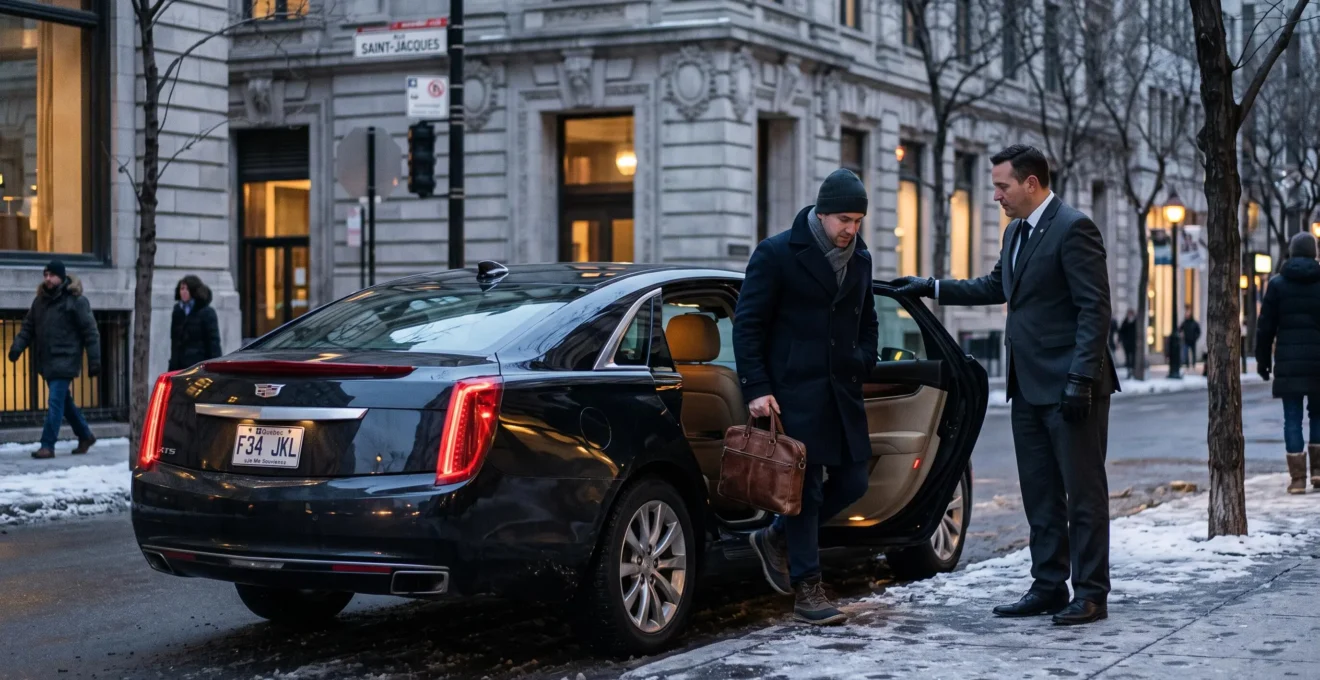
A luxury vehicle rate pays for more than an expensive car. The premium can reflect twelve distinct benefits: acoustic insulation, refined upholstery, ergonomic seating, climate control, suspension quality, cabin space, privacy, passenger technology, luggage flexibility, visual presentation, chauffeur professionalism and dependable service coordination. Their value depends on how the vehicle will actually be used.
For a corporate pickup in downtown Montréal, a discreet chauffeur and immaculate executive sedan may create more value than an oversized SUV. For a celebration, interior atmosphere and arrival presentation may matter more. Following a long-haul flight into Montréal-Trudeau International Airport, comfortable seating and reliable luggage handling may take priority over prestige.
The important distinction is between features that sound luxurious in a quotation and benefits passengers can genuinely experience. Understanding that distinction makes it easier to select the right vehicle, compare complete prices and avoid upgrades that contribute little to the journey.
Luxury transportation value at a glance
- Comfort is cumulative: seating, suspension, cabin quietness and temperature control work together to improve the passenger experience.
- Prestige is contextual: the right vehicle for an executive guest may differ from the best choice for private travel or a celebration.
- The complete service matters: chauffeur quality, booking terms, luggage capacity and the final tax-inclusive price deserve as much attention as the vehicle badge.
- Why a Mercedes S-Class Costs $95 While a Lincoln Navigator Costs $145: Vehicle Class Value Breakdown
- How to Choose Luxury Vehicles for Client Pickups vs. Personal Travel: The Impression Strategy
- Why “Leather Seats” in a $60 Sedan Feel Nothing Like $120 Luxury Vehicle Leather
- The Luxury Vehicle Mistake That Wasted $180 on a 15-Minute Airport Transfer
- When to Book Luxury Vehicles for New Year’s Eve and Grand Prix: The 3-Week Advance Rule
- Why a Lincoln Continental Costs $35 More Than a Toyota Camry: What You Actually Get
- Why Luxury Vehicle Interiors Feel Different: The 7 Sensory Elements You’re Actually Experiencing
- How Luxury Transportation Transforms Transit From Necessity Into Indulgent Experience Worth Remembering
Why a Mercedes S-Class Costs $95 While a Lincoln Navigator Costs $145: Vehicle Class Value Breakdown
A Mercedes-Benz S-Class and a Lincoln Navigator serve different passenger priorities, so a higher quoted rate for the Navigator does not automatically mean a more luxurious journey. An executive sedan emphasizes refined rear-seat travel, while a full-size SUV may offer greater flexibility for passengers and luggage. The $95 and $145 figures illustrate a comparison, not verified Montréal market tariffs.
The first distinction is operating economics. Vehicle acquisition, financing, depreciation, maintenance, insurance, fuel consumption and fleet utilization can influence what a transportation operator charges. However, individual prices also reflect availability, service standards and commercial positioning. No fixed price difference between these two models follows from their vehicle classification alone.
Québec establishes eligibility and inspection requirements for vehicles used in remunerated passenger transportation. The SAAQ requirements for vehicles used in remunerated passenger transportation distinguish qualifying vehicle characteristics and regulatory obligations, including criteria applicable to limousines. They do not establish separate S-Class and Navigator chauffeur certification classes or prescribe the price of a luxury booking.
The practical question is what each class can deliver for the intended passenger. The following grid distinguishes typical priorities rather than claiming laboratory-measured differences between particular vehicles.
| Decision factor | Mercedes-Benz S-Class | Lincoln Navigator |
|---|---|---|
| Cabin quietness | Strong emphasis on isolated executive travel | Premium cabin refinement; actual quietness depends on configuration and conditions |
| Rear-seat comfort | Potential advantages from executive seating options | Spacious seating suited to different passenger arrangements |
| Suspension experience | Refinement-focused sedan suspension technology | Premium SUV suspension with a different vehicle height and ride character |
| Brand impression | Formal, understated executive prestige | Commanding presence and full-size luxury image |
| Luggage flexibility | Conventional sedan trunk capacity | Potentially greater flexibility depending on occupancy and seating configuration |
| Best-fit trip | Executive meetings and individual premium transfers | Group pickups, luggage-intensive trips and SUV-preferred occasions |
Vehicle class does not guarantee service quality. Two operators offering the same model may differ in vehicle condition, chauffeur communication, pickup coordination and their response to itinerary changes. Those differences can matter more than the advertised manufacturer badge.
Compare written quotations using identical pickup locations, times, passenger counts and service requirements. Ask whether waiting time, parking, tolls, airport meeting service, gratuity and GST/QST are included. Revenu Québec explains the tax framework in its passenger transportation tax guidance. Regulated taxi tariffs already include applicable taxes, but privately quoted chauffeur prices require confirmation of their own billing terms.
The financially sound choice is the class that satisfies the actual trip requirements at an acceptable complete price. For professional transportation, the next consideration is whether the vehicle also communicates the intended impression.
How to Choose Luxury Vehicles for Client Pickups vs. Personal Travel: The Impression Strategy
Choosing a luxury vehicle for a client pickup requires a different decision framework from selecting one for personal travel. A business guest evaluates the entire arrival experience, including the vehicle’s presentation, punctuality and chauffeur conduct. A private passenger can prioritize personal comfort, working space or relaxation without necessarily considering the impression communicated to others.
For a corporate pickup, the vehicle becomes an extension of the hosting organization’s hospitality. A clean executive sedan with a professionally dressed chauffeur can communicate discretion and careful planning. A full-size luxury SUV may better accommodate multiple guests, bulky luggage or a preference for elevated seating.
Neither choice is universally more prestigious. The appropriate impression depends on the guest, the nature of the meeting and the expectations associated with the occasion.
At Montréal-Trudeau International Airport, international arrivals add practical considerations: flight delays, meeting-point instructions, language preferences and unpredictable baggage collection times. A convincing premium service should manage these details without making the guest coordinate every step personally.
Personal travel introduces a different set of priorities:
- Working time: adequate rear-seat space, charging facilities, usable lighting and an environment suitable for calls when privacy permits.
- Recovery: comfortable seating, climate control and a quiet cabin after a demanding flight or event.
- Convenience: easy entry and exit, luggage assistance and transportation matched to the itinerary.
- Discretion: professional conduct, respectful communication and appropriate handling of passenger information.
Business hosts can apply a straightforward impression test: if the guest described or photographed the arrival, would the vehicle and chauffeur reinforce the host organization’s intended image?
For a formal downtown appointment, an executive sedan may satisfy this test without unnecessary visual extravagance. For a delegation arriving with several suitcases, a luxury SUV may demonstrate better preparation through its practicality.
Montréal’s international business environment also makes it useful to ask about a guest’s transport preferences instead of assuming one vehicle class carries the same meaning across cultures. Preference for a sedan, SUV or discreet non-branded arrival should be treated as individual information rather than a cultural stereotype.
Once the appropriate image and vehicle class are established, attention can move inside the cabin, where the physical differences between ordinary and premium transportation become easier to evaluate.
Why “Leather Seats” in a $60 Sedan Feel Nothing Like $120 Luxury Vehicle Leather
Leather upholstery alone does not determine seat comfort. The difference between a standard sedan and a premium luxury interior may come from leather quality, foam construction, stitching, seat geometry, ventilation, adjustment range and the way the seat responds to road movement. The $60 and $120 amounts represent illustrative service tiers, not evidence of a guaranteed comfort difference.
Two seats can both be advertised as leather while delivering noticeably different experiences. Leather finish, surface softness, panel construction and padding influence how the seat feels. Seat shape and adjustment affect whether the passenger receives appropriate support over time.
Premium manufacturers may also offer heating, ventilation, massage and advanced rear-seat recline functions. These features can change how the passenger experiences a long journey, although their presence must be verified for the specific booked vehicle.
Mercedes-Benz Canada‘s technical presentation of the updated S-Class describes optional rear-seat equipment including enhanced recline, massage, ventilation and executive seating configurations. The manufacturer identifies backrest adjustment of up to 43.5 degrees for an executive rear-seat configuration. These specifications concern particular equipment packages and should not be assumed to exist in every chauffeured S-Class.
The construction beneath the leather is just as important. Seat cushioning must distribute pressure and retain support, while adjustment controls help occupants find a suitable position. Sophisticated upholstery offers limited practical benefit if the seating geometry does not suit the passenger.
Seat comfort also interacts with the rest of the vehicle. Smooth suspension reduces disruptive movement, acoustic insulation reduces surrounding noise and effective climate control helps maintain a pleasant cabin environment. As a result, upholstery quality cannot be evaluated in isolation.
When inspecting a premium vehicle, check the following features rather than relying on its interior photographs:
- Test the available seat adjustments and determine whether the rear seating position suits the intended passenger.
- Examine leather texture, panel alignment, stitching and visible wear.
- Confirm whether seat heating, ventilation or massage equipment is actually installed and working.
- Assess support after remaining seated long enough to notice pressure or posture discomfort.
- During a permitted test ride, observe highway noise and vibration on routes such as Autoroute 40 or Autoroute 15.
These observations cannot establish the precise leather grade or internal foam composition without technical documentation. They can, however, reveal whether the vehicle delivers the comfort implied by its advertised category.
The value of these features grows when a passenger has enough time to experience them. On a short journey, the benefits may be much less significant, making trip duration an important part of the booking decision.
The Luxury Vehicle Mistake That Wasted $180 on a 15-Minute Airport Transfer
A $180 luxury booking can represent poor value when the journey is so short that its principal premium features go unused. Consider a hypothetical 15-minute airport-area transfer involving one traveler, a small suitcase and no ceremonial arrival. If the passenger neither needs executive seating nor benefits from additional space, paying for the highest vehicle category may add little practical value.
This is an illustrative decision scenario, not a documented customer loss. In particular, a journey between downtown Montréal and Montréal-Trudeau Airport should not be assumed to take only 15 minutes. Traffic, route, weather and departure location all influence travel time.
For context, Montréal-Trudeau Airport publishes conventional taxi fares of CAD 49.45 during daytime hours and CAD 56.70 overnight, according to information updated in May 2026. These figures are useful reference points, but conventional taxis and privately booked luxury chauffeur services are not equivalent products.
CAD 49.45 / CAD 56.70
Published daytime and overnight conventional taxi fares between Montréal-Trudeau Airport and downtown Montréal, respectively, according to airport information updated May 14, 2026. These are not luxury chauffeur tariffs.
The problem is not necessarily the absolute amount charged. A private chauffeur booking may include advance vehicle reservation, personalized pickup coordination or other services absent from a conventional taxi journey. The problem arises when the passenger pays for benefits that do not serve the trip’s purpose.
A better decision compares the incremental benefits with the journey itself. A brief transfer involving one passenger and minimal luggage may justify a well-maintained executive sedan instead of a larger flagship vehicle. Conversely, a business guest with substantial luggage, additional passengers or demanding arrival requirements may obtain genuine value from an upgraded class.
Booking terms create another financial risk. Minimum service periods, waiting charges, cancellation deadlines and peak-demand conditions may increase the final amount even when the time spent inside the car is limited.
Five checks before confirming a luxury vehicle upgrade
- Define the journey: record pickup, destination, expected duration and time constraints in a short itinerary.
- Confirm physical requirements: prepare a passenger and luggage count, including any special accessibility or equipment needs.
- Identify essential benefits: write down the two or three premium features that will actually be used during this particular trip.
- Compare complete quotations: obtain written totals for suitable vehicle classes with included taxes, waiting allowances and supplementary charges identified.
- Verify booking conditions: save the cancellation deadline, pickup instructions and operator confirmation before committing.
If the additional vehicle category offers no meaningful benefit after those checks, choosing a lower class from a reliable premium operator can be the better decision. Chauffeur conduct and punctuality remain valuable regardless of the model.
Trip duration is only one variable. The date of travel also matters, especially when major Montréal events place additional pressure on premium vehicle availability.
When to Book Luxury Vehicles for New Year’s Eve and Grand Prix: The 3-Week Advance Rule
Booking a luxury vehicle roughly three weeks before a major Montréal event is a useful planning heuristic, not a guaranteed availability rule. The appropriate booking window depends on the vehicle class, passenger count, pickup time and flexibility of the itinerary. New Year’s Eve, Grand Prix weekend and major conventions can make specific premium vehicles more difficult to secure.
Demand peaks create several possible pressures: fewer vehicles available for a preferred time, minimum booking periods, restricted cancellation flexibility and higher quoted rates. The magnitude of these effects varies by operator and event, so no universal surcharge should be assumed.
For a standard executive sedan during a comparatively flexible daytime journey, several acceptable options may exist. A specific full-size SUV for a larger group, or an unusual vehicle configuration required for an important celebration, introduces additional constraints.
Return transportation deserves particular attention. A driver may be available before an event but difficult to secure when large numbers of guests leave at similar times. Grand Prix-related evenings and New Year’s Eve departures are practical examples of occasions where return-leg coordination can become more challenging.
For Grand Prix weekend, reverse the usual booking sequence: identify the required late-night return arrangement before finalizing the easier outbound leg. Confirm where the chauffeur can legally and practically collect passengers, since event traffic management may affect access to preferred meeting points.
When comparing offers, request written answers to four questions:
- Is the agreed total fixed at booking, or can event-related charges change?
- Does the reservation involve a minimum number of billable hours?
- What happens if the event finishes later than expected?
- What are the cancellation conditions and the arrangements for confirming chauffeur availability?
The three-week approach is most useful as a reminder to begin planning, rather than as a precise deadline. If a specific model, group arrangement or late-night service is essential, making inquiries earlier may be sensible. Flexible travelers may have more options, but availability cannot be presumed.
It is also worth distinguishing a vehicle reservation from a complete transportation plan. Confirming a vehicle without an agreed pickup location, driver communication process or waiting policy leaves important parts of the experience unresolved.
Even outside major events, the question of whether to upgrade remains relevant. Comparing a conventional sedan with an entry-level luxury model provides a useful way to determine where the premium begins to make sense.
Why a Lincoln Continental Costs $35 More Than a Toyota Camry: What You Actually Get
A Lincoln Continental may justify a higher chauffeur-service rate than a Toyota Camry when the passenger values a more prestigious presentation, particular cabin comforts and a premium service experience. However, the proposed $35 difference is an illustrative quotation gap rather than a verified Montréal tariff. The actual benefit depends on each vehicle’s condition, specification and operator.
This comparison concerns the entry threshold of luxury: the point where additional spending begins to produce benefits the passenger can recognize and value. Unlike the S-Class-versus-Navigator decision, which weighs different premium vehicle categories, this decision asks whether moving beyond conventional sedan transportation is worthwhile at all.
The first possible improvement is ride refinement. A well-maintained premium sedan may provide an interior that feels more isolated from the road, with seating and trim designed around passenger comfort. However, model year, tire condition, suspension maintenance and driving style strongly influence the actual experience.
The second is presentation. A Continental-class vehicle can communicate a more formal arrival for a professional guest or celebratory occasion. That benefit is largely contextual: someone traveling privately to an ordinary appointment may attach little importance to it.
The third is service positioning. Some operators associate higher vehicle categories with additional hospitality or concierge-style arrangements. This should be verified rather than inferred from the car itself.
| Journey characteristic | Camry-class sedan | Continental-class sedan |
|---|---|---|
| Short private trip | May fully satisfy transportation needs | Limited added value if comfort differences go unnoticed |
| Business guest arrival | Appropriate when clean, comfortable and professionally operated | Potentially stronger executive presentation |
| Longer passenger journey | Comfort depends on condition and configuration | Premium cabin refinement may become more valuable |
| Formal celebration | Functional transportation | May better support the desired arrival atmosphere |
| Chauffeur reliability | Must be evaluated independently | Not guaranteed by the upgraded vehicle |
A useful personal threshold is the smallest upgrade that produces a noticeable improvement in a benefit the traveler cares about. That may be better seating, quieter travel or a more suitable arrival impression. If none matters for the journey, there is little reason to pay extra simply because the vehicle belongs to a luxury category.
Premium is not always better value. A well-driven Camry-class vehicle on a short, low-stakes daytime transfer may provide almost everything the passenger requires. A poorly maintained luxury sedan can also disappoint despite its higher advertised tier.
Once a premium vehicle does create a perceptible difference, its underlying sensory qualities can help explain why. Those qualities extend well beyond the upholstery or the vehicle’s exterior appearance.
Why Luxury Vehicle Interiors Feel Different: The 7 Sensory Elements You’re Actually Experiencing
Luxury vehicle interiors feel different because multiple sensory details are designed to work together. Acoustic insulation, seat materials, lighting, climate control, suspension refinement, cabin air quality and visual consistency shape the overall passenger experience. A single premium feature rarely produces the full effect; what matters is the quality and coordination of the complete environment.
Seven observable dimensions provide a useful framework for evaluating a vehicle without relying on branding alone.
- Acoustic insulation: a quieter interior can make conversation easier and reduce the intrusion of road, wind and mechanical noise. Actual performance depends on vehicle design, tires, condition and travel speed.
- Seating materials and ergonomics: texture, cushioning, seat geometry and adjustment options determine how the body interacts with the cabin, especially as a journey progresses.
- Ambient lighting: carefully positioned illumination can create a comfortable atmosphere and improve the usability of controls without producing distracting glare.
- Climate refinement: effective airflow, suitable temperature distribution and available seat heating or ventilation can help passengers remain comfortable across Montréal’s seasonal conditions.
- Ride smoothness: suspension design, vehicle maintenance and chauffeur driving style influence how passengers experience uneven pavement, braking and cornering.
- Scent and air quality: clean ventilation, the absence of persistent odours and appropriate cabin maintenance contribute to the impression of a well-cared-for vehicle.
- Visual coherence: consistent materials, clean surfaces, aligned trim and restrained presentation can make an interior feel more carefully finished than one dominated by isolated decorative features.
These elements are not a scientifically validated scoring instrument. They are a practical passenger-experience framework that makes subjective observations easier to organize.
The central principle is sensory consistency. Soft seats cannot fully compensate for excessive road noise. Elaborate lighting loses appeal when the cabin is poorly maintained. An advanced suspension system may offer limited benefit if the chauffeur brakes abruptly throughout the journey.
This explains why evaluating only one advertised feature, such as leather upholstery, provides an incomplete understanding of luxury transportation. Passenger comfort results from the interaction between the vehicle’s equipment, condition and operation.
A useful inspection exercise is to assign each dimension a personal rating from one to five after a journey. This is a subjective comparison method, not an externally established quality score. Record a brief observation alongside each number, such as noticeable tire noise at highway speed or insufficient rear-seat adjustment.
Comparing these observations across rides helps identify which operators consistently provide a well-maintained experience. It also distinguishes a vehicle with impressive specifications from one whose premium features are genuinely useful in service.
Technical refinement is ultimately a means to an end. The strongest justification for luxury transportation appears when these sensory advantages support a specific personal, professional or celebratory experience.
Key takeaways before making the final decision
- Buy benefits, not categories: select the vehicle according to passenger needs, journey purpose and the features that will actually be used.
- Account for the occasion: an important arrival, celebration or demanding travel day can change the practical and emotional value of premium service.
- Verify the experience: a complete quotation, confirmed vehicle configuration and dependable chauffeur arrangements matter more than an impressive model name.
How Luxury Transportation Transforms Transit From Necessity Into Indulgent Experience Worth Remembering
Luxury transportation becomes worth remembering when it changes how passengers experience the time between departure and arrival. The value is not necessarily greater speed. It may be the opportunity to prepare for an important meeting, recover after a demanding flight, share an uninterrupted conversation or begin a celebration before reaching the destination.
That distinction changes how the premium should be evaluated. Instead of treating travel time exclusively as an unavoidable expense, passengers can consider whether a better vehicle and chauffeur service make those minutes more comfortable, useful or enjoyable.
For a corporate traveler moving between Montréal-Trudeau Airport and a downtown meeting, a quiet cabin, comfortable seating and professional coordination may create space for preparation or rest. A passenger whose priorities involve productivity might value appropriate charging options and a practical rear-seat workspace more than a dramatic exterior design.
For an anniversary or milestone celebration, the emotional equation is different. Arrival presentation, interior ambience and thoughtful service can contribute to the atmosphere of the occasion. The journey becomes part of the event rather than simply the means of attending it.
Similarly, transportation following a long-haul flight may be valued for comfort, predictable coordination and the reduced need to manage logistical details. A family or group may place more importance on vehicle access, luggage capacity and practical seating than on the formal prestige of an executive sedan.
The likelihood of a memorable experience can be considered through three conditions:
- The right occasion: there is a meaningful reason to value the journey beyond basic transportation.
- The right vehicle: the chosen class offers comfort, space or presentation suited to the passengers and the occasion.
- The right chauffeur service: timing, communication, vehicle condition and discretion support the experience rather than interrupt it.
This framework is a decision aid, not a guaranteed formula for satisfaction. Individual preferences differ, and no particular vehicle category ensures that an occasion will be memorable.
There are also legitimate reasons to reject the premium. An ordinary short journey with no special comfort requirements may not benefit meaningfully from a flagship sedan or SUV. A reliable conventional vehicle can be entirely appropriate when transportation efficiency is the principal objective.
The strongest luxury booking decision therefore combines pricing transparency, vehicle suitability, comfort evaluation, timing and occasion-specific value. These elements explain why a higher rate may be justified in one setting and unnecessary in another.
For the next booking, define the experience that matters most, request comparable written quotations and choose the vehicle and operator that best meet those requirements. A luxury rate earns its value when the journey delivers something useful or meaningful beyond the transportation itself.
Does a higher luxury vehicle rate guarantee a better chauffeur?
No. Vehicle category and chauffeur service quality should be evaluated separately. A higher rate may reflect a more expensive vehicle, additional service arrangements or booking conditions, but professional conduct, reliability and communication must still be assessed through the operator’s actual offering and reputation.
Are luxury chauffeur rates in Québec automatically inclusive of GST and QST?
Not every privately quoted luxury chauffeur rate can be assumed to include taxes. Revenu Québec indicates that most passenger transportation services are subject to GST and QST and that regulated taxi tariffs already include applicable taxes. Request an itemized final quotation and confirm the treatment of any additional charges before booking.
Can a chauffeur operator guarantee a particular luxury vehicle model and equipment package?
A booking may specify a particular model, class or configuration, but the exact commitment depends on the operator’s written terms. Features such as ventilated rear seats, massage functions and executive seating can be optional. Confirm the model year, actual equipment and substitution policy whenever a specific feature is essential.
Should luggage capacity influence the choice between a luxury sedan and SUV?
Yes. Suitcase dimensions, passenger count and the vehicle’s usable cargo space should be checked together. A full-size SUV may offer more flexible luggage arrangements, but available cargo capacity can change when additional seating positions are occupied. Provide the operator with a complete luggage inventory rather than relying solely on the vehicle category.
Is advance booking necessary for luxury transportation during major Montréal events?
Advance booking is advisable when the vehicle type, passenger count or pickup timing is important. Three weeks is a planning heuristic rather than a guaranteed reservation deadline. For Grand Prix weekend, New Year’s Eve or other high-demand occasions, confirm vehicle availability, return transportation, cancellation conditions and event-related restrictions with the operator.