
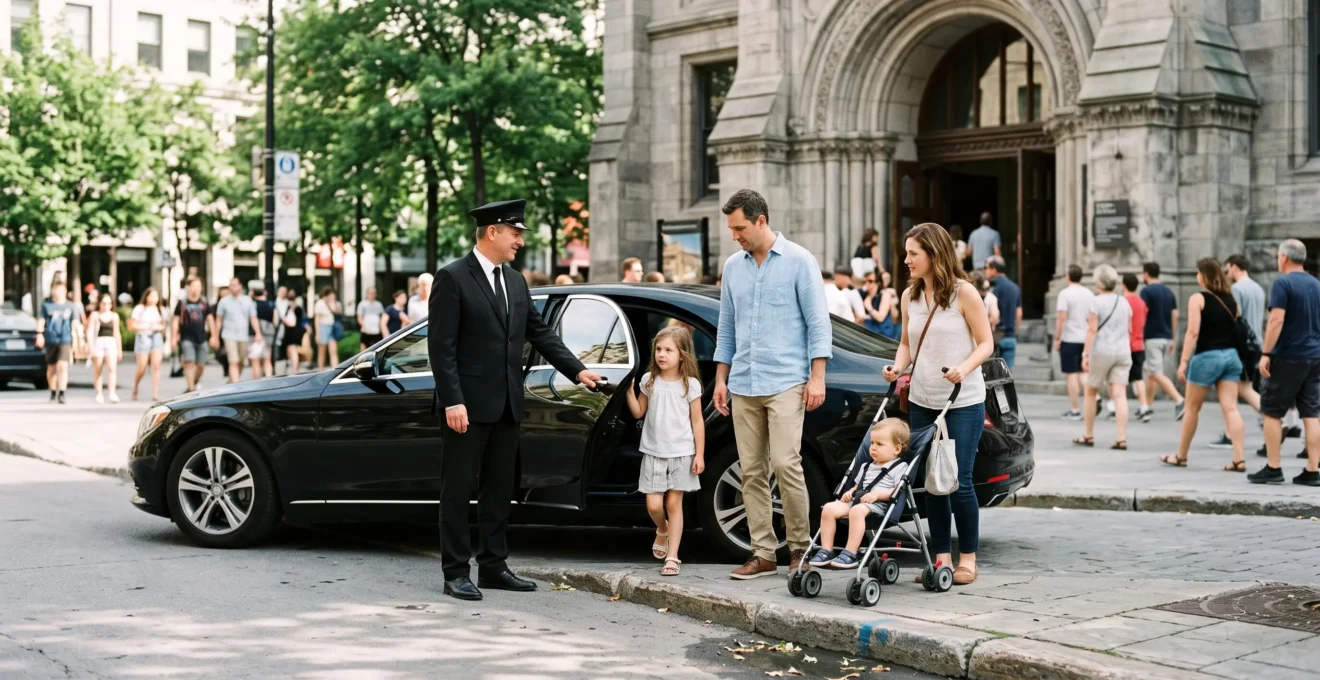
Montréal’s Biodôme, Botanical Garden, Old Port and Mount Royal promise very different visitor experiences, yet three transportation problems can complicate all four: finding suitable parking, arriving at the right time and managing the walking distance between a vehicle and the attraction itself.
The solution is not necessarily a private driver or even a car. It is choosing transportation around each attraction’s entrance, operating conditions and intended visit duration rather than treating every destination as an ordinary address.
A metro journey may eliminate downtown parking uncertainty. A carefully selected Mount Royal parking lot may reduce an unexpected uphill walk. A prearranged drop-off can help families preserve energy for exploring the attraction instead of reaching it.
The following guide translates these choices into practical decisions, using official municipal and attraction information where available while distinguishing documented facts from illustrative travel scenarios.
Montréal attraction transportation at a glance
- Parking: Select the actual entrance or parking facility, not merely the attraction’s name. Mount Royal has five official paid parking lots with different access conditions.
- Timing: Arrange timed admissions before choosing departure times, particularly for the Biodôme. An early arrival is useful only when it matches the attraction’s actual opening schedule.
- Walking: Include paths inside attractions, parking-to-entrance transfers and seasonal conditions when choosing between driving, public transit and door-to-door service.
- Why “Mount Royal” Isn’t Specific Enough: The 3 Parking Levels and Their Access Tradeoffs
- How to Visit Biodome, Botanical Garden, and Old Port in One Day Without Feeling Rushed
- May–September vs. October–April: How Season Changes Your Montréal Attraction Transportation Strategy
- The “Walking Distance” Mistake That Left a Family Exhausted After Just 2 Attractions
- When to Arrive at Biodome and Botanical Garden: The 9 AM Strategy That Skips 90-Minute Lines
- $28 Parking vs. $45 Drop-Off and Pickup: The Break-Even Point for 3-Hour Downtown Appointments
- Why Old Montréal Looks Nothing Like Plateau Mont-Royal: The 5 Architectural Eras Explained Through Transportation
- How Drop-Off Service Saves 40 Minutes of Parking-Search Stress at Montréal’s Busiest Venues
Why “Mount Royal” Isn’t Specific Enough: The 3 Parking Levels and Their Access Tradeoffs
Searching for “Mount Royal” without specifying an entrance can lead visitors to a parking location poorly suited to their intended viewpoint, walking capacity or schedule. Three practical access categories help organize the decision: approaches from surrounding streets, elevated parking facilities within the park and destinations reached only after continuing on foot. These are planning categories, not the municipality’s official parking classification.
According to Ville de Montréal’s Mount Royal Park access and parking information, the park has five paid parking lots: two near the Beaver Lake pavilion, two at Maison Smith and one at the Camillien-Houde lookout.
The distinction matters because reaching a parking lot is not necessarily the same as reaching the viewpoint or recreational area a visitor intended to see.
A useful access framework is:
| Access category | Transportation trade-off | Visitor consideration |
|---|---|---|
| Surrounding streets at the foot of the hill | Offers access from neighbouring districts but may require a significant uphill walk. | Better suited to visitors deliberately planning a longer walk. |
| Paid parking facilities within the park | Brings the vehicle closer to selected park facilities, although walking may still be required. | Choose the specific lot according to the planned activity. |
| Pedestrian-only paths and lookout approaches | Vehicles cannot complete every part of the journey. | Allow for the final walking segment and check the accessibility of the intended route. |
The municipality lists parking hours of 6 a.m. to midnight for the Beaver Lake and Maison Smith lots, and 6 a.m. to 11 p.m. for Camillien-Houde. Each lot includes one or two spaces reserved for people with reduced mobility. These published arrangements should still be verified before travel.
For families with strollers or visitors with limited mobility, the most useful comparison is therefore the accessible route from the selected parking location to the precise destination, not simply the distance between map markers.
Temporary works introduce another variable. The city’s park information has identified restrictions affecting Chemin Olmsted and reduced parking availability around Maison Smith. Such restrictions are date-specific and should not be assumed to remain permanently in force.
The practical method is to identify the intended lookout or facility, choose a compatible parking or drop-off location, then check municipal restrictions the day before departure.
Choosing the right endpoint prevents the avoidable surprise of arriving at the correct park but the wrong starting point for the visit.
How to Visit Biodome, Botanical Garden, and Old Port in One Day Without Feeling Rushed
A practical one-day itinerary groups the Biodôme and Botanical Garden in Montréal’s eastern Olympic Park area before continuing toward the Old Port. This avoids repeatedly crossing between eastern attractions and the historic waterfront. Success depends less on squeezing three stops into a timetable than on reserving enough time inside each attraction and minimizing unnecessary vehicle transfers.
The Biodôme and Botanical Garden belong to Espace pour la vie, but they are distinct visitor destinations. Separate entrances, admission arrangements and internal walking requirements must be accounted for.
A workable planning sequence is:
- Morning: Visit the Biodôme using a reserved admission time where available.
- Late morning or early afternoon: Continue to the Botanical Garden, selecting the areas that matter most rather than assuming the entire garden can be explored quickly.
- Later afternoon: Travel toward Old Montréal and the Old Port for a waterfront walk, provided the previous visits have not already exhausted the available time.
The Botanical Garden is located at 4101 Rue Sherbrooke Est. Its published access information identifies Pie-IX metro station and bus routes 185 and 139 as transportation options.
For drivers, Espace pour la vie’s Botanical Garden transportation and parking information lists an outdoor lot with 326 spaces, including six wheelchair-accessible spaces, and a published daily parking rate of 14.25 CAD.
The same source indicates that parking vouchers are valid across the Botanical Garden, Insectarium, Biodôme and Planétarium parking facilities. Voucher validity should not be confused with guaranteed space availability.
| Mode | Main advantage | Main limitation |
|---|---|---|
| Private car | Flexible for carrying belongings and adapting departure plans. | Requires planning separate parking arrangements, especially downtown. |
| Metro and walking | Avoids vehicle parking at the Old Port and can make trip costs predictable. | Requires station access, transfers and walking at both ends. |
| Taxi or scheduled drop-off | Allows transport between selected entrances without retrieving a parked car. | Cost and travel time depend on traffic, pickup conditions and availability. |
Exact journey-time comparisons require a live route check for the chosen day and departure hour. A taxi is not automatically faster than the metro during heavy traffic, and a private vehicle may lose time when downtown parking is included.
No official evidence in the supplied attraction information establishes one universally correct visit duration. A visitor interested in extensive plant collections will need substantially more time at the Botanical Garden than someone choosing only a small section.
The realistic alternative is to split the attractions across two days whenever admission availability, walking tolerance or a late start makes the combined itinerary overly ambitious.
An itinerary with enough flexibility for the attractions themselves is more useful than one optimized solely for the number of stops completed.
May–September vs. October–April: How Season Changes Your Montréal Attraction Transportation Strategy
Montréal’s attraction transportation strategy changes with the season because street access, walking comfort and parking conditions are not constant. From May through September, pedestrian activity, festivals and temporary road arrangements can affect car access. From October through April, colder weather, snow-clearing operations and shorter daylight periods make final walking distances and winter parking restrictions more important.
These date ranges are planning approximations rather than fixed boundaries for summer or winter conditions.
During warmer months, walking between attractions in Old Montréal can be enjoyable. However, festival-related street restrictions may require drivers to select parking outside a particular event perimeter and complete the remaining journey on foot.
Before driving downtown during a major event, check the municipal event information, temporary circulation restrictions and permitted drop-off locations rather than relying entirely on an ordinary navigation route.
Winter introduces a different set of operational risks.
The Ville de Montréal’s street and sidewalk snow-clearing information, updated July 13, 2026, describes snow clearing beginning at 2.5 cm of accumulation and snow-loading operations at approximately 10–15 cm.
These are municipal maintenance thresholds, not predictions of how long tourists will take to walk.
2.5 cm
The snow-accumulation threshold from which Montréal begins snow-clearing operations, according to the municipal information. The threshold does not determine whether an individual street or parking space is immediately cleared.
Ville de Montréal, municipal snow-clearing information, updated July 13, 2026.
Snow removal can also involve temporary parking restrictions, making a space that appears convenient on an ordinary map unavailable during municipal operations.
For visitors, the relevant question is not whether driving is always better in January. It is whether the entire route remains manageable under the day’s conditions, including sidewalks, station approaches and transfers.
| Planning factor | May–September | October–April |
|---|---|---|
| Old Montréal access | Check events and pedestrian street restrictions. | Check weather, sidewalk conditions and winter parking notices. |
| Mount Royal | Consider recreational walking and busy visitor periods. | Confirm path conditions and whether the intended access remains suitable. |
| Multi-attraction days | Account for festivals, crowds and outdoor walking. | Allow flexibility for daylight, weather and seasonal opening hours. |
| Door-to-door transport | Useful when event traffic makes parking impractical. | Useful when reducing outdoor walking is a priority, provided legal curb access remains available. |
Attractions may also operate different seasonal hours. Tourist transport services may change schedules, but the information available here does not establish specific seasonal frequency reductions.
Check attraction hours and transport timetables individually before finalizing the itinerary.
The strongest seasonal plan preserves an alternative route or mode rather than assuming the original parking or drop-off arrangement will remain practical.
The “Walking Distance” Mistake That Left a Family Exhausted After Just 2 Attractions
A family can underestimate a Montréal sightseeing day by measuring only the distance between attractions. Walking inside the Botanical Garden, climbing paths on Mount Royal, crossing large public spaces and returning to a distant parking garage all add effort. The relevant planning measure is the total expected walking burden, including slopes and breaks, rather than the shortest distance shown on a map.
Consider an explicitly hypothetical family visiting the Botanical Garden and Mount Royal.
The parents identify a convenient parking location near each attraction and assume the day will involve two short walks. But the Botanical Garden requires movement within its grounds, while the selected Mount Royal route involves a climb toward a viewpoint.
The initial map calculation did not include either activity.
Illustrative family walking-budget calculation
Assume a family plans 2.5 km of walking within the Botanical Garden and 1.5 km on Mount Royal. Another 1 km is expected between parking locations, attraction entrances and return points.
The resulting estimated walking total is 5 km, not counting additional detours. These distances are hypothetical planning inputs, not measured routes or evidence of an actual family’s experience.
The calculation becomes more useful when adjusted for the visitors.
A family with young children may need frequent stops. Older visitors may prefer gentler gradients. Someone using a wheelchair or stroller needs reliable accessible routes rather than merely a short route on the map.
A simple walking budget should record:
- Expected walking inside each attraction.
- Distance from parking or the transit stop to the entrance.
- Changes in elevation, stairs and accessible-route alternatives.
- Return journeys and additional walking caused by meals or rest stops.
- Available opportunities to rest, shorten the visit or change transportation.
Reducing the last segment through a legal curbside drop-off can help, but it does not remove the walking required within a large attraction.
A practical improvement is to reserve walking capacity for the part visitors actually want to experience. If Mount Royal is the day’s main physical activity, avoid adding an unnecessarily long parking-to-entrance transfer beforehand.
Transportation becomes part of accessibility planning when the entire visitor experience, rather than the journey alone, determines the amount of effort required.
When to Arrive at Biodome and Botanical Garden: The 9 AM Strategy That Skips 90-Minute Lines
Arriving near opening time can be a sensible way to organize a Biodôme or Botanical Garden visit, but neither a universal 9 a.m. opening nor a guaranteed 90-minute queue saving is established by the available sources. The reliable strategy is to confirm the day’s operating hours, secure appropriate admission and schedule transportation around the confirmed entry conditions.
The distinction matters because queue-management advice often turns plausible visitor behaviour into an unsupported numerical promise.
The Biodôme’s official visitor FAQ strongly recommends buying timed admission tickets online to reduce the risk of disappointment and waiting in line.
That guidance supports advance reservation. It does not establish a measured difference between morning queues and later queues, nor does it show that arriving at exactly 9 a.m. consistently avoids 90 minutes of waiting.
Visitors should therefore treat 9 a.m. as a potential planning reference only when consistent with the attraction’s actual hours and ticket availability.
The Botanical Garden requires separate consideration. Its large grounds encourage a visit organized around the specific areas, exhibitions or seasonal activities of interest. The preferred arrival time may depend on weather and event schedules, rather than merely avoiding an entrance queue.
Several factors can influence expected attendance: weekends, Québec school holidays, special events and weather. None should be translated into a precise waiting-time forecast without reliable operational data.
Five steps to secure an attraction-ready arrival plan
- Confirm operating hours: Record the opening and admission hours for the exact visit date in a short itinerary note.
- Secure admission: Save the Biodôme timed-ticket confirmation and any other required attraction reservations.
- Select an entrance: Record the intended arrival address or entrance rather than using only the attraction’s general name.
- Check transportation: Save the selected metro route, parking location or legal drop-off arrangement and an alternative.
- Set the departure plan: Record a departure time that accommodates the confirmed admission conditions and a contingency for delays.
An advance ticket and well-planned arrival work together. A reservation addresses admission uncertainty, while transportation planning addresses the risk of reaching the attraction later than intended.
The most useful arrival time is the one supported by confirmed opening hours, admission arrangements and a realistic journey, not a fixed hour promoted as universally optimal.
$28 Parking vs. $45 Drop-Off and Pickup: The Break-Even Point for 3-Hour Downtown Appointments
A CAD 28 parking charge can appear cheaper than a CAD 45 drop-off and pickup service, but the comparison changes when parking searches, walking time and schedule overruns are considered. For a three-hour downtown appointment, the break-even point depends on the total monetary cost and how much time the visitor can reasonably save. The CAD 28 and CAD 45 amounts are illustrative scenario values, not verified market quotations.
The starting monetary calculation is straightforward:
- Illustrative parking cost: CAD 28.
- Illustrative combined drop-off and pickup cost: CAD 45.
- Initial price difference: CAD 17.
At those assumed prices, parking is cheaper before accounting for additional costs or time.
Suppose the combined time saved by avoiding a parking search, garage access and walking to the final destination is 30 minutes. Recovering the CAD 17 difference through time savings would imply valuing that half-hour at CAD 17, or CAD 34 per hour.
That is an arithmetic decision threshold, not an asserted local wage, service rate or measured transportation saving.
| Scenario | Parking at CAD 28 | Drop-off/pickup at CAD 45 |
|---|---|---|
| Price only | CAD 17 cheaper | Higher direct cost |
| 20 minutes saved by drop-off | Cheaper unless time is valued above CAD 51/hour | Reaches break-even at CAD 51/hour of saved time |
| 30 minutes saved by drop-off | Cheaper below CAD 34/hour of saved time | Reaches break-even at CAD 34/hour |
| 40 minutes saved by drop-off | Cheaper below CAD 25.50/hour of saved time | Reaches break-even at CAD 25.50/hour |
All time savings in the table are hypothetical. The formula is the CAD 17 price difference divided by the assumed hours saved. Parking fees, pickup costs and waiting charges would need to be updated using actual quotes.
Passenger count introduces another perspective. If four people share the hypothetical CAD 45 service, the direct price corresponds to CAD 11.25 per passenger. The equivalent allocation of CAD 28 parking is CAD 7 per passenger, excluding vehicle operating costs. Dividing costs does not itself reverse which option is cheaper, but it may change how affordable the difference feels to each traveller.
A solo business traveller with a tight appointment schedule may place a high value on predictability. A couple visiting downtown without strict timing may prefer whichever option has the lower actual total cost. A family carrying substantial equipment may find that retaining its vehicle is more convenient.
Any comparison with a taxi or rideshare should also check whether the quoted amount includes waiting, traffic-related adjustments and pickup arrangements. A scheduled pickup may reduce the need for paid driver waiting, but only if the provider’s terms support that arrangement.
The better choice is the option whose full cost, reliability and accessibility fit the appointment, not simply the one with the lower advertised starting price.
Why Old Montréal Looks Nothing Like Plateau Mont-Royal: The 5 Architectural Eras Explained Through Transportation
Old Montréal, downtown and Plateau Mont-Royal look different because their streets and buildings developed around distinct historical transport needs. Earlier pedestrian and commercial routes, later industrial connections, downtown business infrastructure and residential street patterns continue to influence modern accessibility. Understanding these differences helps visitors decide where to walk, where public transit is more practical and where parking demands extra planning.
Montréal’s urban landscape can be interpreted through five broad architectural and transportation phases. These categories overlap in time and geography rather than representing five strictly separated municipal development periods.
| Urban phase | Visible urban character | Today’s visitor implication |
|---|---|---|
| French colonial development | Historic street patterns and surviving architectural features in Old Montréal. | Walking helps visitors experience the historic fabric without repeated vehicle movements. |
| Victorian and commercial expansion | Warehouses and commercial buildings associated with the historic port economy. | Older street layouts and tourism activity require careful curbside planning. |
| Industrial and working-class development | Factories, former industrial areas and associated residential neighbourhoods. | Routes should be planned around actual street connections rather than simple straight-line proximity. |
| Modern downtown business development | Larger commercial buildings, major roads and parking infrastructure. | Garages and public transit may provide more structured access than curbside parking. |
| Plateau residential development | Residential streets, characteristic exterior staircases and neighbourhood-scale commercial activity. | Walking and transit can be more convenient than repeatedly searching for street parking. |
These are historical interpretations rather than findings established by the operational sources used for park and attraction access. Their main planning value lies in the differences between neighbourhood street environments.
In Old Montréal, a visitor can often get more value from arriving once and exploring on foot than from driving between individual historic landmarks.
In Plateau Mont-Royal, the destination may be a residential street, independent shop or neighbourhood attraction. A metro journey followed by a walk can remove the need to negotiate unfamiliar parking arrangements.
Downtown presents a different calculation: parking garages may be available, but their cost, precise location and pedestrian connections matter.
A cross-neighbourhood itinerary should therefore combine two strategies: efficient transfers between districts and exploration within each district using the most suitable local mode.
For instance, visiting several Old Montréal landmarks consecutively avoids unnecessary vehicle retrieval. A later transfer toward Plateau Mont-Royal can be considered separately, with the destination address determining whether transit or a pickup service is practical.
The city becomes easier to navigate when transportation decisions follow the structure of each district rather than assuming a single method will perform equally well everywhere.
Key takeaways before choosing a drop-off service
- A drop-off removes the parking task, but it does not automatically eliminate congestion, queues or walking within the attraction.
- The correct comparison includes legal curb access, pickup coordination, actual fares and the ability to recover a parked vehicle if plans change.
- The highest-value journeys are those where parking uncertainty directly threatens an admission time, mobility requirement or multi-stop schedule.
How Drop-Off Service Saves 40 Minutes of Parking-Search Stress at Montréal’s Busiest Venues
A scheduled drop-off can remove several parking-related steps from a Montréal attraction visit, but a 40-minute saving is a hypothetical illustration rather than a documented average. The potential benefit comes from eliminating the parking search, garage-to-entrance walk and subsequent vehicle retrieval. It is greatest when suitable legal drop-off access exists and the alternative parking arrangement is inconvenient.
The relevant comparison must account for the entire visitor journey.
A driver who parks near a busy attraction may need to find an available space, reach the entrance on foot and eventually return to the vehicle. A drop-off passenger avoids some of those steps but still depends on traffic conditions and a workable pickup location.
Consider an explicitly hypothetical 40-minute parking-related burden:
| Activity | Illustrative duration |
|---|---|
| Searching for available parking | 15 minutes |
| Walking from parking to the entrance | 10 minutes |
| Returning to the garage and exiting | 15 minutes |
| Total | 40 minutes |
These figures explain a possible mechanism for saving time; they are not observations from the Old Port, Espace pour la vie or any measured Montréal traffic study. Actual savings may be smaller, nonexistent or offset by pickup delays.
Drop-off is particularly worth evaluating for visitors facing timed admission, limited walking capacity or multiple attractions whose entrances are far from convenient parking.
However, a private vehicle may be more useful for a full-day trip with substantial equipment, repeated storage needs or several young children requiring approved child restraints. The operator’s vehicle suitability and child-seat arrangements must be confirmed before booking.
For a successful drop-off, three details matter.
First, the stopping point must be legal and practical. An entrance that looks accessible on a map may have curb restrictions, event closures or congestion that prevents stopping exactly outside.
Second, the pickup needs a defined meeting point. A phrase such as “outside the attraction” may be inadequate where multiple entrances or busy streets exist. Confirm the precise location, agreed pickup time and a way to contact the driver.
Third, the visitor needs a contingency plan. A delayed admission, longer-than-expected visit or changed street arrangement should not leave the family depending on an unavailable pickup.
For Old Montréal, arranging transport to a suitable perimeter location may be more reliable than attempting to reach an interior historic street by car. For Espace pour la vie, coordinate around the actual attraction entrance. At Mount Royal, confirm whether the intended drop-off point supports the planned pedestrian route.
The strongest service is not necessarily the one promising the greatest time saving. It is the one that accurately specifies where the passenger will be collected, where the vehicle may legally stop, what costs apply and how changes are handled.
For the next Montréal attraction visit, choose the admission time first, identify the precise entrance, compare the complete walking and parking requirements, then select the transport option that offers the most manageable journey.
Can visitors use one parking voucher for the Biodôme and Botanical Garden?
Espace pour la vie states that parking vouchers are valid across the Botanical Garden, Insectarium, Biodôme and Planétarium parking facilities. This does not guarantee that a space will be available at each location. Visitors should verify current conditions and the voucher’s applicable terms before travelling.
Is public transportation better than driving to Old Montréal?
Public transportation can be convenient for visitors who want to walk around the historic district without finding parking. Driving may still be preferable when carrying equipment or travelling with specific accessibility needs. Compare the total journey, including the walk from the transit stop or garage, before deciding.
Does the Biodôme guarantee faster entrance with a timed ticket?
The Biodôme recommends online timed admission tickets to reduce the risk of disappointment and waiting in line. That recommendation does not guarantee immediate entry or establish a specific amount of time saved. Visitors should follow the admission instructions associated with their confirmed booking.
Can a vehicle take visitors directly to every Mount Royal lookout?
No such universal vehicle access should be assumed. Mount Royal has multiple parking locations and pedestrian routes, with different access arrangements. Check the intended viewpoint, appropriate parking or drop-off location and current municipal restrictions before departure.
What should visitors check before driving to Montréal attractions after snowfall?
Check municipal snow-clearing notices, temporary parking restrictions, road access and the condition of the final pedestrian route. Snow removal can alter parking availability, and a normally convenient street may have temporary restrictions. Keep an alternative parking or transportation option available when conditions are uncertain.