
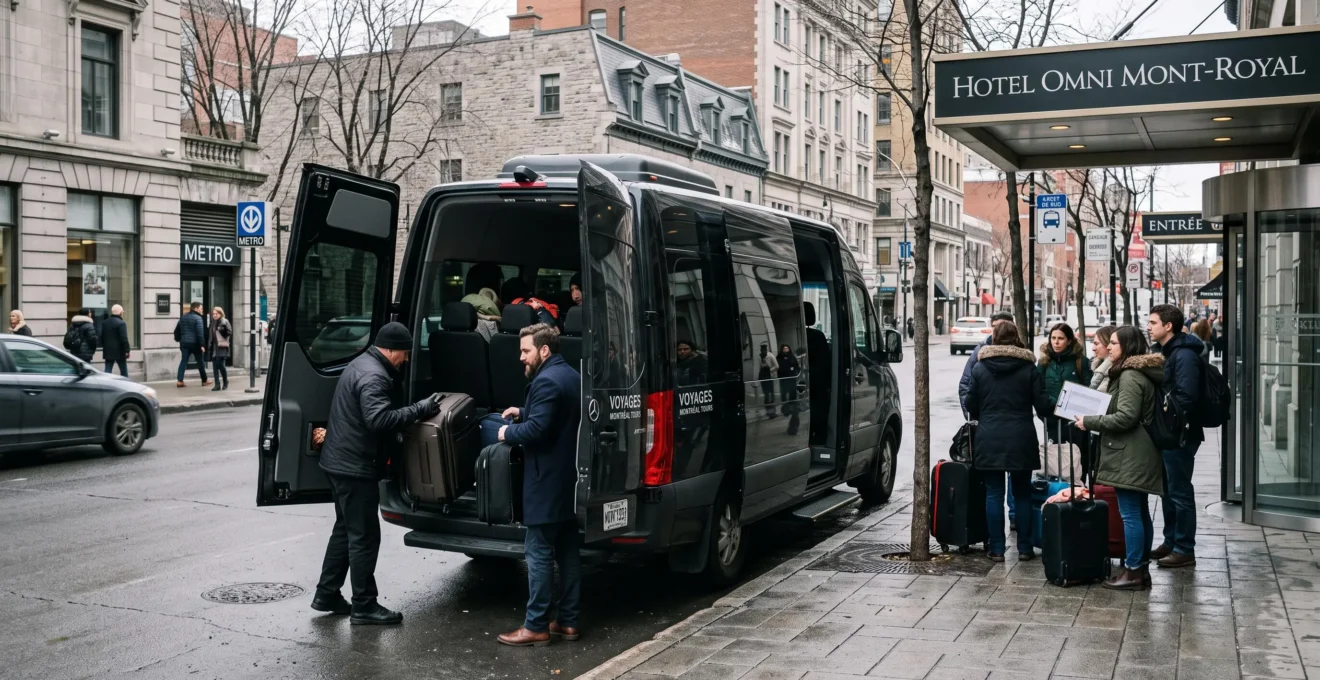
Transporting 12 people across Montréal becomes complicated when passenger capacity, luggage volume and pickup logistics are treated as separate problems. A vehicle advertised with enough seats may lack sufficient baggage space, while booking several smaller vehicles can introduce unnecessary expense, coordination work and the possibility of guests arriving at different times.
For corporate events, family reunions and organized tours, the most effective approach is to match vehicle configuration to the actual journey. A downtown dinner transfer without luggage has different requirements from an airport arrival with 12 large suitcases or a sightseeing excursion with several stops.
Start with the complete passenger and luggage manifest, not the advertised seat count. Then compare appropriately configured vehicles using the total cost of moving everyone together. Finally, confirm pickup access, loading arrangements and contingency procedures for the specific date. This method helps preserve group cohesion without purchasing more vehicle capacity than the itinerary requires.
Montréal group transportation: essential decisions
- Count passengers, usable seat belts and luggage dimensions separately before selecting a van, SUV convoy or minibus.
- Compare complete transportation quotes, including driver charges, waiting time, gratuities and coordination requirements.
- For multi-hotel events, assign guests to vehicles, stagger departures and designate one dispatcher to handle changes.
- Why a “14-Passenger Van” Only Comfortably Fits 10 With Airport Luggage
- One Sprinter Van vs. Two SUVs: The Pricing Break-Even for Groups of 10-14 in Montréal
- Minibus vs. Full-Size Coach: Which Makes Sense for 18 Passengers on a 4-Hour City Tour?
- The Luggage Mistake That Forced a Wedding Party to Wait for a Second Vehicle at YUL
- When to Announce “Lobby by 8”: How Event Planners Coordinate 6+ Vehicles Without Delays, Confusion, or Lost Guests
- Sedan vs. Minivan vs. Sprinter Van: Which Fits Your Group’s Comfort and Budget?
- When to Start Hotel Pickup Rotations for a 6 PM Event With 80 Guests Across 3 Hotels
- How Event Planners Coordinate 6+ Vehicles Without Delays, Confusion, or Lost Guests
Why a “14-Passenger Van” Only Comfortably Fits 10 With Airport Luggage
A van advertised for 14 passengers may accommodate only 10 travelers comfortably when everyone brings substantial airport luggage, but this is not a universal capacity rule. The actual limit depends on the vehicle’s seating configuration, dedicated cargo compartment, payload allowance and luggage dimensions. A larger van may accommodate all 14 without sacrificing seats.
Advertised seating capacity establishes how many occupants a particular configuration is designed to carry, not how many suitcases its cargo area can accommodate. Passenger vans differ considerably in body length, roof height and the space remaining behind their final seating row.
For example, Ford Canada‘s 2026 Transit vehicle specifications distinguish multiple passenger configurations. The supplied technical figures identify cargo volumes ranging from 48.9 cubic feet behind the fourth row in a long-body, low-roof configuration to 100.5 cubic feet behind the fifth row in an extended-length, high-roof configuration. These are configuration-specific Ford measurements, not universal specifications for Sprinter vans.
Some operators use removable seating configurations or other approved layouts to increase baggage space. The resulting passenger capacity must be confirmed for the actual vehicle. A suitcase does not automatically consume one seat, and volume alone cannot predict whether baggage will fit safely.
To assess practical capacity, request the usable cargo dimensions behind the final occupied row. Compare the width, depth and height with the dimensions of the actual bags. Account separately for strollers, golf equipment, skis, garment bags and boxed presentation materials. Then ask the operator to verify the proposed loading arrangement against weight limits and baggage-securing requirements.
The difference between airport transfers and local journeys is substantial. Twelve passengers moving between a hotel and a restaurant may travel together with virtually no luggage. The same group arriving at Montréal-Trudeau International Airport with checked suitcases could require additional baggage capacity or a different vehicle.
Passenger safety remains non-negotiable. The SAAQ‘s official seat-belt safety information explains that the number of passengers in an automobile cannot exceed the number of positions equipped with manufacturer-installed seat belts. Commercial bus categories may involve additional rules, and no luggage arrangement justifies improvised seating.
The most economical vehicle is not necessarily the one with the highest advertised seat count. It is the smallest suitable configuration that transports every passenger and bag safely, without forcing an unexpected second dispatch.
One Sprinter Van vs. Two SUVs: The Pricing Break-Even for Groups of 10-14 in Montréal
One appropriately configured Sprinter-style passenger van can be more economical than two SUVs when it accommodates the entire group and its luggage. However, the break-even point depends on actual operator quotes, driver charges, waiting time and vehicle availability. Compare total trip costs for the same itinerary rather than comparing advertised hourly or vehicle rates alone.
A single van has one driver, one loading operation and one scheduled arrival. Two SUVs require separate passenger assignments and potentially different loading arrangements. When the journey involves airport arrivals, group coordination also becomes part of the expense.
The relevant calculation is:
Total transportation cost = vehicle charges + driver-related charges + waiting or access fees + additional coordination costs.
Some coordination costs are financial, such as paid staff time. Others are operational risks, including split arrivals or a passenger entering the wrong vehicle. These should be assessed separately instead of being disguised as fixed monetary charges.
A simple hypothetical comparison illustrates the process without representing actual Montréal fleet prices.
| Cost component | One passenger van | Two SUVs |
|---|---|---|
| Quoted vehicle and driver charges | CAD 360 | CAD 170 × 2 = CAD 340 |
| Illustrative gratuities | CAD 36 | CAD 17 × 2 = CAD 34 |
| Additional paid coordination | CAD 0 | CAD 40 |
| Illustrative total | CAD 396 | CAD 414 |
| Arrival arrangement | One group | Two assigned groups |
These figures are hypothetical arithmetic examples, not published rates or recommended gratuities. Actual quotations must also clarify applicable taxes, waiting allowances, parking, tolls and any required minimum booking duration. In this illustration, the van is CAD 18 less expensive only after all assumed charges are included.
Two SUVs can be preferable when passengers need privacy, separate destinations or different departure times. They may also provide flexibility where the selected van cannot access a particular entrance or parking facility. Vehicle dimensions and access permissions require individual verification.
At YUL, meeting arrangements should be confirmed in advance. Montréal-Trudeau Airport‘s official passenger pickup guidance describes pickup alternatives including P4 and P10 Express facilities. Those general passenger arrangements do not establish that every commercial charter vehicle may use the same locations.
Major events such as the Canadian Grand Prix and Montréal’s summer festivals can affect transportation planning. Winter operating conditions also matter. Request date-specific quotes and confirmation of the authorized pickup point rather than assuming identical availability throughout the year.
When the totals are close, protecting group cohesion can justify choosing the single vehicle. When the convoy provides a genuine operational advantage, its additional coordination may be worthwhile.
Minibus vs. Full-Size Coach: Which Makes Sense for 18 Passengers on a 4-Hour City Tour?
For 18 passengers taking a four-hour Montréal sightseeing tour, a suitably configured minibus is often a practical first option because it can offer adequate seating without the scale of a full-size coach. The decisive factors are access at planned attractions, luggage requirements, passenger comfort and accessibility, rather than the number of unused seats alone.
A sightseeing itinerary involving Old Montréal, a Mount Royal lookout and Olympic Park requires repeated passenger loading, unloading and regrouping. These activities can consume a meaningful share of a short tour.
A minibus may simplify some stops, but smaller size does not guarantee legal or practical access. Vehicle-specific restrictions, curb regulations and designated stopping areas must be checked before finalizing the itinerary. A coach may need different drop-off arrangements, while certain minibuses can still be too large for constrained entrances.
For a four-hour experience, seating comfort and visibility deserve greater weight than they would on a short airport transfer.
| Consideration | Minibus | Full-size coach |
|---|---|---|
| Capacity matching | Potentially close to the group size | Often substantial unused seating |
| Attraction access | May offer more stopping flexibility | May require designated large-vehicle access |
| Sightseeing visibility | Depends on window and seating layout | Depends on coach design and seat position |
| Guide commentary | Verify microphone or PA availability | Verify installed PA and guide arrangements |
| Baggage storage | Configuration-dependent | May offer dedicated luggage compartments |
| Accessibility | Confirm suitable accessible equipment | Confirm accessibility of the actual vehicle |
| Pricing | Check minimum hours and inclusions | Check minimum hours and additional services |
A full-size coach may justify its higher capacity if passengers need extensive luggage storage, particular onboard amenities or seating arrangements unavailable in a smaller vehicle. Conversely, paying for dozens of empty seats rarely benefits an 18-person group when the minibus meets all other requirements.
Before selecting either category, establish whether passengers must remain seated together, whether the guide needs amplification, whether mobility equipment must be accommodated and whether baggage stays on board during stops.
Ask operators to identify approved stopping locations for the proposed vehicle and the time required to move the group from those locations to each attraction.
A four-hour tour should prioritize time spent experiencing Montréal over time spent walking from distant drop-off points or reorganizing passengers. The appropriate vehicle is the one that supports the planned stops without compromising comfort or accessibility.
The Luggage Mistake That Forced a Wedding Party to Wait for a Second Vehicle at YUL
The luggage mistake that can leave a wedding party waiting at YUL is booking transport for the correct number of passengers without verifying whether their combined baggage fits the assigned vehicle. No documented wedding-party incident or verified second-vehicle waiting time is supplied here, so the following example is hypothetical. Its purpose is to identify where the booking process can fail.
Hypothetical scenario: a wedding group arriving at YUL
A wedding party of 12 passengers reserves a vehicle advertised with sufficient seating. At booking, the organizer confirms the passenger count but does not specify checked suitcases, garment bags or boxed wedding decorations.
At the airport, the driver discovers that the reserved configuration cannot accommodate all passengers and baggage safely. The group must arrange additional transport or an alternative suitable vehicle. The length of any delay depends on actual fleet availability, dispatch arrangements and airport pickup permissions; no particular waiting time can be assumed.
The mistake typically develops through three separate administrative stages. At quotation, the provider receives an incomplete luggage description. At confirmation, vehicle seating capacity is accepted without a verified cargo plan. At dispatch, the driver may receive only the passenger count and pickup information.
The critical control point is written vehicle confirmation. The operator should approve both the passenger count and the baggage manifest for the exact vehicle layout assigned to the transfer.
For a group carrying unusual items, a useful manifest includes:
- Passenger count, including children and any relevant restraint requirements.
- Number and dimensions of large checked suitcases and cabin bags.
- Garment bags, strollers, sports equipment or presentation cases.
- Fragile or oversized boxed items requiring special handling.
- Arrival flight information and the nominated group contact.
Send the manifest approximately 48 hours before pickup as an operational planning target, while complying with any earlier deadline imposed by the provider. Ask whether the assigned vehicle can safely accommodate everything or whether a larger vehicle, approved trailer arrangement or separate luggage transport is necessary.
Airport arrival timing adds uncertainty. Travelers may clear baggage collection at different times, while an additional charter vehicle may not be immediately available. The pickup meeting point should also be confirmed under the commercial operator’s applicable YUL arrangements.
For weddings and other time-sensitive group movements, a confirmed baggage plan is more valuable than an optimistic assumption about available space. It gives both the organizer and operator a shared basis for preventing an avoidable capacity mismatch.
When to Announce “Lobby by 8”: How Event Planners Coordinate 6+ Vehicles Without Delays, Confusion, or Lost Guests
For a coordinated departure at 8:00, the guest-facing lobby time should be earlier than the actual vehicle release time whenever check-in, baggage handling or staggered boarding is required. The appropriate buffer depends on passenger numbers, elevators, luggage and loading capacity. Assigning every guest to a specific vehicle before arrival makes the operation substantially easier to control.
A common planning error is treating a lobby announcement as equivalent to departure readiness. Guests may still be collecting luggage, searching for companions, checking out or waiting for elevators when the transport fleet arrives.
With six or more vehicles, simultaneous curbside loading may be impossible. A hotel entrance can accommodate only the number and type of vehicles permitted by its physical layout and applicable loading rules. Vehicle waves should therefore be scheduled around actual loading capacity.
A practical sequence separates three moments: guests report to the lobby, the coordinator verifies each passenger against the manifest, and assigned vehicles are called forward when loading space becomes available.
Consider a hypothetical 80-person departure using six vehicles. Rather than asking everyone to gather at the hotel entrance simultaneously, the coordinator can create passenger groups linked to vehicle identifiers and dispatch them in successive waves.
Each vehicle receives a confirmed boarding list, while one hotel contact maintains the master manifest. Guests should receive their assigned vehicle, meeting place and reporting time in advance. If an assignment changes, the master list must be updated before the guest boards.
Missing guests require a defined response. Assign staff to check the designated gathering area, contact absent passengers and complete a second reconciliation before releasing the final vehicle. A 10-minute checking window can be used as an initial planning assumption, but it must fit the actual hotel layout and event schedule.
Winter coats, boots and bulky baggage may increase boarding time. Hotels hosting multiple conferences may also experience congested elevators and common areas. During planning, ask the property about loading availability rather than presuming vehicles can wait continuously at the curb.
A clear announcement is only the beginning. Reliable departures depend on knowing who is present, which vehicle each person will board and who has authority to release that vehicle.
Sedan vs. Minivan vs. Sprinter Van: Which Fits Your Group’s Comfort and Budget?
A sedan is generally appropriate for a small party, a minivan can suit many groups of four to six, and a properly configured Sprinter-style passenger van becomes attractive for approximately seven to twelve travelers who want to remain together. Those ranges are planning guides, not universal vehicle capacities. Luggage, installed passenger seats, travel duration and seating comfort determine the final choice.
The journey itself changes what passengers perceive as comfortable. Several sedans may work acceptably for a short hotel transfer where passengers have separate schedules. They are less practical when a corporate team needs to discuss the day together or a family group wants to share the journey.
For a longer transfer toward Mont-Tremblant, for example, splitting passengers between cars can reduce opportunities for group conversation and make coordinated stops more complicated. However, a larger van is not automatically more comfortable: seat pitch, climate control, accessibility and luggage arrangement also matter.
The most useful comparison is total cost per passenger delivered, calculated after all vehicles, drivers, service charges and necessary extras are included.
| Vehicle category | Potential advantage | Main limitation to verify |
|---|---|---|
| Sedan | Useful for small groups or separate schedules | Passenger and baggage capacity per car |
| Minivan | Combines passengers into one smaller vehicle | Comfort and remaining cargo space with occupied rear seats |
| Sprinter-style van | Preserves cohesion for larger groups | Exact customer seating and luggage configuration |
| Multiple vehicles | Allows independent pickups and destinations | Additional drivers, coordination and arrival synchronization |
A useful decision rule is to tolerate a convoy only when the flexibility it provides outweighs the coordination it creates. The acceptable journey length for a split group is a planning preference, not a universal time threshold.
When requesting quotes, ask the same Montréal operator to price two valid configurations for identical passenger numbers, luggage quantities, pickup times and destinations. For example, compare one suitable passenger van with two appropriately sized minivans. Repeat with another provider if necessary because fleet composition and availability differ.
Do not assume that an advertised 12-passenger vehicle has 12 passenger seats available to customers; some configurations count the driver. Also verify that each passenger has a legitimate seat and that all bags can be transported without compromising safe access or loading.
The optimal configuration can change between an airport arrival, a business meeting and an excursion. Requesting separate quotes for those movements may cost less than reserving oversized transport for an entire itinerary.
When to Start Hotel Pickup Rotations for a 6 PM Event With 80 Guests Across 3 Hotels
For an event beginning at 6:00 PM with 80 guests staying across three Montréal hotels, plan departures backward from the required venue arrival time. Allow for traffic, vehicle loading, staggered pickups and guest reconciliation. Different hotels may need different departure schedules, and an illustrative plan could begin rotations 60–90 minutes before the event, depending on the actual routes.
The event start time is not necessarily the latest acceptable arrival time. If guests must register, find seats or attend a reception before the program begins, set an earlier target arrival and work backward from that deadline.
The basic planning calculation is:
First departure deadline = required venue arrival time − planned travel allowance − rotation duration − operational buffer.
Apply this calculation independently to each hotel. A property holding 45 guests may require more loading waves than one accommodating 12, even when it is physically closer to the destination.
For an illustrative scenario, suppose the group needs to reach the venue by 5:45 PM, with 30 minutes allocated to the journey, 20 minutes to the hotel’s loading rotation and 10 minutes of contingency. Under those assumptions, the first vehicle would need to depart by 4:45 PM. These are hypothetical inputs, not verified Montréal travel times.
The planner should distinguish the first vehicle’s departure time from the latest departure allowed for the final wave. A single schedule showing only one pickup time conceals this difference.
Montréal’s afternoon congestion, bridge approaches, roadworks and local restrictions can alter journey planning. Check the expected route close to the event date using suitable traffic information, and consult the City of Montréal‘s road obstruction and construction information to identify relevant municipal work. This service does not cover every jurisdiction or provide guaranteed driving times.
An earlier departure may reduce the need for extra vehicles when the existing fleet has sufficient time to complete several rotations. However, earlier departures also create guest waiting time and may increase billable service hours. The trade-off should be calculated using both timetable feasibility and actual operator pricing.
Define a final guest reporting cutoff, a clearly communicated fallback arrangement and an expense approval policy for exceptional taxi or other transfers. One dispatcher should track vehicle progress and update the remaining sequence when delays occur. If GPS information is unavailable, scheduled driver status reports can serve as an alternative.
For an 80-person event, arriving on time requires more than early departures. It requires a feasible sequence in which each hotel knows its assigned loading windows, the venue is prepared to receive arrivals and late guests have a documented alternative.
Key decisions before dispatch
- Approve a single version of the passenger-to-vehicle manifest and identify who may change assignments.
- Give each driver a run-sheet containing departure windows, hotel access instructions and the confirmed venue entrance.
- Set a predefined response for delays, missing passengers and the final post-event departure.
How Event Planners Coordinate 6+ Vehicles Without Delays, Confusion, or Lost Guests
Coordinating six or more vehicles requires one current guest manifest, a separate driver run-sheet and one authorized transportation coordinator. The manifest identifies who travels where; the run-sheet identifies when and how vehicles move; the coordinator handles exceptions. Keeping these three elements synchronized prevents conflicting instructions, overlooked passengers and unnecessary departures.
The most frequent organizational weakness is not necessarily a shortage of vehicles. It is fragmented information. A hotel reception desk may have one passenger list, drivers another and the event organizer a third. A last-minute room change or delayed arrival can then create contradictory instructions.
For a multi-vehicle operation, establish a clear communication hierarchy. Hotel contacts report exceptions to the coordinator. Drivers report vehicle status and access problems to the same coordinator. Guests receive updates through the designated event communication channel rather than independently attempting to redirect drivers.
Define escalation rules before transport begins. For example, an organizer may choose a hypothetical threshold of 15 minutes behind the planned schedule to trigger reassessment. That threshold is an internal decision rule, not a published Montréal transport standard. The coordinator then determines whether to hold, reassign or release the affected vehicle.
Confirmations should cover both the outbound transfer and the journey back. Post-event guests often depart at different times, especially when a program includes dinner, speeches or informal networking. Depending on demand and operator terms, consider scheduled return waves, an authorized standby vehicle or approved independent transportation.
Five actions to finalize a multi-vehicle transport plan
- Finalize the guest manifest: assign every passenger a hotel, pickup time, vehicle identifier and contact method. Deliverable: one approved master spreadsheet or printable list.
- Verify physical capacity: obtain written confirmation of passenger seats, luggage arrangements and any accessibility requirements for each assigned vehicle. Deliverable: a vehicle-capacity approval record.
- Create driver run-sheets: document the pickup sequence, loading locations, arrival targets, venue entrance and contact numbers. Deliverable: an individual confirmed run-sheet for every driver.
- Rehearse exceptions: confirm the procedure for missing guests, delayed vehicles, inaccessible loading areas and reassignment. Deliverable: a one-page contingency and escalation protocol.
- Approve return transportation: establish departure waves, final boarding instructions and the procedure for guests who leave independently. Deliverable: a return-trip manifest and departure schedule.
On the day before the event, reconfirm vehicle assignments, driver instructions and venue access with the operator. Ensure printed or accessible electronic manifests are available where needed. Personal information should be limited to what drivers and authorized staff genuinely require.
The venue drop-off location deserves explicit attention. A driver arriving at a loading dock when guests expect the main entrance can create confusion even when the vehicle itself is on time. Record the approved entrance and verify any access restrictions.
During the event, maintain a live record of departures, arrivals, passenger exceptions and operational changes. This makes the return operation easier to manage and provides a useful reference if a passenger reports missing baggage or an unresolved transfer problem.
The next step is to send the complete manifest, luggage requirements and proposed itinerary to shortlisted Montréal transportation operators, request comparable written quotes and appoint a single coordinator to approve the final operating schedule. The result should be a workable transport plan, not simply a collection of vehicle reservations.
Can 12 passengers travel together in one van with all their luggage?
Yes, if the specific vehicle has at least 12 legitimate passenger seats available for the group, sufficient usable cargo space, and appropriate weight and baggage-securing capacity. The operator must verify the proposed configuration against the actual luggage manifest. An advertised seating number alone is insufficient.
Should a group book its airport transfer before knowing the final luggage count?
An initial reservation may be possible, but it should remain subject to confirmation of the final baggage requirements. Give the operator a preliminary estimate, specify oversized items and establish a deadline for confirming the manifest. Ask whether changes could affect the vehicle class or quoted price.
Does a larger van automatically cost less per passenger than two SUVs?
No. Divide the complete quoted transportation cost by the number of passengers actually traveling. Include the relevant vehicle, driver, waiting, gratuity, access and coordination charges. The lowest total may vary by date, vehicle availability and whether passengers need separate destinations.
How far in advance should a Montréal group organizer confirm pickup arrangements?
Booking lead time depends on fleet availability, group size and the travel date. After reserving, reconfirm the itinerary, baggage requirements and authorized loading points according to the operator’s deadline. A final operational review one day before travel is useful, provided it does not replace earlier contractual confirmations.
What should happen if a passenger misses the scheduled group departure?
The designated coordinator should follow the agreed missed-passenger procedure rather than allowing individual drivers to improvise. This may involve contacting the passenger, checking the manifest, assigning an available later vehicle or authorizing independent transport under the event’s expense policy. Safety, venue access and the remaining group schedule should guide the decision.