
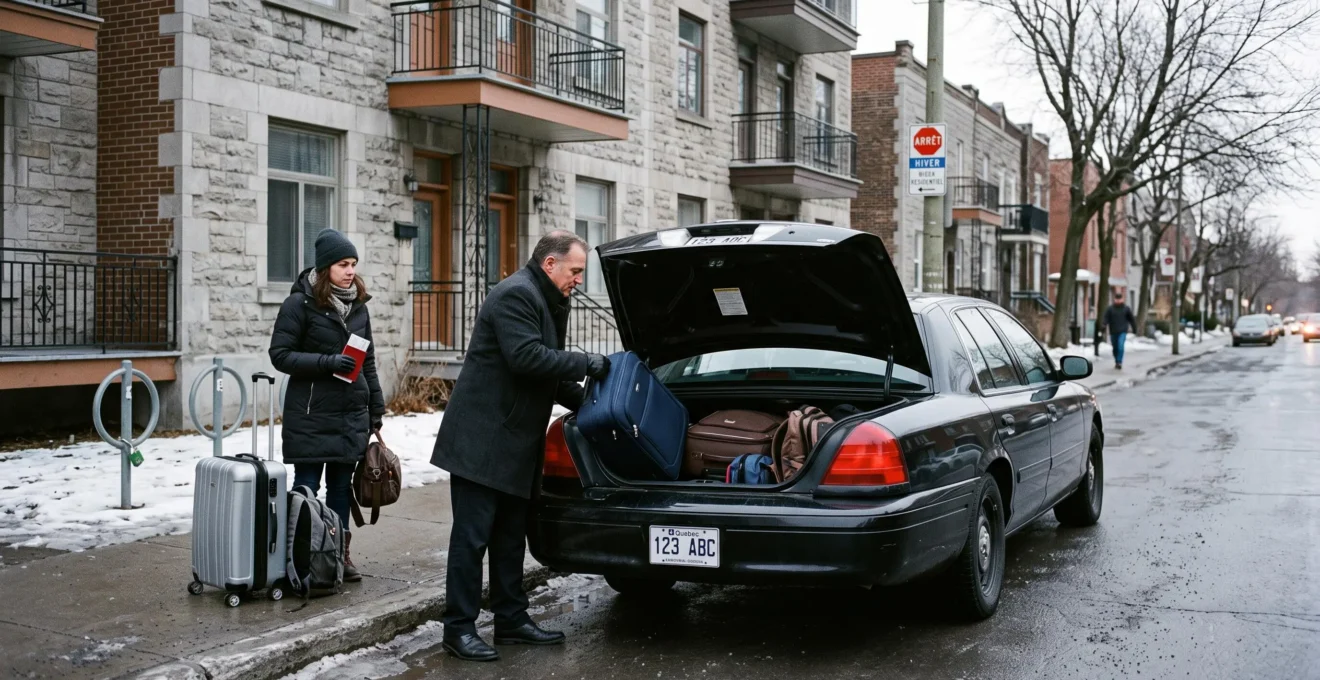
A private transfer can shorten a journey across Montréal by eliminating station access, connections, vehicle changes, and the final walk to a destination. A 28% reduction in door-to-door time is a useful comparison scenario, but it is not a verified citywide average. Actual savings depend on the route, departure time, congestion, and number of passengers.
For a professional traveling between offices or a family arriving at Montréal-Trudeau International Airport (YUL), the relevant measurement is not simply how quickly a train, bus, taxi, or private vehicle moves. It is how long the complete journey takes from the starting door to the destination entrance.
Montréal’s transportation network offers different advantages depending on the journey. Rail can bypass road congestion, shared rides may reduce individual fares, and pre-booked vehicles can simplify luggage handling and pickup planning. Understanding these trade-offs makes it possible to choose the fastest practical option without assuming that private transportation always wins.
Montréal transfer decisions at a glance
- Measure the complete journey: Include walking, waiting, connections, boarding, and destination access rather than comparing vehicle travel times alone.
- Match transportation to passenger needs: Families, travelers carrying several bags, and professionals with fixed appointments may benefit most from direct pickup.
- Treat percentage savings as route-specific: The 28% headline illustrates a potential advantage, not a documented result applicable to every Montréal itinerary.
- Why Private Transfer Beats REM for Airport-to-Laval Routes Despite the Train’s Speed
- How Private Transfers Eliminate the 4 Pain Points of Public Transit for Families With Toddlers
- Sedan vs. SUV for Private Montréal Transfers: Which Handles Potholes and Winter Roads Better?
- The “Shared Ride” Mistake That Turned a 25-Minute Transfer Into a 70-Minute Ordeal
- When to Request Pickup for a 3 PM Appointment: The Parking-Search Buffer for Residential Zones
- Private Transfer vs. REM vs. Shared Shuttle: The Cost-Time-Comfort Matrix for YUL to Downtown
- Why Driving Yourself Between Offices Takes 38% Longer Than Professional Drop-Off Service
- How Route Optimization Technology Cuts Montréal Travel Time by 35% During Peak Hours
Why Private Transfer Beats REM for Airport-to-Laval Routes Despite the Train’s Speed
A private transfer can be more convenient than a rail-based itinerary between Montréal-Trudeau Airport and many Laval destinations because it provides a continuous journey without station changes or last-mile arrangements. However, the REM airport branch is not yet operational as of October 2026, and Laval already has REM stations. The comparison therefore depends on actual available connections rather than a direct airport train.
According to the official REM commissioning schedule, the Montréal-Trudeau Airport branch is planned to enter service in 2027, subject to changes. Until it opens, passengers cannot board the REM directly at YUL. Any itinerary involving the existing network requires another transport mode to reach a suitable station.
Laval itself is not outside the REM network. Sainte-Dorothée and Île-Bigras have been served since November 17, 2025. The Société de transport de Laval also operates connecting buses, although many addresses across Laval require additional travel beyond the rail stations.
The meaningful distinction is door-to-door time versus rail-segment time. A train may travel efficiently along its own corridor while the complete journey still includes access to the station, waiting, transfers, and destination walking.
| Journey component | Private transfer | Transit with REM connection |
|---|---|---|
| Airport departure | Reach the arranged pickup point | Travel to an operating transit connection |
| Intermediate changes | Normally one continuous vehicle journey | Dependent on station access and route |
| Luggage handling | Load and unload at endpoints | Carry luggage through required connections |
| Final destination | Direct drop-off where access permits | Walk, bus, or another vehicle may be necessary |
| Main uncertainty | Road congestion and pickup conditions | Waiting, connections, and service disruptions |
For a useful calculation, start the clock when the traveler is ready to leave the airport terminal and stop it at the destination entrance. Estimate every segment separately. Do not compare a quoted private driving time with only the duration of the longest transit segment.
Travelers with ski equipment, strollers, or multiple suitcases should also evaluate physical effort. A journey involving several connections can remain manageable for one person carrying a backpack but become considerably less convenient for a family.
Reliability varies by disruption type. A private driver may reroute around certain road incidents, while rail operates independently of road congestion. Neither system can eliminate every delay.
The practical advantage of a private transfer is strongest when avoiding connections matters more than the potentially faster movement of an individual transit segment. That distinction becomes even more important when traveling with young children.
How Private Transfers Eliminate the 4 Pain Points of Public Transit for Families With Toddlers
For families with toddlers, a pre-booked private transfer can simplify four recurring travel difficulties: child-seat arrangements, stroller handling, interrupted routines, and unpredictable waiting. Keeping passengers and belongings in one vehicle reduces repeated boarding and transfers. The convenience advantage depends on reserving adequate space and confirming appropriate child restraints before departure.
The first difficulty concerns child passenger safety. Families cannot assume that every taxi, rideshare, or private transfer automatically provides a suitable car seat. Québec has specific rules and exceptions for taxis and rideshare vehicles, making it important to confirm the vehicle category and arrangements.
The SAAQ guidance on seat belts in taxis and rideshare vehicles explains the applicable safety considerations and advises avoiding travel with a young child without an appropriate safety seat except in emergencies. Its guidance should not be simplified into an unconditional rule applying identically to every transport service.
The second difficulty is transporting a stroller through stations, elevators, sidewalks, and connecting vehicles. A direct vehicle journey can reduce repeated folding, lifting, and repositioning, provided the stroller actually fits in the cargo area.
The third difficulty involves disrupted naps, feeding schedules, and familiar routines. Staying in the same vehicle can make these needs easier to manage, although traffic delays and other travel conditions may still affect the journey.
Finally, waiting becomes harder to accommodate when children are tired, hungry, or uncomfortable. A scheduled pickup can reduce uncertainty about where the journey begins, but the booking should specify the actual meeting point and procedure for flight delays.
Five checks before booking a family transfer
- Record each child’s age and size: Prepare the information needed to request an appropriate restraint.
- Confirm the child-seat arrangement: Obtain written confirmation of availability, suitability, and installation responsibility.
- Measure the stroller and count bags: Prepare a luggage inventory the operator can use to verify vehicle capacity.
- Specify the meeting point: Save the airport pickup instructions and driver contact procedure.
- Confirm the pickup plan: Keep a booking confirmation showing the agreed time, flight details, and delay policy.
Public transit can remain economical and practical, especially on simple routes. A private transfer becomes more attractive when child-related logistics, luggage, and multiple connections would otherwise make the journey difficult.
Sedan vs. SUV for Private Montréal Transfers: Which Handles Potholes and Winter Roads Better?
An SUV may offer greater ground clearance and cargo capacity than a sedan, but vehicle category alone does not establish better winter safety or faster travel across Montréal. Tires, vehicle condition, drivetrain, road conditions, and driver judgment all matter. The appropriate choice depends primarily on passenger count, luggage dimensions, accessibility needs, and expected road conditions.
Montréal presents several practical challenges for vehicle selection: uneven pavement, potholes, winter snow accumulation, and residential streets where clearance can matter. Yet a properly maintained sedan with suitable tires may be preferable to a poorly equipped SUV.
The SAAQ’s winter vehicle preparation requirements establish that winter tires are generally mandatory for vehicles registered in Québec from December 1 through March 15, subject to applicable exceptions. This requirement applies independently of whether the passenger vehicle is a sedan or SUV.
Winter tires are more important than an SUV label. All-wheel drive may improve certain acceleration and traction situations, but it does not replace suitable tires or eliminate braking-distance limitations.
A useful selection method begins with actual space requirements. One or two travelers carrying ordinary cabin luggage may find a sedan entirely adequate. A group with a folded stroller, ski bags, or several large suitcases may need an SUV or minivan.
| Selection criterion | Sedan | SUV or minivan |
|---|---|---|
| Small passenger group | Often sufficient | May provide unused space |
| Multiple large suitcases | Capacity must be verified | Often more cargo flexibility |
| Snow-packed streets | Depends on tires and vehicle characteristics | Potential clearance advantages; not automatic safety superiority |
| Passenger accessibility | Lower entry may be convenient | Higher entry or larger doors may suit some needs |
| Booking cost | Compare the quoted total | Check any vehicle-category premium |
Never infer luggage capacity solely from the number of passenger seats. Four occupied seats and four large suitcases may exceed the usable storage space in some vehicles. Request confirmation using the number and approximate size of each item.
During winter holidays, booking early is sensible when a specific vehicle configuration is required. Availability and premiums are operator-dependent, however, and should be checked rather than assumed.
Vehicle selection is primarily about fit, preparedness, and passenger comfort. Even a perfectly chosen vehicle can lose its convenience advantage if the booking introduces unplanned passenger pickups along the way.
The “Shared Ride” Mistake That Turned a 25-Minute Transfer Into a 70-Minute Ordeal
A shared ride can take substantially longer than a direct transfer when passenger pickups, flight delays, waiting periods, and intermediate drop-offs accumulate. A hypothetical 25-minute direct journey becoming a 70-minute shared journey illustrates this risk, but it is not a documented Montréal passenger incident. The real decision depends on the operator’s routing rules and the traveler’s scheduling flexibility.
Shared transportation combines passengers whose starting points, arrival times, and destinations may differ. This can reduce individual fares, but passengers surrender some control over departure time and route.
Consider a hypothetical airport transfer in which the direct driving portion takes 25 minutes. If shared-service logistics add another 45 minutes, the total journey becomes 70 minutes. The additional time is not caused by slower driving alone; it reflects waiting and intermediate stops.
Illustrative shared-transfer time comparison
A traveler expects a 25-minute direct journey but chooses a shared service. In this hypothetical scenario, waiting for another passenger, loading at an additional pickup, and making intermediate stops add 45 minutes.
The resulting 70-minute journey takes 45 minutes longer than the direct alternative. These values demonstrate how to calculate an itinerary difference, not an observed result or prediction for a particular operator.
Cost comparisons should account for the value of the extra time. If a shared transfer saves a hypothetical CAD 20 but adds 45 minutes, divide the fare saving by 0.75 hours. The implied compensation for the additional travel time is approximately CAD 26.67 per hour. This is a calculation example, not a published Montréal fare.
For a traveler with a fixed business meeting, train connection, or accommodation deadline, uncertain arrival time can outweigh the initial saving. Missed connections or schedule changes may impose costs that the quoted ride price does not capture.
Shared travel remains rational for solo passengers with flexible arrival plans and limited luggage. It can be particularly appealing when the operator clearly defines pickup windows and maximum intermediate stops.
Before booking, ask whether the service guarantees a direct route, how long it may wait for other passengers, how many stops are permitted, and what happens when another passenger is delayed.
The central lesson is that an economical ticket does not necessarily produce an economical use of time. A direct scheduled pickup offers greater control over the itinerary, although the actual departure point still needs careful planning.
When to Request Pickup for a 3 PM Appointment: The Parking-Search Buffer for Residential Zones
For a 3 PM appointment in Montréal, determine the pickup time by working backward from the required arrival time. Subtract an hour-specific driving estimate, an arrival allowance, and a reasonable pickup-staging margin. A 10-to-15-minute staging allowance can serve as a planning assumption in dense residential areas, but it is not a measured universal requirement.
Montréal residential streets can present practical pickup difficulties, particularly where parking restrictions, snow-clearing operations, construction, or limited loading space affect vehicle access. A driver may not be able to wait directly at every building entrance.
The solution is to distinguish three different times: the time the vehicle is expected to reach the pickup location, the time passengers are ready to board, and the time they must arrive at their appointment.
For example, consider a hypothetical 3 PM appointment with a 30-minute estimated journey, a 10-minute arrival allowance, and a 15-minute pickup-staging buffer. Working backward gives a planned pickup request of 2:05 PM. These are illustrative inputs; real bookings require route-specific estimates.
| Planning component | Example |
|---|---|
| Appointment | 3:00 PM |
| Desired arrival | 2:50 PM |
| Estimated driving time | 30 minutes |
| Boarding and staging allowance | 15 minutes |
| Requested pickup | 2:05 PM |
Scheduled transportation allows pickup instructions to be exchanged in advance. The operator can plan a legal stopping point and communicate changes before passengers begin waiting outside.
An on-demand rideshare or taxi may also arrive promptly, but the passenger has less certainty about the exact vehicle assignment and arrival timing before requesting it. Availability varies with demand.
Small communication details can prevent avoidable confusion. Share the correct entrance, nearby loading zone, building access instructions when appropriate, and a contact number. Avoid providing sensitive access codes more broadly than necessary.
During periods of heavy congestion, include a separate traffic contingency rather than treating the pickup-staging allowance as protection against every potential delay.
Planning a departure this way produces a practical schedule rather than a generic early-pickup recommendation. The same principle applies when comparing airport transfer options, where waiting and terminal access often matter as much as the fare.
Private Transfer vs. REM vs. Shared Shuttle: The Cost-Time-Comfort Matrix for YUL to Downtown
For travel from Montréal-Trudeau Airport to downtown Montréal in October 2026, private transfers and shared shuttles can be compared as direct or shared road-transport options, while the REM requires an important qualification: its airport branch is not yet operating. A direct YUL-to-downtown REM itinerary is therefore a future option, not a currently available rail service.
The anticipated REM connection could eventually change airport transport choices by offering a rail alternative less exposed to road congestion on its own segment. However, a reliable present-day comparison must use transportation services that passengers can actually board.
Transit itineraries may combine available buses with operating rail connections where appropriate. Shared shuttle services, where offered, introduce different pickup, scheduling, and passenger-stop constraints. Private transfers generally emphasize a reserved vehicle and destination-specific drop-off.
To evaluate the alternatives fairly, use five criteria: total journey time, price predictability, luggage convenience, group economics, and schedule flexibility.
| Criterion | Private transfer | REM | Shared shuttle |
|---|---|---|---|
| Direct availability from YUL | Subject to booking availability | Airport branch not yet open | Depends on operator and service schedule |
| Fare predictability | Request an all-inclusive quote | Future airport fare cannot be assumed | Confirm fare and additional fees |
| Door-to-door duration | Depends on pickup and road congestion | Not currently comparable as a direct YUL service | Depends on waiting and intermediate stops |
| Luggage comfort | Single vehicle with confirmed capacity | Will depend on station access and connections | Space and handling rules vary |
| Group economics | Divide total vehicle fare by passengers | Not currently applicable from YUL | Calculate combined passenger fares |
| Schedule flexibility | Reservation-dependent | Future operating schedule | Operator-dependent pickup windows |
The group-cost calculation is especially important. A family of four should compare the total fare for one vehicle against the sum of four individual tickets, while including any relevant child fares, luggage charges, or other fees. Private transportation may become relatively attractive when its cost is shared, but parity with transit cannot be presumed without actual quotes.
Arrival conditions also change the decision. Road congestion can disadvantage vehicle services during busy periods. Families arriving late with substantial luggage may place a higher value on a single pickup and fewer transfers.
After the airport REM branch opens, its actual operating hours, fares, connection times, and station access should be incorporated into a new comparison instead of projecting unsupported savings today.
No single mode dominates every Montréal airport journey. Travelers should compare realistic end-to-end itineraries for their departure date, group size, luggage needs, and arrival conditions. Professionals making multiple stops face an additional consideration: how much time is lost after the driving itself ends.
Why Driving Yourself Between Offices Takes 38% Longer Than Professional Drop-Off Service
Driving yourself between Montréal offices can require more total time than using a professional drop-off service because self-driving includes finding parking, paying when necessary, and walking to the destination. A 38% difference is a plausible scenario to test, not a verified average. The actual advantage depends on parking availability, driving conditions, and the number of meetings.
For many professional journeys, the overlooked delay begins after the vehicle reaches the destination street. The driver still needs a legal parking space or garage, may have to complete payment, and must then walk to the office entrance.
A professional passenger can usually finish the road portion at an agreed drop-off point, assuming stopping is permitted. The chauffeur handles subsequent parking or positioning tasks separately.
To illustrate the potential difference, consider a hypothetical office journey where driving takes 25 minutes and self-parking adds 9.5 minutes. The self-driven total becomes 34.5 minutes, approximately 38% longer than the 25-minute professional drop-off scenario. This calculation does not establish actual Montréal average times.
The difference can compound over several meetings. Someone visiting three office locations should track the parking-search, payment, and walking time for each stop rather than measuring only the initial trip.
| Journey activity | Self-driving | Professional drop-off |
|---|---|---|
| Road travel | Required | Required |
| Parking search | Traveler handles it | Generally handled by driver |
| Parking payment | May be required | Depends on service arrangement |
| Walk from parking | Potential additional time | Often reduced by suitable drop-off |
| Work during journey | Not compatible with driving | Some passenger tasks may be possible |
There is also a productivity distinction. A passenger may be able to review documents, prepare meeting notes, or handle appropriate communications while traveling. A driver must remain focused on operating the vehicle.
That productivity advantage should not be overstated. Confidential work, motion discomfort, connectivity, and trip duration can limit what is practical inside a vehicle.
For a single midday appointment with convenient reserved parking, self-driving may be efficient and economical. The strongest case for professional drop-off arises during multi-stop business days with difficult parking and closely scheduled meetings.
Choosing private transportation should therefore depend on the complete business itinerary, not merely the driving segment. Once the need for a driver is established, the next variable is how effectively the operator navigates Montréal’s changing road conditions.
Key decisions before choosing a transfer provider
- Compare routes using the same start and end points, including pickup readiness, connections, and access to the destination.
- Request evidence of the provider’s operating practices rather than accepting percentage-based time-saving claims without route-specific measurements.
- Distinguish delays that routing technology may avoid from unavoidable congestion, weather restrictions, and operational disruptions.
How Route Optimization Technology Cuts Montréal Travel Time by 35% During Peak Hours
Route optimization technology can reduce avoidable driving time by using current congestion information, construction disruptions, and alternative road choices. However, a 35% reduction during Montréal peak hours is not established by the available evidence and should be treated as a scenario rather than a demonstrated average. Results depend on traffic conditions and the availability of usable alternative routes.
Conventional route planning identifies a proposed itinerary before departure. More adaptive systems can reconsider that itinerary when new information appears, such as congestion, incidents, or road restrictions.
Three capabilities are particularly relevant for professional transfer operations:
- Live traffic assessment: Comparing current congestion on available corridors before and during travel.
- Dynamic rerouting: Reconsidering the route when incidents, construction, or unexpected delays alter the original travel estimate.
- Historical pattern analysis: Accounting for recurring differences by day, departure period, or route when producing an initial estimate.
Montréal offers a challenging environment for fixed-route assumptions. Bridge and tunnel approaches, busy arterial roads, construction projects, and seasonal traffic patterns can make the fastest route change between journeys.
The existence of route optimization software does not guarantee superior performance. An alternative road may already be congested, unsuitable for the vehicle, or unable to provide a meaningful time advantage. Some trips simply have few practical alternatives.
A useful way to test a claimed 35% saving is to compare equivalent door-to-door journeys under defined conditions. For example, a hypothetical 40-minute baseline reduced to 26 minutes represents a 35% saving. This arithmetic illustrates the claim but does not show that optimization produces such results in Montréal.
Evaluation should consider departure time, route length, comparable traffic conditions, pickup delays, and the difference between planned and actual arrival. An operator demonstrating repeated improvements on similar journeys provides more meaningful evidence than one quoting an unsupported percentage.
Travelers can ask whether the provider uses live traffic information, whether dispatch can revise a route during travel, and how changes are communicated to the driver. They can also ask how pickup times are adjusted when road conditions deteriorate.
These questions reveal operational practices without requiring access to proprietary routing software.
Optimization is most relevant where congestion varies and multiple reasonable routes exist. It is less capable of creating savings where every viable corridor faces the same restrictions.
Before reserving, request a route-specific quote and pickup plan, confirm passenger and luggage requirements, and ask how the operator manages traffic disruptions. Those checks provide a stronger basis for choosing a reliable Montréal transfer than any unverified citywide savings percentage.
Can a private transfer always save 28% compared with public transit in Montréal?
No. The 28% figure is not an established citywide average. A private transfer may save time where public transit requires walking, waiting, or multiple connections. On routes with efficient direct transit or severe road congestion, public transportation may be equally fast or faster. Compare complete itineraries under similar conditions.
Can travelers take the REM directly from Montréal-Trudeau Airport in October 2026?
No. The airport branch is planned for commissioning in 2027, according to the official REM construction schedule, and that timeline may change. Existing REM branches serve other parts of Greater Montréal, including stations in Laval, but direct REM travel from the airport is not yet available.
Should families book a private transfer with an SUV or minivan?
An SUV or minivan can be appropriate when several passengers, child restraints, strollers, and large suitcases require additional space. However, families should confirm actual seating and cargo capacity before booking. Vehicle category alone does not guarantee suitable child seats or superior winter handling.
How can travelers check whether a private transfer is worth the extra cost?
Compare the complete price for each option against its estimated door-to-door duration. Include passenger fares, vehicle fees, luggage requirements, transfer waiting, parking, and the importance of arriving on time. For groups, divide the total private-vehicle cost by the number of travelers before comparing per-person expenses.
What should a traveler confirm before booking a Montréal airport pickup?
Confirm the pickup location, flight-delay procedure, all-inclusive fare, luggage capacity, vehicle type, and driver contact arrangements. Families should also verify child-restraint requirements and availability. For time-sensitive journeys, ask how traffic disruptions affect the proposed pickup schedule and arrival estimate.