
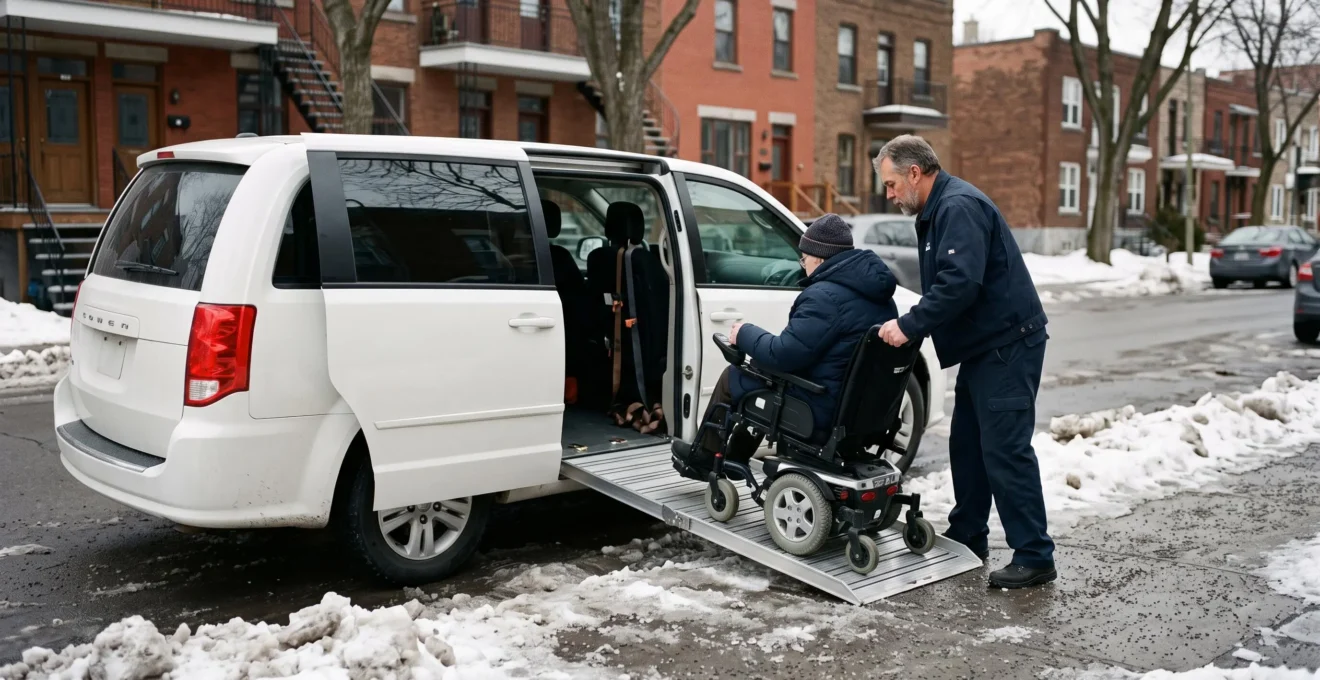
Transportation becomes a barrier to independence when the vehicle arriving at the curb cannot accommodate the passenger’s actual mobility requirements. A wheelchair-accessible van might lack sufficient clearance for a power chair. A spacious SUV might hold medical equipment but require an unsafe transfer. Even a suitable vehicle can become impractical if there is no room for a support person or essential luggage.
Tailored mobility solutions begin with matching the passenger’s functional needs to a vehicle’s verified capabilities. This means examining boarding methods, wheelchair dimensions, securement equipment, medical assistance, available space and the complete journey before confirming transportation.
In Montréal, passengers may encounter accessible taxis, adapted public transportation and specialized private services. These options differ in eligibility, equipment, booking procedures and the assistance they provide. Understanding those distinctions helps passengers retain greater control over their schedules, medical appointments and everyday activities without compromising safety or dignity.
Accessible Transportation: Essential Decisions
- Specify wheelchair dimensions, boarding ability, securement requirements and medical equipment rather than requesting an accessible vehicle generically.
- Choose wheelchair-accessible transportation for mobility access and appropriately staffed medical transportation when clinical care is required during the journey.
- Confirm vehicle compatibility, reservation conditions, companion space and return-trip arrangements before departure.
- Why “Accessible Vehicle” Isn’t Specific Enough: The 5 Accessibility Levels Explained
- How to Specify Your Mobility Needs: The Booking Checklist for Wheelchair, Oxygen, and Medical Equipment
- Wheelchair-Accessible Van vs. Medical Transport Vehicle: Which for Your Specific Mobility Needs?
- The Accessibility Mistake That Left a Wheelchair User With an Incompatible Vehicle
- When to Book Accessible Transportation: The 72-Hour Window for Specialized Equipment Vehicles
- Why Standard Sedans Fail 60% of Passengers With Mobility Aids: What to Request Instead
- Standard SUV vs. Medical-Transport Vehicle: Which for Passengers With Oxygen or Mobility Equipment?
- How to Select Passenger Transportation That Accommodates Mobility, Luggage, and Group Needs
Why “Accessible Vehicle” Isn’t Specific Enough: The 5 Accessibility Levels Explained
An accessible vehicle is not necessarily suitable for every passenger with a disability. Accessibility depends on how someone boards, whether they remain in a wheelchair, what equipment must be secured and whether medical assistance is necessary. Five practical accessibility levels help distinguish ordinary boarding accommodations from specialized passenger transportation, although they are not an official regulatory classification.
The essential question is not simply whether a vehicle is labelled accessible. It is which specific accessibility functions the vehicle can safely perform for the passenger and their equipment.
The following framework organizes transportation requirements by increasing complexity. These categories can overlap, and a single vehicle may satisfy several levels.
| Level | Transportation capability | Typical passenger requirement |
|---|---|---|
| 1 — Assisted boarding | Convenient entry, suitable seating and storage for a folded mobility aid | Passenger who walks with a cane or folding walker and can board safely |
| 2 — Transfer-compatible access | Suitable seating arrangement, transfer space and any agreed assistance | Wheelchair user who can transfer to a passenger seat under the applicable service rules |
| 3 — Wheelchair access | Compatible ramp or lift, doorway clearance and passenger-space dimensions | Passenger travelling while seated in a manual or powered wheelchair |
| 4 — Specialized wheelchair accommodation | Verified equipment capacity, appropriate securement and sufficient interior clearance | Passenger using an unusually large, heavy or specialized mobility device |
| 5 — Clinical transportation | Medical personnel, equipment and monitoring appropriate to the patient’s assessed needs | Passenger requiring clinical care during transportation |
Within these levels, ramp position and configuration matter. A side-entry ramp may offer different boarding possibilities from a rear-entry ramp. Doorway height, ramp loading capacity, wheelchair turning space and securement arrangements must all accommodate the actual device and passenger.
A power wheelchair cannot be assumed compatible merely because a manual wheelchair fits. Likewise, a passenger who uses oxygen does not automatically need an ambulance; the relevant distinction is whether clinical support is required while travelling.
Montréal’s winter conditions introduce another practical variable. Snow accumulation, slippery curbside surfaces and incomplete sidewalk clearing can make a technically compatible boarding arrangement difficult to use. The pickup point therefore deserves the same attention as the vehicle.
Public and private transportation providers also operate under different service frameworks. Federal accessibility guidance should not automatically be interpreted as a uniform technical requirement for every provincially regulated Québec ground transportation provider.
Once the necessary capability has been identified, the next step is translating it into information that a reservation coordinator can verify rather than relying on broad descriptions of accessibility.
How to Specify Your Mobility Needs: The Booking Checklist for Wheelchair, Oxygen, and Medical Equipment
A reliable accessible transportation booking should describe the passenger’s mobility device, boarding ability, equipment dimensions, medical supplies and accompanying travellers. The operator must then confirm that the assigned vehicle can accommodate those requirements. Providing this information early reduces avoidable uncertainty, although it cannot guarantee that a suitable vehicle will be available.
Start by identifying whether the mobility aid will be folded, stored separately or occupied throughout the journey. For a wheelchair or scooter, record its length, width, overall occupied height and total travelling weight, including the passenger where relevant to equipment capacity.
The Canadian Transportation Agency‘s reservation checklist recommends specifying mobility-aid dimensions, weight, battery characteristics and any instructions needed for dismantling or reassembly. Its guidance also addresses support persons, service dogs and potential documentation requirements. Because it concerns the applicable federal transportation framework, individual Montréal ground transportation operators should still be asked about their own procedures.
Medical equipment requires equally precise communication. Describe whether oxygen equipment is carried for occasional use or must operate continuously, whether cylinders require secure storage, and whether another device needs power or active management during travel.
In addition to equipment details, clarify the physical assistance needed. A passenger might be able to enter a vehicle independently but need help positioning a wheelchair. Another might require a particular boarding arrangement without needing any physical assistance from the driver.
Do not assume that drivers can lift passengers, perform clinical procedures or carry out transfers. The operator must explicitly confirm the assistance it offers, and that assistance must be appropriate to the passenger’s needs.
Five Steps to Prepare a Verifiable Accessible Transport Booking
- Measure the mobility device: record its occupied dimensions, total relevant weight and battery type in an equipment specification sheet.
- Describe the boarding process: document whether the passenger can walk, transfer independently or must remain seated in a wheelchair.
- List medical and personal equipment: prepare an inventory identifying oxygen devices, mobility aids, service animals and any equipment requiring securement or power.
- Confirm the operator’s capabilities: obtain written confirmation of vehicle access, securement compatibility, driver assistance, companion accommodation and relevant emergency procedures.
- Verify both journeys: save the outbound and return booking references, agreed pickup arrangements and the provider’s contact details.
Additional questions should address driver training, first-aid capability, breakdown procedures and service-animal policies. For bariatric wheelchairs, unusually large devices or stretcher requirements, request explicit written confirmation rather than assuming standard accessible-vehicle specifications are sufficient.
On Montréal’s STM Transport adapté service, the passenger’s declared limitations and equipment requirements influence vehicle allocation. Its rules and booking arrangements apply specifically to eligible customers, not automatically to every private carrier.
The completed specification also makes it easier to determine whether an accessible passenger vehicle is sufficient or whether a different type of transportation is required for medical reasons.
Wheelchair-Accessible Van vs. Medical Transport Vehicle: Which for Your Specific Mobility Needs?
A wheelchair-accessible van is generally appropriate when the principal requirement is safe boarding, wheelchair accommodation and securement. Medical transportation becomes relevant when the passenger’s condition requires clinical support that an ordinary accessible transport provider cannot supply. The distinction depends on the required care, not simply on the presence of a disability or medical device.
An accessible van may provide a ramp or lift, sufficient interior clearance and equipment for securing a wheelchair. Its driver may have accessibility-related training, but that does not mean the vehicle carries medical staff or offers patient monitoring.
Medical transportation is a broader term whose precise services must be verified. A non-emergency ambulance can be staffed and equipped for clinical needs, while a service marketed as medical transportation may offer only assisted travel to appointments.
Statistics Canada‘s classification of non-emergency ambulance transport distinguishes ambulance services staffed by personnel qualified at the primary care paramedic level or higher. This statistical definition does not establish that all private non-emergency medical transportation providers offer equivalent clinical care.
Several practical differences help clarify which service to investigate.
| Decision factor | Wheelchair-accessible van | Appropriately equipped medical transportation |
|---|---|---|
| Primary purpose | Accessible passenger travel | Transport with care appropriate to assessed medical requirements |
| Wheelchair accommodation | Requires compatible access and securement | Depends on vehicle configuration and patient care needs |
| Clinical monitoring | Not inherently provided | Available only where the specific service includes qualified personnel and equipment |
| Oxygen equipment | May be accommodated subject to operator safety policies | Relevant when clinical oxygen management or monitoring is necessary |
| Reclining or stretcher transport | Not assumed available | Requires verification of the service’s actual stretcher and care capabilities |
| Booking and cost | Depend on the operator and eligibility rules | Depend on the provider, staffing and required level of care |
For example, a medically stable wheelchair user travelling to a routine appointment may only need an accessible van. By contrast, a passenger requiring observation or medical intervention during transportation needs an appropriately staffed service determined through clinical assessment.
Oxygen use alone does not establish which category is necessary. The passenger’s clinical condition, prescribed oxygen requirements, equipment operation and need for assistance must be considered together.
Montréal passengers eligible for STM Transport adapté may receive service through an adapted minibus or taxi, depending on their needs and available resources. This is accessible public transportation, not a substitute for ambulance care.
Neither the relative price nor the immediate availability of private accessible vans and medical transport vehicles can be presumed without obtaining quotations and service confirmations.
Choosing a vehicle with appropriate capabilities helps protect the passenger while avoiding unnecessary reliance on services designed for different requirements.
The Accessibility Mistake That Left a Wheelchair User With an Incompatible Vehicle
A wheelchair user can be left without usable transportation when the booking identifies the need for an accessible vehicle but omits essential wheelchair specifications. The vehicle dispatched may have a ramp, yet its loading capacity, usable width, doorway clearance or securement configuration may not accommodate the passenger’s equipment. The following hypothetical example illustrates how such a mismatch can arise.
Hypothetical Case: An Accessible Van That Could Not Accommodate a Power Wheelchair
A passenger using a large powered wheelchair arranges transportation through an intermediary. The reservation simply requests a wheelchair-accessible van. Neither the passenger’s wheelchair dimensions nor its loaded weight is transmitted to the dispatcher.
On the morning of the appointment, the assigned vehicle arrives with a ramp whose usable width is insufficient for the wheelchair. The driver recognizes the incompatibility before boarding. The passenger cannot use the vehicle, and the journey requires replanning.
This is a constructed training scenario, not a documented incident. Its purpose is to show how incomplete specifications, communication gaps and unverified vehicle assignments can combine to prevent a journey.
Responsibility for a compatible booking cannot rest entirely on the passenger. Operators also need reliable procedures for matching declared accessibility requirements to the vehicle actually assigned. Problems can emerge when a family member, residence or booking platform passes along only a simplified description of the passenger’s needs.
Compatibility involves more than whether wheels fit onto a ramp. A safe journey also requires adequate loading capacity, sufficient interior clearance, a suitable securement system and an appropriate seating or occupant-restraint arrangement.
A practical prevention method involves three separate confirmations. First, provide the mobility device’s exact specifications when booking. Second, request confirmation that the assigned vehicle’s access and securement systems accommodate those specifications. Third, reconfirm the assignment before departure, ideally the previous day when circumstances permit.
If an incompatible vehicle arrives, the passenger should not attempt boarding that cannot be completed safely. Contact the operator, explain the mismatch, request an appropriate replacement and record the vehicle details, booking reference and communications.
Whether a fare, cancellation charge or compensation applies depends on the operator’s conditions and the relevant legal framework. It would be inaccurate to assume an unconditional right to refuse any incompatible vehicle without charge. If the issue involves a possible disability-related service failure, the passenger can document it and seek information about the appropriate complaint process.
A compatible vehicle should be confirmed before the passenger reaches the pickup location, particularly when a missed trip could also disrupt medical treatment or the return journey.
When to Book Accessible Transportation: The 72-Hour Window for Specialized Equipment Vehicles
Booking specialized accessible transportation around 72 hours ahead can be a useful planning precaution, but it is not a universal reservation requirement. The appropriate notice depends on equipment complexity, operator availability, trip frequency and service rules. Passengers should confirm actual booking deadlines directly rather than treating three days as a guaranteed or mandatory window.
Specialized vehicle allocation can require additional coordination. A provider may need to locate a vehicle with the correct ramp or lift, verify securement capacity, confirm staff availability and accommodate other route commitments.
A straightforward journey involving a passenger who transfers independently may offer more vehicle options than one involving an unusually large wheelchair or specialized equipment. Nevertheless, the actual availability of each option depends on the provider.
For recurring journeys, such as regular treatment appointments, establishing a planned schedule can reduce repeated administrative work. The operator should confirm whether recurring bookings are available and how changes or cancellations are handled.
Montréal’s STM Transport adapté illustrates why provider-specific rules matter. According to STM’s paratransit customer handbook, eligible passengers can request occasional journeys starting seven days before travel, with requests generally accepted until the previous day for journeys within its service area. Same-day bookings depend on available resources and may be refused.
STM also distinguishes regular and group transportation arrangements. Its published guidance asks groups of five or more eligible customers to submit a group transportation request at least ten days in advance. These conditions should not be generalized to private accessible taxi operators.
The distinction between booked access and immediate availability becomes especially important following an unexpected hospital discharge or a sudden change in an appointment. Eligible, previously admitted STM passengers can ask about available booking options, while other passengers must establish what suitable private transportation is available.
Transport adapté admission is not automatic. Registering ahead of anticipated transportation needs may therefore be useful for people who meet Québec’s applicable eligibility criteria.
When a booking is urgent, clearly communicate the equipment requirements and ask whether an appropriate vehicle can be assigned. If no suitable option is available, discuss safe alternatives with the relevant care team or appointment provider rather than accepting equipment or assistance arrangements known to be incompatible.
Advance planning is most valuable when it confirms the right equipment and assistance, not merely an available pickup time.
Why Standard Sedans Fail 60% of Passengers With Mobility Aids: What to Request Instead
There is no substantiated general failure rate of 60% for standard sedans transporting passengers with mobility aids in the evidence available here. Sedan suitability varies according to the mobility device, the passenger’s transfer ability and the vehicle’s actual dimensions. Some passengers can use a sedan comfortably, while others require a vehicle with dedicated wheelchair access and securement.
The most common compatibility problem is equipment fit. A folding cane or compact walker may fit into a sedan’s storage area, whereas an unfolded power wheelchair usually requires a purpose-designed accessible vehicle. Even a folded mobility device must fit without obstructing occupants or creating a hazard.
The second concern is transferring between a wheelchair and a passenger seat. Some passengers can transfer independently, while others need arrangements that a typical sedan cannot provide. A driver should not be assumed qualified or authorized to perform physical transfers.
The third issue is safe equipment transportation. Mobility devices must be stored or secured appropriately so they do not move dangerously during braking. A passenger remaining in a wheelchair requires a vehicle designed and equipped for that travel configuration rather than an improvised arrangement.
STM’s official Transport adapté guide makes an important distinction for its standard taxi service: wheelchair users travelling in standard taxis must be able to transfer independently to the passenger seat. Those unable to perform the required transfer travel by minibus or accessible taxi under the service’s allocation rules.
This illustrates a broader decision principle, although other private operators may apply different assistance policies.
| Passenger requirement | Vehicle to investigate | Essential confirmation |
|---|---|---|
| Walks independently with a folding cane | Standard sedan | Safe entry and convenient storage |
| Uses a folding walker | Sedan or spacious minivan | Walker dimensions, luggage capacity and boarding conditions |
| Uses a wheelchair but can transfer | Transfer-compatible vehicle | Transfer space and operator assistance rules |
| Must remain seated in a wheelchair | Wheelchair-accessible van or equivalent | Access, securement and occupied wheelchair dimensions |
| Uses a specialized powered wheelchair | Adapted vehicle with verified equipment capacity | Loaded weight, clearance, loading equipment and securement compatibility |
A common oversight is checking the outbound journey without confirming the return. A passenger may arrive at a medical appointment using a suitable vehicle but encounter different equipment or a different service arrangement for the return trip.
Where equipment compatibility is essential, both legs should be booked and verified. Vehicle substitution policies also deserve attention, because replacing an accessible van with a standard sedan may make the trip impossible even when seating capacity appears sufficient.
The practical goal is to preserve access to ordinary transportation where suitable while recognizing when the passenger needs a more specialized configuration.
Standard SUV vs. Medical-Transport Vehicle: Which for Passengers With Oxygen or Mobility Equipment?
A standard SUV may be suitable for a passenger who can board safely and whose mobility or oxygen equipment can be transported and used according to the carrier’s safety requirements. A medical transport vehicle is appropriate when the passenger needs clinical assistance, monitoring or equipment that an ordinary passenger vehicle cannot safely support. Oxygen use by itself does not automatically determine the vehicle category.
SUVs can offer useful luggage space for folding walkers, portable mobility aids and certain medical devices. However, a higher vehicle floor can make boarding more difficult for passengers with limited strength, balance or joint mobility.
Equipment volume must also be assessed realistically. A large cargo compartment does not establish that a wheelchair can remain occupied during travel, nor does it provide the specialized wheelchair securement equipment that such transportation requires.
For passengers using oxygen, a relevant first question is whether the prescribed equipment and care arrangements can be safely maintained throughout the journey without medical assistance from the driver.
A portable oxygen concentrator or cylinder may be compatible with some ordinary passenger services, subject to the operator’s conditions, safe positioning and equipment requirements. Confirmation is necessary before booking.
If oxygen delivery requires clinical management, if the patient’s condition is unstable or if monitoring and intervention may be needed, the appropriate transportation category should be determined with a qualified healthcare professional.
The operator should be asked about oxygen-cylinder acceptance, permitted quantities, equipment restraint, ventilation-related precautions and any applicable restrictions. Such requirements cannot be presumed uniform across providers.
Where battery-powered medical equipment is involved, confirm that its available operating capacity covers the planned journey and reasonable disruptions. Do not assume an SUV provides an appropriate power supply.
A passenger using oxygen may also have limitations unrelated to the oxygen system. Difficulty transferring, the need to remain reclined or insufficient access to essential equipment can make an otherwise spacious vehicle unsuitable.
Cost and scheduling may influence the final choice, but safety requirements come first. A lower-cost vehicle that cannot provide the required assistance is not a viable alternative, while unnecessary clinical transportation may create avoidable expense and complexity.
Once those needs are clear, the remaining task is checking whether the selected vehicle can also accommodate companions, luggage and the practical demands of the route.
Key Takeaways Before Choosing a Provider
- Start with non-negotiable accessibility and medical requirements; convenience and vehicle size cannot compensate for missing safety capabilities.
- Evaluate occupied wheelchair space, companions and all equipment together rather than checking each requirement separately.
- Verify the complete journey, including pickup conditions, luggage policies, return transportation and the response to vehicle substitutions.
How to Select Passenger Transportation That Accommodates Mobility, Luggage, and Group Needs
Selecting suitable passenger transportation requires evaluating three connected dimensions: the passenger’s accessibility requirements, the equipment and luggage being transported, and the number of accompanying travellers. A vehicle can satisfy any one of these requirements individually yet lack the usable space or configuration to accommodate all three together.
First, determine the necessary accessibility configuration. This includes boarding method, wheelchair securement, transfer capability and the assistance the operator agrees to provide. Only vehicles satisfying those conditions should remain under consideration.
Second, calculate the practical equipment requirements. A wheelchair-accessible van might accommodate a powered chair and its occupant but offer limited remaining space for additional mobility aids, luggage or specialized medical equipment.
Third, account for everyone travelling. Support persons, family members and healthcare attendants need appropriate passenger seating and restraint systems. Wheelchair positions and companion seats should not be treated as interchangeable capacities.
For example, a passenger travelling with a power wheelchair, two companions and several bags may need more usable space than a van advertised simply as wheelchair accessible. The operator must verify the combined arrangement rather than confirming each item independently.
STM’s official Transport adapté guide describes specific booking requirements for mobility aids, accompanying passengers and luggage. It also addresses situations involving an additional mobility aid being transported for repair and particular baggage arrangements at designated destinations, including Montréal-Trudeau Airport.
These are conditions of the STM service and should not be treated as universal policies governing private vehicles. In particular, passengers should confirm whether they must manage their own luggage and whether additional space is available.
The following questions help establish the final suitability of a proposed service:
- Accessibility: Is the access system compatible with the occupied wheelchair’s dimensions and weight? Can the equipment be secured appropriately?
- Assistance: What help will the driver provide during boarding, positioning and arrival? Are there limitations on physical transfers?
- Companions: How many approved passenger seats remain available once the mobility equipment is accommodated?
- Equipment and luggage: Can every medical device, mobility aid and bag be transported under the operator’s rules?
- Journey coverage: Can the provider serve the complete route, including airport or regional destinations where relevant?
- Contingency arrangements: What happens if the assigned vehicle becomes unavailable, and will a replacement meet the same requirements?
Equipment protection also deserves consideration. Ask how mobility devices are handled, what the provider’s liability or insurance arrangements cover and how any damage should be reported. Coverage should never be assumed from the description of a vehicle as accessible.
For longer or regional journeys, verify pickup accessibility, rest-stop needs, travel duration and the ability to use any necessary equipment throughout the trip. A vehicle suited to a short urban transfer may not provide an equally practical arrangement for extended travel.
Before confirming a booking, send the provider one complete specification covering the passenger, mobility equipment, assistance, companions, luggage and return arrangements. Request confirmation that the actual assigned vehicle meets those requirements. That documented match is the practical foundation of transportation that supports independence rather than creating another barrier.
Can someone who is not registered with STM Transport adapté book an accessible taxi in Montréal?
Private accessible taxi arrangements are separate from admission to STM Transport adapté. A person who is not admitted to STM’s specialized public transportation service can inquire about privately available accessible transportation. Vehicle compatibility, assistance policies and availability must be confirmed with the individual operator.
Does a wheelchair-accessible van always have a lift instead of a ramp?
No. Wheelchair-accessible vehicles may use ramps or lifts with different configurations and capacities. The operator should confirm the installed equipment, safe loading capacity, doorway clearance and compatibility with the passenger’s actual wheelchair. Neither type of boarding system should be assumed suitable without verification.
What should passengers do if their wheelchair specifications change after booking?
Contact the transportation provider promptly and supply updated dimensions, weight, battery details or boarding requirements. Ask whether the existing vehicle assignment remains compatible and obtain confirmation of any necessary change. A revised wheelchair configuration may affect ramp access, securement and available passenger space.
Can a support person travel alongside a wheelchair user in an accessible vehicle?
Potentially, but the operator must confirm companion eligibility, available seating and any applicable booking conditions. STM Transport adapté distinguishes arrangements involving mandatory and optional accompanying passengers. Private providers may have different policies, so companions should be declared when the reservation is made.
What if the passenger’s medical condition changes shortly before departure?
Reassess whether the planned transportation remains appropriate and inform the provider of relevant changes. If the passenger develops a need for clinical monitoring or medical intervention during travel, seek guidance from a qualified healthcare professional before proceeding with ordinary accessible transportation. For an immediate medical emergency, contact emergency services rather than relying on a standard booked vehicle.