
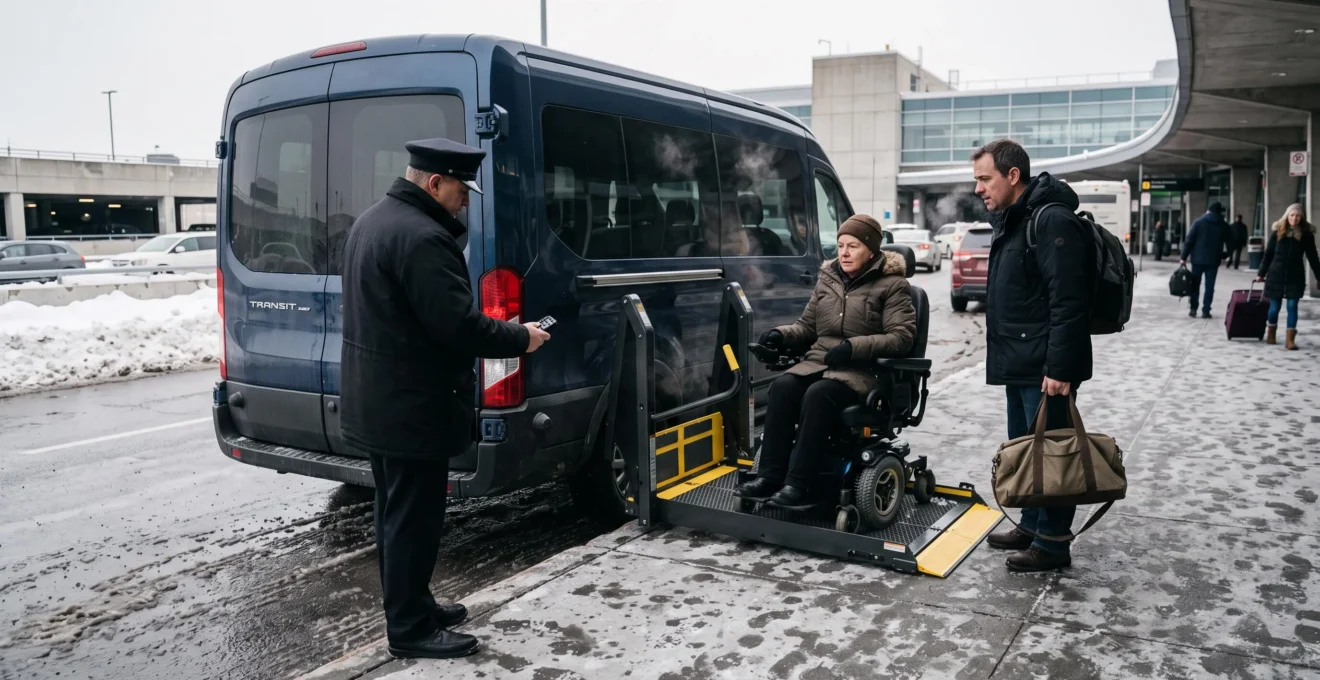
A transportation service can offer luxury vehicles, flexible pickup times and additional stops yet still be unable to accommodate a powered wheelchair, specialized medical equipment or an unusual event itinerary. The difficulty is not necessarily the quality of the service. It is the difference between selecting available options and designing an operation around requirements that existing options cannot satisfy.
Bespoke transportation design begins with the passenger’s constraints, not a vehicle catalogue. The provider identifies what must happen for the journey to work, verifies the equipment and personnel required, coordinates with other organizations and develops contingency arrangements before confirming the service.
In Montréal, these considerations become particularly important when a journey involves Montréal-Trudeau International Airport (YUL), accessible vehicles, winter pickup conditions or several passengers with different assistance needs. A reservation may appear complete while essential operational details remain unresolved.
Understanding how to specify, verify and schedule a custom transportation solution helps travellers distinguish genuine feasibility from an attractive but incomplete booking promise.
Bespoke transportation: the essentials
- True customization changes the transportation operation when necessary, including vehicle configuration, personnel, procedures and third-party coordination.
- A complete six-question brief turns individual requirements into specifications that a provider can verify and confirm in writing.
- Complex journeys require more than a booking confirmation: vehicle compatibility, realistic planning time and contingency arrangements must be established before departure.
- Why “Customizable Service” Isn’t the Same as Bespoke: The 4 Levels of Personalization Explained
- How to Brief Your Unique Transportation Needs: The 6-Question Framework for Complete Specifications
- Standard SUV vs. Medical-Transport Vehicle: Which for Passengers With Oxygen or Mobility Equipment?
- The Assumption Mistake That Left a Wheelchair User With a Non-Accessible Vehicle at the Airport
- When to Request Custom Transportation Solutions: The Lead Time Your Complex Needs Actually Require
- Why Custom Transportation Planning Takes 3-6 Weeks: The 5-Phase Design Process Explained
- Why “Accessible Vehicle” Isn’t Specific Enough: The 5 Accessibility Levels Explained
- How Custom Transportation Design Delivers Flawless Logistics for Events That Have Never Been Done Before
Why “Customizable Service” Isn’t the Same as Bespoke: The 4 Levels of Personalization Explained
A customizable transportation service allows passengers to choose among predefined options. A bespoke service can redesign how the journey is delivered. The distinction matters when a passenger requires changes to vehicle accessibility, driver qualifications, pickup procedures or coordination with another organization. Those requirements cannot always be satisfied by selecting a larger vehicle or adding special instructions to an ordinary reservation.
A practical four-level framework helps identify how much personalization a journey requires. These are planning categories, not officially recognized transportation classifications.
| Level | Service characteristics | Montréal example |
|---|---|---|
| 1. Standard | Fixed service specifications with routine booking choices. | A conventional airport transfer from YUL to a downtown hotel. |
| 2. Selectable options | Additional features chosen from an existing menu. | An airport transfer booked with an available child seat and an additional luggage allowance. |
| 3. Adjusted service | Changes to scheduling, route or coordination within the provider’s existing capabilities. | A journey with multiple pickups and a coordinated arrival at a Montréal event venue. |
| 4. Bespoke design | An operational solution built around requirements requiring verified resources and procedures. | A YUL pickup involving a passenger remaining in a powered wheelchair, a companion, compatible equipment securement and a precisely coordinated pickup. |
The expression “customizable” does not establish which level a provider can deliver. A company might offer several vehicle categories while lacking the operational ability to accommodate a particular mobility device. Another might arrange suitable equipment, trained personnel and coordination with airport assistance services.
Three questions help determine whether an ordinary booking process is sufficient:
- Does the requirement change the type or physical configuration of the vehicle?
- Does it require a different schedule, pickup sequence or operating window?
- Does it require particular personnel, procedures or coordination beyond the driver?
A single affirmative answer warrants additional verification. Several affirmative answers indicate that the journey should be assessed as an operational design problem.
The financial consequence of confusing service levels is not limited to a possible replacement vehicle charge. An unsuitable transfer may create a missed connection, an additional reservation or a disruption affecting multiple travellers. These are potential consequences, not inevitable outcomes.
Once the required level is understood, the next challenge is translating individual circumstances into specifications that can be checked before the vehicle is dispatched.
How to Brief Your Unique Transportation Needs: The 6-Question Framework for Complete Specifications
A complete bespoke transportation brief answers six questions: who is travelling, what they are bringing, where the journey begins and ends, when each movement must occur, which safety or regulatory constraints apply, and what should happen if the original plan changes. Each answer should describe a verifiable operational requirement rather than a general preference.
The framework prevents misunderstandings between everyday passenger language and the technical terminology used by transportation operators.
- Who is travelling? Specify passenger numbers, ages where relevant, mobility capabilities, companions and assistance requirements. Clarify whether a wheelchair user can transfer independently or must remain seated in the wheelchair during transportation.
- What is travelling with them? Record luggage, mobility equipment, medical devices, child restraints and unusual cargo. Provide dimensions, weight and relevant handling or power requirements.
- Where does each movement happen? Give exact addresses, pickup locations, building entrances, accessible paths and loading restrictions. At YUL, identify the agreed passenger pickup area rather than relying on the phrase “airport arrivals.”
- When must it happen? Document flight information, fixed appointments, acceptable pickup windows, connection times and the consequences of delays.
- Which special constraints apply? Identify medical support requirements, equipment limitations, accessibility needs and any permissions or safety conditions requiring confirmation from the appropriate provider or authority.
- What is the contingency plan? Define who receives updates, what happens after a flight delay, which alternatives are acceptable and who has authority to approve changes.
For example, “accessible transportation for one passenger” leaves several critical questions unanswered. Does the passenger use a manual or powered wheelchair? Is a transfer possible? What are the wheelchair’s dimensions and occupied weight? Is there an accompanying caregiver?
These are not merely administrative details. The Canadian Transportation Agency‘s guidance on travelling with mobility aids explains why equipment characteristics and advance communication matter in federally regulated transportation. Its requirements should not automatically be treated as rules governing every private Montréal ground carrier.
A brief becomes operationally useful when the provider returns a written specification confirming the assigned vehicle’s relevant capabilities, the planned pickup process and any agreed assistance. A generic acknowledgement that the request has been received is not equivalent to confirmation of feasibility.
Five actions to turn a travel brief into a verified reservation
- Complete the six-question brief and save one dated specification document listing every passenger, device and operational constraint.
- Measure relevant mobility equipment and send a dimension-and-weight record, including the passenger’s occupied wheelchair weight when applicable.
- Request the actual vehicle’s access and securement specifications, and retain a written compatibility confirmation.
- Agree on pickup locations, responsible personnel and assistance arrangements, then obtain a confirmed journey itinerary.
- Document the dispatch contact, escalation procedure and acceptable backup arrangements in a contingency sheet.
With those requirements established, vehicle selection becomes a compatibility decision rather than a choice based on appearance, comfort or advertised passenger capacity.
Standard SUV vs. Medical-Transport Vehicle: Which for Passengers With Oxygen or Mobility Equipment?
A standard SUV may be suitable when a passenger can enter and leave it safely, uses portable equipment that can be accommodated securely, and does not require specialized assistance during the journey. An adapted vehicle is necessary when the passenger’s mobility and equipment requirements cannot be met by the SUV. Medically supervised transportation may be appropriate when the passenger’s clinical needs require it, but that decision should not be based on vehicle size alone.
The crucial distinction is between passenger transportation, wheelchair-accessible transportation and transportation involving medical care. These categories describe different operational needs and may fall under different regulatory arrangements.
An SUV’s advertised seating capacity does not demonstrate that it can accommodate a powered wheelchair, secure bulky equipment or provide adequate access for a passenger who cannot climb into the vehicle.
| Selection criterion | Standard SUV | Specialized or adapted vehicle |
|---|---|---|
| Passenger access | Typically requires entry into a conventional passenger seat. | May provide ramp or lifting-platform access for a wheelchair occupant. |
| Wheelchair during travel | Potentially suitable for transporting a folded wheelchair as cargo, subject to fit and secure storage. | Can accommodate an occupied wheelchair when the specific vehicle and securement system are compatible. |
| Equipment storage | Limited by actual cargo dimensions and approved securing arrangements. | Configuration can be selected around necessary equipment and safe clearances. |
| Passenger assistance | Dependent on the agreed service and driver capabilities. | Specialized assistance may be available, but qualifications must be verified. |
| Medical care | Does not imply clinical monitoring or treatment. | Requires a separately verified medical service and qualified personnel if clinical care is needed. |
Portable oxygen equipment illustrates why classification needs care. A passenger using a portable oxygen concentrator does not automatically require an ambulance or mechanical wheelchair lift. The suitability of ground transportation depends on the person’s mobility, clinical instructions, equipment characteristics and the transport operator’s confirmed capabilities.
For passengers arriving by air, aviation requirements must be examined separately. Transport Canada‘s advisory circular on medical oxygen during air travel distinguishes portable oxygen concentrators from compressed medical oxygen cylinders. It discusses aircraft acceptance procedures and the protection of spare concentrator batteries against short circuits.
Those aviation arrangements must not be copied automatically into road transportation rules. The airline and ground carrier each need to confirm their applicable equipment conditions.
Consider a hypothetical YUL transfer involving a passenger who uses a powered wheelchair and a portable oxygen concentrator. If the passenger can transfer safely and the equipment can be transported appropriately, an SUV might be feasible. If the passenger must remain seated in the wheelchair, the operator must instead confirm a compatible adapted vehicle, appropriate access and wheelchair securement.
If the passenger needs monitoring, treatment or assisted transfer beyond the capabilities of an ordinary transportation service, the necessary clinical support must be assessed separately. A wheelchair-accessible van is not automatically a medical-transport service.
In Québec, the relevant operating framework depends on the actual service being provided. Travellers should ask whether the operator provides ordinary remunerated passenger transportation, adapted transportation or a distinct medical service, and what authorizations and personnel qualifications apply.
Even selecting the correct vehicle category is insufficient unless the confirmed configuration reaches the driver and dispatch team responsible for the journey.
The Assumption Mistake That Left a Wheelchair User With a Non-Accessible Vehicle at the Airport
One critical transportation failure occurs when a customer mentions a wheelchair during booking but the provider dispatches a vehicle that cannot accommodate the passenger. The underlying mistake is treating a booking note as confirmation of an operational requirement. Without verification between reservation, dispatch and driver, the correct information can exist in one system without influencing the vehicle assignment.
The following example is hypothetical. It illustrates a possible information-transfer failure, not a documented incident involving a specific Montréal provider.
Hypothetical case: an inaccessible airport pickup
A passenger books transportation from YUL and adds “travelling with wheelchair” in the reservation notes. The booking platform accepts the request, and a general confirmation is issued. The passenger assumes the assigned vehicle has a suitable ramp or lift.
On arrival, a standard SUV appears. The driver has been briefed about the airport pickup but not about the requirement to remain seated in a powered wheelchair. The equipment cannot be accommodated safely, so the transfer cannot proceed as planned. The example demonstrates a potential failure of operational communication, not an established frequency or outcome of such incidents.
Several handoff points need verification: the original reservation, any third-party booking platform, dispatch instructions, vehicle substitutions and driver assignment. Confusion can also arise when “wheelchair accessible” is interpreted as space for a folding chair rather than access for an occupied powered wheelchair.
Prevention requires a specific confirmation. Ask the operator to identify the assigned vehicle’s access method, relevant doorway and platform dimensions, weight capacity, wheelchair restraint arrangements and the driver’s responsibilities. If substitutions are permitted, require any replacement to satisfy the same specifications.
At YUL, the ground journey may involve responsibilities beyond the private driver. According to Montréal-Trudeau International Airport’s assistance booking instructions, the airport offers complimentary assistance between designated airport areas and public terminal areas, with advance reservation recommended. Boarding and in-flight assistance must be arranged with the airline.
Therefore, an airport assistance booking and a private accessible vehicle booking are not interchangeable. The passenger needs a clear handoff between the services, including the exact agreed meeting location.
Winter introduces an additional practical variable. A vehicle may have a compatible ramp, yet accumulated snow, slush or an obstructed curb can make deployment at the intended location difficult. The pickup plan should identify an alternative suitable location when conditions prevent safe boarding.
If an unsuitable vehicle arrives, the immediate priority is to avoid an unsafe transfer. Contact dispatch, restate the documented requirement, request an appropriately equipped replacement and coordinate an alternative safe waiting or pickup arrangement. Preserve the booking and incident records for any subsequent complaint or remedy request under the applicable service terms and legal framework.
That verification becomes easier when the transport provider has enough advance notice to identify equipment, coordinate responsibilities and avoid unsuitable last-minute substitutions.
When to Request Custom Transportation Solutions: The Lead Time Your Complex Needs Actually Require
Custom transportation should be requested as soon as a journey requires specialized equipment, particular personnel or coordination with other organizations. Two weeks can be a useful planning target for moderately complex requirements, but it is not a guaranteed minimum or an official industry standard. The necessary lead time depends on resource availability, operational complexity and the consequences of an unsuccessful journey.
Three variables determine how early planning should begin: the availability of a genuinely compatible vehicle, the availability and qualifications of suitable personnel, and the time required to coordinate access or assistance with third parties.
A routine journey with clearly understood requirements may require relatively little preparation. A powered wheelchair requiring specific loading dimensions or securement may require weeks of coordination. An event involving multiple vehicles, timed arrivals and different passenger requirements may justify several weeks of planning.
| Journey profile | Indicative planning approach | Primary verification |
|---|---|---|
| Simple or recurring journey | A few days may be adequate when compatible resources and procedures are already confirmed. | Vehicle availability and current itinerary. |
| Specialized accessibility or equipment | Begin planning several weeks ahead where possible; two weeks may be a reasonable initial target for moderate complexity. | Equipment compatibility, personnel and assistance arrangements. |
| Complex group or event logistics | Allow several weeks for design, coordination and contingency preparation. | Fleet allocation, scheduling, venue access and operational control. |
These ranges are practical planning illustrations, not evidence-based booking guarantees. Availability must be established for the particular journey and date.
Short lead times become especially problematic when a provider starts substituting resources before verifying whether they remain compatible. A vehicle that is nearly suitable does not satisfy an essential wheelchair-access requirement. Likewise, a driver who lacks necessary assistance training cannot automatically replace a properly qualified person.
A useful decision rule is to review the transportation brief for dependencies. If completing the journey requires changing a vehicle, assigning personnel with particular capabilities or obtaining confirmation from an external organization, treat the service as a planning project rather than a routine reservation.
When time is limited, distinguish non-negotiable safety requirements from preferences. A pickup time might be adjusted by agreement; a required securement system cannot be treated as optional. If essential conditions cannot be confirmed, the provider should communicate that limitation rather than promise an unverified solution.
For more demanding journeys, lead time is best understood through the sequence of design activities the provider must complete before execution.
Why Custom Transportation Planning Takes 3-6 Weeks: The 5-Phase Design Process Explained
Complex bespoke transportation may require three to six weeks because the provider must move from an initial requirement to a verified operational plan. The work can involve checking vehicle compatibility, securing appropriate personnel, coordinating access to several locations, preparing contingencies and testing critical assumptions. The three-to-six-week range is an illustrative project-planning window, not a universal requirement or verified Montréal market average.
Five phases provide a useful framework for understanding what must happen between the first inquiry and the completed journey.
- Requirements qualification. Establish who is travelling, what equipment is involved, the itinerary, safety constraints and acceptable alternatives. The output is an agreed transportation specification.
- Feasibility verification. Check actual vehicle capabilities, availability, relevant operating authorizations, driver qualifications and access conditions at pickup and destination sites. The output is a documented feasibility assessment identifying any unresolved constraints.
- Operational design. Assign vehicles and personnel, sequence pickups, establish timing allowances, define communications and develop contingency arrangements. The output is an actionable transportation plan.
- Pre-execution validation. Where the risks justify it, verify vehicle dimensions, confirm site access, review loading procedures and test the communication or dispatch arrangements. The output is a readiness check with documented outstanding issues.
- Execution and control. Dispatch the confirmed resources, communicate changes, monitor critical connections and apply the agreed contingency procedures when needed. The output is the completed journey with a record of operational exceptions.
The phases are sequential in logic, although some coordination can occur in parallel. For example, vehicle availability may be checked while the passenger clarifies equipment measurements, but final compatibility cannot be confirmed until both sets of information are available.
Montréal-specific factors can add scheduling constraints. Adapted vehicles and appropriately qualified personnel must be available for the requested date. Events may need venue access arrangements, while winter conditions may justify additional route and loading-location checks. These are planning considerations; they do not establish a uniform regional processing time.
The passenger can accelerate the first phase by supplying a complete brief and responding quickly to clarification requests. By contrast, a full booking description cannot make an unavailable vehicle appear or substitute for necessary operational authorization.
A particularly important distinction is between feasibility being assumed and feasibility being verified. A provider might indicate that an accessible vehicle is available without checking the exact wheelchair dimensions or pickup configuration. That is still an unresolved technical assumption.
Before accepting a final confirmation, ask what was checked, who checked it, which vehicle is intended and what conditions remain outstanding. Clear answers provide more useful assurance than a general statement that everything is arranged.
The feasibility phase is particularly important for accessible transport, where a broad vehicle category often hides several different levels of actual usability.
Why “Accessible Vehicle” Isn’t Specific Enough: The 5 Accessibility Levels Explained
“Accessible vehicle” is not a complete technical specification because passengers have different mobility, transfer, loading and securement needs. A person who can transfer from a folding wheelchair may use a different vehicle from someone who remains seated in a heavy powered wheelchair. Access method, interior dimensions, equipment weight, securement and assistance requirements must all match the individual journey.
The following five-level framework is a practical way to discuss service capabilities. It is not an official classification established by Québec transportation regulations. The levels describe different arrangements, rather than a universal progression in which each higher level is always required or preferable.
| Level | Vehicle or service profile | Verification required |
|---|---|---|
| 1. Transfer-capable passenger | A conventional vehicle accommodating a passenger who can enter a seat and transport a folded mobility aid. | Transfer safety, seat access and secure equipment storage. |
| 2. Ramp-based access | A suitably equipped vehicle offering ramp access for compatible mobility equipment. | Ramp geometry, doorway clearance, load capacity and securement for any occupied wheelchair. |
| 3. Mechanical lifting access | A vehicle equipped with a lifting platform for compatible wheelchair loading. | Lift capacity, platform dimensions, doorway clearance and restraint configuration. |
| 4. Integrated adapted configuration | A vehicle, potentially with a lowered floor, designed around occupied-wheelchair access and securement. | Interior height, floor space, restraint points and occupied wheelchair compatibility. |
| 5. Specialized medical support | A transportation arrangement involving appropriate medical or paramedical capabilities when clinically required. | Service authorization where applicable, qualified personnel, medical equipment and care responsibilities. |
A compliant ramp can be suitable for some passengers who remain in their wheelchairs; a mechanical lift is not universally necessary. Similarly, a lowered floor does not guarantee compatibility with every powered wheelchair. The actual vehicle design determines whether the combination works.
Québec’s adapted-automobile framework includes specific requirements for access and wheelchair securement. The January 2024 consolidation of Québec’s regulation on remunerated passenger transportation by automobile specifies four floor-mounted wheelchair anchorage points and a forward-facing wheelchair securement arrangement. It also addresses ramp or lifting-platform access, with a transitional exception concerning certain previously authorized rear-access vehicles.
Because this referenced consolidation is dated January 2024, applicable current provisions should be checked before making a legal compliance determination. The regulation does not create the five illustrative accessibility levels above.
4 anchorage points
The January 2024 Québec regulatory text specifies four floor-mounted anchorage points for wheelchair securement in the adapted-automobile provisions. This is a legal design requirement within the regulation’s applicable scope, not a general guarantee that every wheelchair will fit.
Éditeur officiel du Québec, regulation on remunerated passenger transportation by automobile, January 2024 consolidation.
A passenger’s wheelchair dimensions and occupied weight must be compared with the vehicle’s usable entry dimensions, ramp or lift rating, internal clearances and compatible securement arrangement. Where relevant, the verification should also include restraints for the wheelchair occupant and the safe positioning of additional mobility or medical devices.
Physical compatibility also depends on the pickup site. A steep street, narrow curbside space, obstructed loading area or winter snowbank can change whether a ramp can be deployed safely. This is particularly relevant when arranging a Montréal pickup at a location that has not previously been assessed.
Request the actual vehicle’s useful measurements rather than relying solely on a vehicle model name or generic fleet photograph. Compare those measurements with the passenger’s equipment record, and ask for current photographs of the intended vehicle and its access arrangement when needed.
This verification should lead to a clear answer: the specific combination is compatible, additional conditions must be satisfied, or another solution is required. Ambiguous reassurance should not replace a technical compatibility assessment.
When multiple passengers have different equipment, access and scheduling requirements, these individual compatibility checks become inputs to a larger event transportation design.
Key considerations before designing complex event transportation
- Confirm individual passenger and equipment compatibility before assigning vehicles to a shared event schedule.
- Separate conditions that can change, such as preferred departure times, from requirements that cannot be compromised, such as safe wheelchair securement.
- Establish clear operational responsibilities and contingency decisions before several connected journeys depend on the same fleet.
How Custom Transportation Design Delivers Flawless Logistics for Events That Have Never Been Done Before
Custom transportation design makes unprecedented event logistics manageable by turning unfamiliar requirements into a coordinated operating plan. Instead of treating each transfer as an independent booking, the planner connects passenger needs, vehicle capabilities, pickup windows, site access, communications and contingency decisions. The objective is not to guarantee that nothing unexpected will happen, but to keep the operation workable when conditions change.
Consider a hypothetical Montréal event bringing together international delegates, wheelchair users, accompanying caregivers and participants carrying specialized equipment. Arrivals occur at different times, some travellers need assistance at YUL, and the venue offers limited loading space.
A standard reservation approach might allocate vehicles individually according to passenger counts and requested pickup times. Bespoke event design begins by examining the dependencies between those movements.
Five planning components make those dependencies explicit:
- Passenger requirements matrix: A consolidated record of passenger groups, equipment, accessibility needs, companions, pickup locations and essential constraints.
- Timed transport schedule: Defined pickup windows, realistic operating allowances, coordination with flight or event schedules and identification of critical connections.
- Vehicle sequencing plan: The order in which vehicles enter loading areas, serve passengers and depart, reducing conflicts at restricted venue entrances or curbside pickup points.
- Communication structure: Identified responsibilities for dispatch, drivers, event organizers and passenger contacts, with a single operational coordination point.
- Contingency decision framework: Agreed responses to flight delays, weather disruptions, vehicle problems and changes in passenger requirements.
The sequencing plan is especially important where a venue cannot accommodate several vehicles loading at the same time. A suitable fleet may still create congestion if every driver is assigned the same arrival window without a controlled order of operations.
Contingency design begins before the event. It should identify whether a compatible replacement vehicle can actually be arranged, who receives delay information, which passenger movements have priority and what circumstances trigger a revised schedule.
For example, if an international flight arrives later than expected, dispatch must determine whether the assigned vehicle can remain available without disrupting a later accessible pickup. If not, an alternative must be assessed against the original passenger specifications. Simply assigning an available standard vehicle would not be an acceptable solution for a passenger whose wheelchair requires a particular configuration.
Montréal winter conditions introduce another scenario for advance planning. Changes in road conditions or accessible curbside loading space may require operational decisions. Alternative boarding locations should be assessed for suitability rather than selected solely for convenience.
During the event, a coordination lead can monitor critical movements and communicate authorized changes. This reduces the need for each passenger, driver and organizer to independently reinterpret the transportation plan when something unexpected occurs.
The design process continues after the final transfer. Document actual pickup and departure times, equipment compatibility issues, route adjustments, communication gaps and contingency decisions. Those records provide a factual basis for improving a future edition instead of rebuilding the entire operation from assumptions.
The practical next step is to prepare a consolidated passenger-and-equipment brief, identify the event’s non-negotiable conditions, and request an operational feasibility review before committing to a fleet or timetable. A bespoke transportation plan is ready for execution only when its critical assumptions have been checked and its remaining limitations clearly communicated.
Can bespoke transportation accommodate cultural or religious requirements?
Potentially, yes. Requirements concerning privacy, seating arrangements, accompanying personnel, schedules or other cultural practices can be included in the initial transportation brief. The provider must then establish which requests can be accommodated safely, lawfully and operationally. No particular accommodation should be assumed until it has been confirmed.
Does booking an accessible vehicle automatically include personal assistance?
No. Vehicle accessibility and personal assistance are distinct service capabilities. An adapted vehicle may provide appropriate wheelchair access and securement without offering medical care or every form of physical assistance. Travellers should confirm the driver’s responsibilities, qualifications and permitted assistance activities separately.
Who coordinates assistance between YUL and a private accessible vehicle?
Responsibilities should be agreed before arrival. YUL provides specified airport assistance services, while airlines handle boarding and in-flight assistance, and a private ground operator remains responsible for the transportation service it has accepted. The passenger or designated travel coordinator should confirm the precise handoff point and relevant contact details with each organization.
What should travellers do if their mobility equipment changes after booking?
Provide the operator with updated equipment dimensions, weight and handling requirements as soon as possible. Request a new compatibility assessment and written confirmation before travel. Approval for one wheelchair, scooter or medical device does not automatically establish compatibility with a replacement model.
Can a customized transport itinerary guarantee an on-time arrival?
No transportation design can eliminate traffic, weather, flight delays or other external disruptions. A well-prepared itinerary can incorporate realistic scheduling allowances, defined communication responsibilities and pre-agreed responses to foreseeable problems. The meaningful distinction is between planning for uncertainty and promising that uncertainty will not occur.