
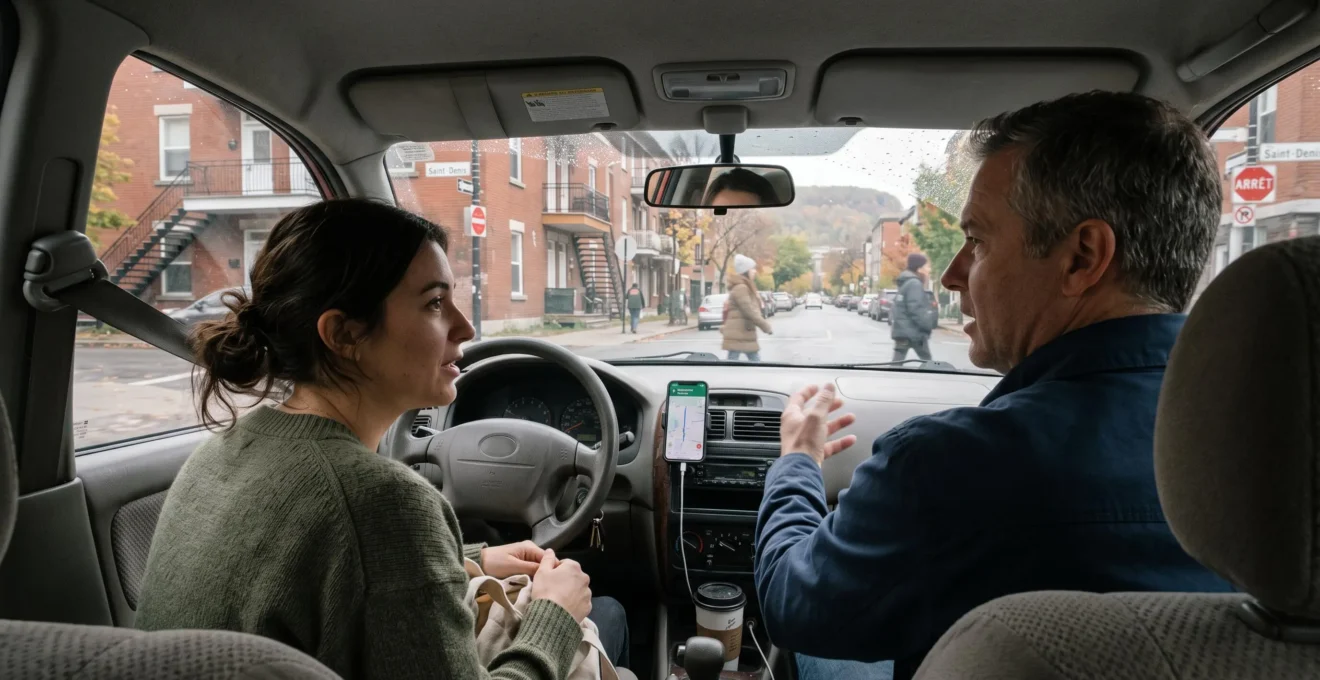
A $200 transportation booking in Montréal can deliver more than a comfortable journey between destinations. When a knowledgeable driver shares neighborhood history, everyday observations and personal recommendations, the passenger gains a perspective that conventional sightseeing materials may overlook. The additional cultural value comes from the conversation, not automatically from the fare itself.
Consider traveling from a downtown hotel toward Mount Royal. A straightforward transfer reveals streets, buildings and landmarks. A conversational driver might also explain why exterior staircases define certain residential neighborhoods, describe how local businesses have changed, or suggest a market worth exploring later. Those details can turn passing scenery into a meaningful introduction to the city.
Making the most of this experience requires realistic expectations. A driver is not necessarily a licensed tourist guide, storytelling must never interfere with road safety, and recommendations remain personal opinions rather than verified facts. The best cultural immersion emerges when curiosity, local knowledge and professional boundaries work together.
How to Get More Cultural Value From a Montréal Ride
- Ask focused questions about neighborhoods, food and local life rather than expecting a comprehensive guided tour.
- Combine personal driver insights with independently verified historical information and practical checks.
- Respect driving conditions, professional boundaries and the driver’s willingness to converse.
- Why a “Knowledgeable Driver” Isn’t a Licensed Tour Guide: What You Can Legally Expect
- How to Ask Your Driver for Restaurant Recommendations That Beat TripAdvisor’s Top 10
- Local Driver Stories vs. Pre-Recorded Audio Tours: Which Creates More Memorable Montréal Experiences?
- The Courtesy Mistake: When “Can You Explain Everything?” Crosses Into Exploiting Driver Time
- When to Ask Your Driver Questions: The 4 Safe Conversation Windows During City Driving
- Why Combining Transportation and Sightseeing Saves Time Compared to Separate Tour Bookings
- The Monument-Only Mistake That Misses Most of Montréal’s Historical Character
- How Narrated Transportation Tours Reveal the Hidden Stories Behind Montréal’s Landmarks
Why a “Knowledgeable Driver” Isn’t a Licensed Tour Guide: What You Can Legally Expect
A knowledgeable driver and a licensed tourist guide provide different services. In Montréal, a qualified transportation driver can share personal observations and local recommendations without automatically delivering a regulated professional tour. Professional tourist guiding in the Ville-Marie borough is subject to specific municipal requirements. Passengers should distinguish informal conversation from an advertised, structured sightseeing service.
The distinction matters particularly in Old Montréal, which lies within Ville-Marie. According to the Ville de Montréal‘s tourist-guide permit requirements in Ville-Marie, tourist guides wishing to practise there must obtain a municipal permit and complete training through the Institut de tourisme et d’hôtellerie du Québec (ITHQ).
The municipal information identifies a CAD 105 permit fee, with permits valid until December 31 of their year of issuance and requiring annual renewal. That amount is an administrative fee for guides, not the price of a sightseeing experience or a charge passengers should expect to pay.
Separately, Québec’s passenger transportation legislation generally requires remunerated automobile transportation to involve a qualified driver and vehicle, subject to statutory exemptions. Transportation authorization and professional guiding requirements therefore address different activities.
A passenger can understand the practical boundary by distinguishing conversational requests from services that may require a different professional arrangement.
| Passenger request | Ordinary transportation conversation | Professional service consideration |
|---|---|---|
| Which neighborhoods are interesting? | A driver may voluntarily share personal impressions. | No comprehensive neighborhood tour is implied. |
| What is the story behind this building? | An informal anecdote may be appropriate. | Verified historical interpretation is not guaranteed. |
| Can you organize a detailed sightseeing itinerary? | Brief practical suggestions may be possible. | A structured tour should be agreed upon separately. |
| Will you accompany us inside a monument? | Not part of an ordinary point-to-point transfer. | Guiding rules and service conditions may need checking. |
For a hypothetical CAD 200 booking, the amount establishes the assumed transportation budget, not a universal Montréal fare or proof that cultural commentary is included. A driver’s willingness to talk can create additional value, but passengers should not treat that willingness as a contractual entitlement.
Equally important, ordinary questions about restaurants or architecture do not automatically create a licensing violation. Whether a particular paid sightseeing arrangement requires additional authorization depends on its actual activities, location and applicable rules; the cited municipal guidance does not conclusively resolve every vehicle-based scenario.
The most useful expectation is straightforward: book transportation for the transportation service, welcome voluntary local insights, and confirm the scope of any separately advertised guided experience. That clarity makes cultural exchanges more comfortable for both passenger and driver.
How to Ask Your Driver for Restaurant Recommendations That Beat TripAdvisor’s Top 10
To discover restaurants beyond familiar online rankings, tell your driver where you are staying, explain your budget and food preferences, then ask where they personally enjoy eating. This approach invites specific local knowledge rather than a generic tourist recommendation. The result may be more relevant to your trip, although it is not inherently more reliable than a carefully checked review platform.
Consider the difference between asking, “What’s the best restaurant in Montréal?” and “We’re staying near Saint-Henri, would like an informal dinner, and prefer somewhere residents go regularly. Is there a place you personally enjoy?”
The second question gives the driver useful constraints. Neighborhood, spending preference and atmosphere help narrow the possibilities without requiring an exhaustive restaurant search.
A productive conversation follows three stages:
- Establish the context: Identify your neighborhood, approximate budget, dietary constraints and preferred type of meal.
- Request personal experience: Ask where the driver eats, what dishes they enjoy and why the establishment appeals to them.
- Check practical suitability: Confirm the location, current opening hours, menu and reservation requirements before making plans.
The value of local knowledge becomes clearer when the question is specific. Instead of requesting another popular café in Old Montréal, a visitor might ask where Saint-Henri residents go for an unhurried coffee. Someone interested in Montréal’s culinary communities might ask about Portuguese, Haitian or Armenian food traditions and neighborhoods in which to explore them.
A driver who travels through several neighborhoods regularly may notice restaurant turnover, changes in street activity or new establishments before a visitor does. Such observations can help identify places that would otherwise remain outside an itinerary.
However, this advantage has limits. Drivers can have outdated information, personal preferences or commercial relationships, just like other recommendation sources. Neither frequent neighborhood exposure nor a confident recommendation proves food quality, authenticity or impartiality.
Combine conversational discovery with independent verification. Restaurant websites, current menus and recent customer feedback can confirm practical details that a driver may remember imperfectly. The goal is not to defeat an online ranking but to supplement it with a human perspective.
One thoughtful question can produce a richer lead than a long list of popular establishments. It also opens a conversation about the communities, streets and food cultures shaping Montréal beyond its headline attractions.
Local Driver Stories vs. Pre-Recorded Audio Tours: Which Creates More Memorable Montréal Experiences?
Driver conversations and prerecorded audio tours create different opportunities for memorable travel experiences. A driver can respond to questions, share personal observations and discuss changing neighborhood life. An audio tour usually provides more consistent, structured information. Neither format is universally more memorable: the better choice depends on the visitor’s interests, the quality of the content and the circumstances of the journey.
The difference becomes apparent when both approaches describe the same street. An audio recording might explain its architectural background and identify historical buildings. A driver might describe how the street feels at different times of day, which businesses have changed or what the neighborhood means to people who spend time there.
These perspectives can complement rather than contradict each other.
| Experience dimension | Driver conversation | Prerecorded audio tour |
|---|---|---|
| Current local context | May include recent firsthand observations, subject to accuracy. | Depends on when its content was recorded and updated. |
| Interactivity | Questions can follow individual interests when driving conditions permit. | Usually follows a predetermined sequence. |
| Historical consistency | Depends on individual knowledge and recollection. | Can provide systematically researched material. |
| Emotional character | Personal stories can create a sense of human connection. | Sound design and narration can create atmosphere. |
| Accessibility and coverage | Depends on the driver’s availability and language skills. | May offer multiple languages and repeatable explanations. |
Storytelling also influences how travelers describe their experiences afterward. Researchers Scott McCabe and Clare Foster examined the role of narrative in tourist interaction in a 2006 paper published in the Journal of Tourism and Cultural Change.
The University of Birmingham research record on tourist narratives discusses how travel experiences become accounts that tourists recount and interpret. This provides a useful conceptual basis for appreciating personal stories, although the research does not establish that driver conversations outperform audio tours in memory retention.
For example, a visitor might later remember an unexpected conversation about a family-run business more vividly than a general description of a historic street. Another visitor may prefer the clear chronology and detailed historical interpretation of a well-produced recording. Both outcomes are plausible, but neither can be assumed for every traveler.
A hybrid experience offers a practical compromise. Use an established audio guide to understand the principal historical sites of Old Montréal, then invite a willing driver to share observations about neighborhoods encountered during subsequent transfers.
The recording provides structure. The conversation adds an individual perspective, including personal impressions that should be recognized as such rather than presented as verified history.
Memorable cultural travel does not require choosing between expert narration and spontaneous human encounters. It benefits from knowing when to listen to each, particularly when personal stories introduce questions worth exploring independently.
The Courtesy Mistake: When “Can You Explain Everything?” Crosses Into Exploiting Driver Time
Asking a driver to explain everything throughout an entire journey can turn a friendly cultural exchange into an unreasonable professional demand. Continuous narration requires attention, effort and sometimes research beyond the transportation service. A respectful passenger asks selective questions, accepts pauses and never expects conversation to compete with driving responsibilities or substitute for a separately arranged guided tour.
There is an important difference between showing curiosity and assigning someone an additional job without agreement.
A passenger might naturally ask why certain Montréal residential buildings have exterior staircases. But requesting uninterrupted commentary on every building, intersection and historical event throughout a journey creates a different expectation.
Even a driver who enjoys discussing the city needs flexibility. Traffic conditions change, directions require attention, and passengers may encounter subjects the driver does not know well enough to explain accurately.
Watch for conversational signals. Short replies, extended silence, attention shifting toward traffic or a direct statement that the driver needs to concentrate should all prompt the passenger to reduce or stop questioning.
Respecting professional time also means understanding the commercial boundary. A fare compensates an agreed transportation service; it does not necessarily include historical research, customized sightseeing interpretation or unlimited conversation. If substantial narration is essential, ask whether the provider offers that service and confirm its terms before booking.
Appreciation may include a courteous thank-you, a positive review reflecting the actual experience or a voluntary gratuity where appropriate.
15%
Tourisme Montréal’s recommended customary tip for taxi drivers, calculated on the pre-tax bill. This is guidance, not a legally required charge or a special storytelling rate.
Some passengers prefer to round up a fare, while others choose an amount reflecting their satisfaction and circumstances. Neither a higher gratuity nor a particular storytelling supplement should be represented as universally expected.
For a hypothetical CAD 200 taxi fare before taxes, applying the published 15% recommendation would amount to CAD 30. That arithmetic illustrates the guidance; it does not establish that all CAD 200 transfers should receive this tip, particularly when service categories and gratuity policies differ.
The most rewarding exchanges are voluntary. A passenger who values the driver’s expertise while respecting the driver’s primary responsibilities creates the conditions for an enjoyable conversation rather than an improvised obligation.
When to Ask Your Driver Questions: The 4 Safe Conversation Windows During City Driving
Four practical opportunities for brief driver conversations are initial greetings, uncomplicated stretches of travel, suitable pauses and the approach to a destination. These are conversational planning categories, not scientifically validated safety windows. Even at these moments, the driver must decide whether speaking is appropriate, because traffic conditions and driving demands always take priority.
Montréal’s driving environment changes from broad roads to busy downtown intersections and pedestrian-heavy neighborhood streets. Conversation that feels comfortable during one part of a journey may become distracting moments later.
Passengers can organize questions around the journey without assuming the driver is available to answer continuously.
| Conversation window | Suitable question | Safety consideration |
|---|---|---|
| 1. Boarding and initial departure | “Is there a neighborhood you especially enjoy?” | Keep exchanges brief while the driver confirms the destination and begins moving. |
| 2. Relatively uncomplicated driving | “How has this neighborhood changed?” | Ask only if the driver appears comfortable; avoid demanding long explanations. |
| 3. Appropriate pauses | “Is there a local tradition visitors often miss?” | Do not assume intersections, traffic lights or congestion make conversation safe. |
| 4. Arrival and drop-off | “Is there a café nearby worth checking?” | Wait until parking, navigation and passenger unloading are safely managed. |
These categories are not a license to demand attention. Highway entries, difficult turns, crowded intersections, pedestrian crossings and parking maneuvers can require full concentration. Even a stationary vehicle may demand immediate decisions when traffic changes.
A useful habit is to ask permission before introducing a detailed question: “Would this be a good time to ask about the neighborhood?” If the driver prefers silence, the conversation can resume later or end without discomfort.
Passengers should also avoid asking drivers to turn around, point at buildings, look up information on a device or change their route unexpectedly while driving. Identifying something outside the vehicle is useful only when it does not interfere with maintaining control and awareness.
The following checklist turns cultural curiosity into a manageable passenger routine.
Five Actions for a Safe and Rewarding Driver Conversation
- Prepare two focused questions. Write down one neighborhood question and one practical local recommendation you would value.
- Confirm the primary journey. Establish the destination, agreed route expectations and transportation service before seeking commentary.
- Ask whether conversation is welcome. Obtain a clear verbal indication that the driver is comfortable speaking.
- Adapt to the driving environment. Pause whenever the driver needs concentration, and leave any unfinished question for later.
- Record useful insights after the ride. Save recommended neighborhoods, businesses or historical topics in a short note for independent verification.
The five resulting deliverables are simple: two questions, an understood journey, permission to converse, uninterrupted driving attention and a verified follow-up list.
A driver should never have to choose between delivering a compelling story and concentrating on the road. Successful cultural exchanges accommodate silence as naturally as conversation.
Why Combining Transportation and Sightseeing Saves Time Compared to Separate Tour Bookings
Combining transportation with sightseeing commentary can reduce duplicated travel time because the journey itself becomes an opportunity to learn about Montréal. The actual saving depends on the itinerary, distances, scheduling and service arrangements. A three-hour advantage is possible in a hypothetical comparison, but it is not an established average or a guarantee for Montréal visitors.
Separate sightseeing arrangements can involve several time commitments beyond the advertised tour duration: traveling to the meeting point, waiting for departure, following a fixed group schedule and returning from the tour’s endpoint.
These activities may be worthwhile, particularly when they provide specialist historical interpretation, admission arrangements or experiences that cannot be enjoyed from a vehicle. However, they should be counted when comparing options.
A transportation-based cultural experience operates differently. A journey already necessary for the day’s plans can also introduce the neighborhoods between destinations.
For example, a traveler going from a downtown hotel toward Mount Royal could use the ride to ask about the streets along the way. The transportation time remains necessary, but part of it now serves a second purpose.
Hypothetical Itinerary Comparison: How a Three-Hour Difference Could Arise
Imagine a separate-tour itinerary requiring 45 minutes to reach a meeting point, 30 minutes of waiting, 90 minutes following a fixed tour schedule and 45 minutes returning to the next planned destination. These illustrative commitments total 210 minutes.
Now imagine that a different arrangement incorporates 30 minutes of relevant cultural commentary during a necessary transfer, with no separate meeting-point journey or group wait. Comparing those illustrative schedules produces a 180-minute, or three-hour, difference. The itineraries are not necessarily equivalent in depth or destinations covered, and the figures are assumptions rather than Montréal travel measurements.
This example clarifies the mechanism behind possible time savings without proving a universal advantage. A traffic delay, a more dispersed itinerary or an especially efficient organized tour could substantially change the result.
To evaluate a real booking, compare both time and price rather than looking only at the driver’s hourly rate or the published tour fee.
| Evaluation factor | Separate organized tour | Transportation with local commentary |
|---|---|---|
| Total monetary cost | Tour fees plus any additional transportation | Agreed transportation cost and any separately priced services |
| Additional travel time | Trips to and from meeting locations | Detours, if requested and agreed upon |
| Waiting and scheduling | Departure schedules and possible group waiting | Booking availability and road conditions |
| Cultural interpretation | Potentially planned and professionally delivered | Dependent on driver knowledge and willingness |
| Site access | May include walking visits or planned admissions | Generally limited to the agreed transportation scope |
A CAD 200 budget should be assessed against the exact transportation duration, route, passenger needs and any additional service terms. Without an actual quotation, it cannot be treated as a fixed price for a narrated Montréal itinerary.
For travelers with limited time, turning necessary movement into contextual discovery can be particularly valuable. Yet an organized tour remains preferable when structured interpretation, specialist expertise or access to specific sites is the main priority.
The Monument-Only Mistake That Misses Most of Montréal’s Historical Character
Montréal’s major monuments are essential historical reference points, but focusing exclusively on them can obscure the everyday neighborhoods that give the city much of its character. Residential architecture, commercial streets, community institutions and changing local landscapes reveal how Montréal is lived in. A knowledgeable driver can help visitors notice these layers during ordinary transfers.
A classic sightseeing itinerary may highlight Notre-Dame Basilica, Mount Royal and the Old Port. These places are meaningful, visually distinctive and useful for understanding the city’s heritage.
However, a monument-focused itinerary leaves important questions unanswered. What do ordinary residential streets reveal about housing? How do neighborhood markets reflect cultural life? Why do different districts feel architecturally and socially distinct?
The idea that visitors miss “80%” of Montréal’s historical character by seeing monuments alone is best understood as a rhetorical illustration, not a measured statistic. No such percentage is established by the supplied evidence.
Instead, consider how different parts of the city offer different kinds of observation:
- Plateau-Mont-Royal: Exterior staircases, brick residential buildings and neighborhood streets invite questions about local housing and urban form.
- Mile End: Commercial and residential streets provide opportunities to discuss the coexistence of different communities and local businesses.
- Little Italy: The surroundings of Jean-Talon Market offer an entry point into food culture and neighborhood identity.
- Griffintown: Contrasting building types can prompt questions about industrial heritage and urban redevelopment.
- Saint-Laurent Boulevard: Street art, storefronts and varied urban environments reveal a different perspective from monumental landmarks.
These observations are starting points, not comprehensive historical interpretations. A driver’s lived familiarity can suggest what deserves attention; detailed claims about a site’s age, development or social history should still be checked against reliable material.
A useful itinerary design starts with one or two major landmarks, then considers which neighborhoods lie naturally between them. Rather than asking the driver to manufacture a complicated tour route, discuss whether an agreed journey could pass through a district you are curious about.
For instance, a visitor interested in food culture could pair a major landmark with a later stop near Jean-Talon Market, taking any practical route and timing constraints into account. Another visitor might explore the contrast between Old Montréal and more residential streets during separate necessary transfers.
Where a different route requires additional distance or time, confirm the effect on the fare in advance. Cultural curiosity should not become an assumption that the driver will provide unplanned detours without agreement.
The result is a more layered understanding of place: monuments supply recognizable anchors, while the streets between them reveal urban patterns, community life and questions that conventional sightseeing checklists may never raise.
Key Takeaways Before Your Next Ride
- Choose one historical landmark and one neighborhood theme to explore rather than expecting a comprehensive city tour from a driver.
- Treat personal stories as valuable perspectives that complement, rather than replace, documented historical information.
- Evaluate a CAD 200 journey by its agreed transportation service and the relevant insights actually received, not by an assumed sightseeing entitlement.
How Narrated Transportation Tours Reveal the Hidden Stories Behind Montréal’s Landmarks
Narrated transportation can reveal connections between Montréal landmarks that visitors might miss when exploring individual sites separately. A driver can relate personal experiences, describe neighborhood changes and suggest how different parts of the city fit together. The strongest experience combines these firsthand perspectives with reliable historical knowledge, while respecting the boundaries of ordinary passenger transportation.
Unlike a static monument visit, movement creates a sequence. A building glimpsed from a vehicle can acquire meaning when a later street, market or neighborhood raises a related question.
For example, a visitor may first notice the architecture of Old Montréal, then encounter very different residential forms elsewhere. A conversation about those differences can encourage further exploration of Montréal’s urban development without requiring the driver to deliver a formal architectural lecture.
This is the central advantage of narration in motion: individual observations become connected rather than remaining isolated impressions.
Three complementary narrative layers can emerge during a journey.
- The documented historical layer: Established information about a landmark’s origins, function or development, ideally supported by authoritative interpretation.
- The community layer: Accounts of neighborhood life, local traditions and changes observed or remembered by residents.
- The personal layer: A driver’s own experiences, family stories or recommendations that provide individual meaning without claiming universal authority.
Imagine a driver mentioning that a relative once worked near a particular industrial street. The passenger now has a human story attached to the place. The anecdote may be authentic as a personal recollection, but any broader historical interpretation still calls for independent corroboration.
Similarly, observations about French-speaking, English-speaking and immigrant communities can help visitors formulate questions about Montréal’s cultural identity. Those identities and histories are complex, however, and cannot be reduced to a single driver’s experience or a few passing streetscapes.
There is also a meaningful distinction between a spontaneous narrated transfer and a professionally organized transportation tour. The latter may promise a defined route, duration, level of interpretation or additional services. Such promises should be verified through the booking terms and any applicable professional requirements rather than inferred from the driver’s conversational ability.
The journey’s value becomes more tangible when passengers retain insights that influence what they do next. A restaurant mentioned in passing might become an evening destination. A neighborhood anecdote might inspire a walking exploration. A question about an unfamiliar building might lead to deeper historical reading.
For a hypothetical CAD 200 transfer, that progression is the cultural opportunity: the traveler arrives not only at a physical destination but with a more detailed mental picture of Montréal and several ideas for further discovery.
The dollar amount alone cannot measure immersion. What matters is whether the journey offered relevant insights, whether those insights were appropriately framed and whether the passenger can use them to understand the city more fully.
For the next Montréal journey, choose a destination, prepare two thoughtful questions and invite local conversation when circumstances allow. Record one intriguing story and one recommendation afterward, verify what needs checking, and let those discoveries shape the next part of the visit.
Does a CAD 200 ride in Montréal automatically include cultural commentary?
No. A CAD 200 fare does not automatically establish an entitlement to narration, sightseeing interpretation or personalized recommendations. The service depends on the booking agreement. Informal conversation may add value, but a structured cultural tour should be explicitly described and agreed upon with the provider.
Can a driver legally share historical information during a journey in Montréal?
Ordinary informal conversation is not automatically prohibited by the transportation and guiding provisions discussed here. Professional tourist guiding in Ville-Marie is subject to specific permit requirements. Whether a particular advertised, paid narration service requires additional authorization depends on its activities and applicable rules, which should be checked for the individual service.
Should passengers rely entirely on a driver’s historical stories?
No. Personal stories can illuminate neighborhood life, but memories, impressions and secondhand anecdotes are not equivalent to verified historical records. Use them as valuable starting points and confirm important dates, events or architectural claims through authoritative references.
What if the driver prefers not to talk?
Respect that preference immediately. Safe transportation remains the priority, and a driver may need silence because of traffic, fatigue, concentration or personal working style. Cultural commentary should be voluntary unless it forms part of an expressly agreed service.
Is a private driver better than an organized Montréal sightseeing tour?
Neither option is automatically better. A knowledgeable driver may add spontaneous observations during necessary transportation, while an organized tour can offer structured interpretation, scheduled site visits and specialized expertise. Compare the confirmed service scope, price, time requirements and desired depth of historical information before choosing.